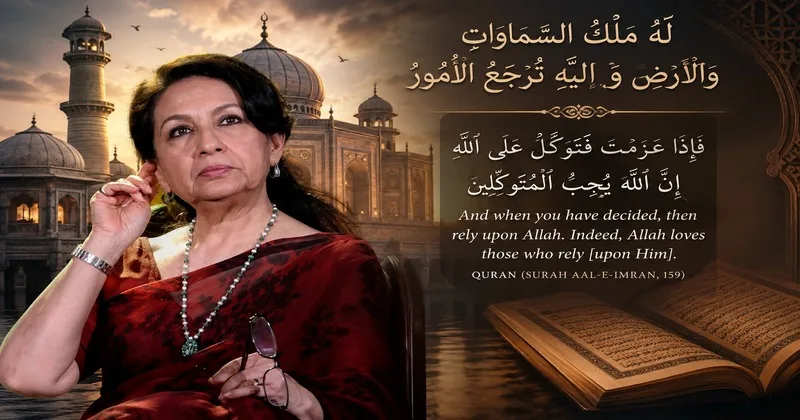
In the history of Indian cinema, there are a select few names that have left an indelible mark on the screen, yet their real lives differ from the personas they project. One such name is Sharmila Tagore, or rather, Ayesha Sultana.
Sharmila Tagore, who began her career with Satyajit Ray’s films, has recently been in the spotlight, particularly following a controversial statement she made regarding ‘Vande Mataram’. While she bears a Hindu name, she often articulates arguments concerning India’s national song, ‘Vande Mataram’, that mirror the rhetoric typically employed by Muslims holding hardline Islamic views. Consequently, it is natural to ask: is her true identity still rooted in Bengali Hindu traditions or is she fully embracing her Islamic identity as ‘Ayesha Sultana’? Indeed, examining this identity has become essential because her conduct appears to reveal deep contradictions regarding religion.
The story of the transformation from Sharmila Tagore to ‘Ayesha Sultana’
To understand this, let us go back to 1968; at that time, Sharmila Tagore was among the leading actresses of Hindi cinema. It was during this period that she entered into a romantic relationship with Mansoor Ali Khan Pataudi, the captain of the Indian cricket team and the Nawab of Bhopal. At that time, the ‘Special Marriage Act (1954)’ was in place, allowing individuals from different religions to marry legally without converting; yet, despite being an educated woman, Sharmila Tagore embraced Islam to fulfil the legal and religious formalities of the union. She adopted an Islamic name, Ayesha Sultana and underwent the ‘Nikah’ ceremony in accordance with Islamic Sharia law.
She now held a new identity as the daughter-in-law of the royal Pataudi family and the Begum of Bhopal. However, she continued to work in films after her marriage, retaining her original screen name, ‘Sharmila Tagore.’ This is precisely where the controversy arose: why did she maintain this dual identity? Naturally, she understood that if the reality were fully revealed, her original name might fade into obscurity, as Indian society would not readily accept her under the name ‘Ayesha.’
The Truth Behind Legal Documents: Was the Name Concealed?
A significant argument holds that if a person voluntarily converts to another religion, they should fully and proudly embrace their new identity. Yet, this does not appear to be the case with Sharmila Tagore; a distinct contradiction is evident in her legal and official documents. In Indian court records, property deeds and succession certificates, her name is officially registered as “Sharmila Tagore ‘alias’ Ayesha Sultana.” In legal terminology, the term ‘alias’ is employed when a single individual operates under two distinct names and identities within society or administrative circles.
Her daughter, Soha Ali Khan, has acknowledged in her book and various interviews that she and her siblings were often confused during childhood because their mother would sign some government documents as ‘Sharmila’ and others as ‘Ayesha.’ This contradiction reinforces the fact that the ‘Hindu name’ (Sharmila Tagore) continued to be used for public life and professional gain, whereas the ‘Islamic name’ (Ayesha\ Sultana) was used for family, religious and property-related benefits.
The ‘Vande Mataram’ Controversy
Let us now discuss the ‘Vande Mataram’ issue. Sharmila Tagore recently made a statement regarding this, despite being aware of the long-standing political and religious contention surrounding India’s national song, ‘Vande Mataram’. Muslims have historically been reluctant to sing the full song, often boycotting the complete version on religious grounds; yet, commenting on the matter, she argued that in a multi-religious country like India, where a large population believes in monotheism, making the recitation of all verses of ‘Vande Mataram’ mandatory is inappropriate. She reasoned that since the later verses invoke Hindu goddesses (Devi) like ‘Durga’ and ‘Kali’, singing the full song poses a religious challenge for the Muslim community. She proposed that only the first two verses should be sung.
This controversy clearly reveals the dominance of religious consciousness in Sharmila Tagore’s perspective. It is widely acknowledged, both by India’s majority society and within the history of the freedom struggle, that the names ‘Durga’ or ‘Lakshmi’ appearing in ‘Vande Mataram’ are not used in a narrow sectarian sense. Rather, they serve as living symbols of the motherland’s boundless energy, power, courage, and prosperity. Bankim Chandra Chattopadhyay envisioned the very soil of the nation as a supreme power (Mahashakti). Freedom fighters famously chanted ‘Vande Mataram’ as they faced the gallows, transcending all religious divides.
On the other hand, according to the core Islamic principle of ‘Tawhid’ (monotheism), the worship or veneration (Sajdah) of any figure, goddess, symbol, or even the country itself, other than Allah, is considered strictly forbidden (Shirk). When Sharmila Tagore states that “it is difficult for believers in one God to say ‘Vande Durga’,” she is, whether inadvertently or deliberately, aligning herself entirely with a conservative Islamic perspective.
Naturally, people are bound to ask and remark that had she truly embodied that Bengali Hindu heritage (stemming from Rabindranath Tagore’s family), she would have readily embraced these symbols of the Motherland’s power. However, her statement clearly demonstrates and serves as the strongest proof that deep down, her ideological and religious allegiance is inextricably linked to her identity as ‘Ayesha Sultana’.
Upbringing and the domestic environment: Cultural synthesis or a one-sided tilt?
Admirers of Sharmila Tagore and the Pataudi family often cite their household as a symbol of cultural synthesis, noting that both Eid and Diwali are celebrated there. Yet, in practical terms, the inclination is clearly one-sided.
The names, early education, and religious identities of all three of Sharmila Tagore’s children- Saif Ali Khan, Saba Ali Khan and Soha Ali Khan- are entirely Islamic. In a recent interview, her daughter Saba Ali Khan clarified that her mother (Sharmila) had focused on teaching them Islamic prayers, etiquette, and religious rituals from childhood. Hindu customs or acts of worship never held a permanent place within Pataudi Palace.
Furthermore, the nationwide controversy surrounding the names of Saif Ali Khan’s children (Taimur and Jeh) also highlighted just how steadfast the family remains regarding its new religious and cultural identity. In this context, it does not seem unreasonable to surmise that rhetoric regarding ‘cultural harmony’ or ‘secularism’ was merely for public consumption, whereas in actual practice, the Pataudi family prioritised its Islamic traditions above all else. A prime example of this is Saif Ali Khan naming his son Taimur, a name historically associated with the massacre of Hindus.
The invasion of India (in 1398) by the Turco-Mongol invader Taimur-i-Lang (Tamerlane) stands as one of the most harrowing chapters of brutality, plunder, and horrific mass slaughter. Taimur himself explicitly stated in his autobiography, ‘Tuzuk-i-Taimuri’, that the primary objective of his invasion was to wage war against idolatrous Hindus and to loot wealth. Throughout his campaign, the Hindu population was subjected to extreme barbarity.
The Onset of the Invasion and Devastation of Border Towns
Timur (Tamerlane) set out from Samarkand with a massive army in March 1398 and crossed the Indus River to enter Punjab in September. His army wreaked havoc on towns along the route, such as Tulamba, Sirsa, Fatehabad, Kaithal, and Panipat. Hindu settlements in these regions were thoroughly looted, standing crops were destroyed, and those who refused to convert to Islam were either ruthlessly killed or taken prisoner. The massacre that followed the capture of the Bhatner (Hanumangarh) fort struck terror across North India.
Mass Execution of One Hundred Thousand Hindu Prisoners
One of the most gruesome episodes in the history of Timur’s campaign occurred at a place called ‘Loni,’ near Delhi. Timur’s army had amassed approximately 100,000 Hindu captives- men, women and children. Timur ordered his troops to put all one hundred thousand prisoners to death in a single day. According to historians, the rivers and streams ran red with blood during this horrific massacre.
The Destruction of Delhi and Towers of Skulls
On December 17, 1398, after defeating the Sultan of Delhi, Timur’s army entered the city. Although assurances of peace were initially given, his soldiers soon began looting and slaughtering the inhabitants. During this rampage, which lasted several days, the Hindu population was specifically targeted; their homes were burned, and their property was plundered. The height of this cruelty was reached when the severed heads of the victims were collected to erect towering structures of skulls at various locations, intended to strike terror into the hearts of the people.
Furthermore, Timur’s atrocities were not limited to the slaughter of human beings; he also dealt a severe blow to India’s cultural heritage. After reducing Delhi to ruins, he turned his attention towards Meerut, Haridwar and Kangra. At Haridwar, a sacred Hindu pilgrimage site on the banks of the Ganges, he unleashed a bloodbath and desecrated and destroyed ancient temples. Destroying symbols of Sanatan culture, idols, and places of worship was a central part of his campaign.
During this horrific invasion, thousands of Hindu women endured unspeakable torture. They were taken captive and transported to Central Asian markets to be sold as slaves. Additionally, thousands of skilled Indian craftsmen, masons and artisans from Delhi and North India were forcibly taken prisoner. Timur took these Indian artisans to Samarkand, where he used the immense wealth looted from India, along with the labour of these enslaved craftsmen, to construct magnificent buildings and the Jama Masjid. Timur’s invasion crippled Delhi and North India to such an extent that the region took decades to recover from the devastation. Yet, knowing all this, the name ‘Taimur’ was chosen for a child in Sharmila Tagore’s family! This points directly towards Islamic fundamentalism.
Assessing Contradictions of Identity
Sharmila Tagore’s life and recent statements serve as a vivid example that, no matter how great an artist one becomes in the public eye, one’s inner ideological allegiance is ultimately defined by religious and personal choices. The love, respect and stardom she garnered in Bollywood under the name ‘Sharmila Tagore’ symbolise the magnanimity of India’s Hindu majority, which never viewed an artist through a religious lens.
However, when that same artist begins to judge national symbols (such as Vande Mataram) through the prism of religious narrow-mindedness, society is compelled to reflect on her true nature. Thus, it must be said that the name “Sharmila Tagore alias Ayesha Sultana” appearing on legal documents represents more than just a combination of two names; it signifies an attempt to strike a balance between two distinct worlds for personal reasons, an effort wherein ‘Ayesha Sultana’s’ religious and ideological identity occasionally asserts itself more prominently over that of Sharmila Tagore. This is evident in instances such as the naming of Taimur, the upbringing of the children in accordance with Sharia and Islamic law and the specific episode in question.