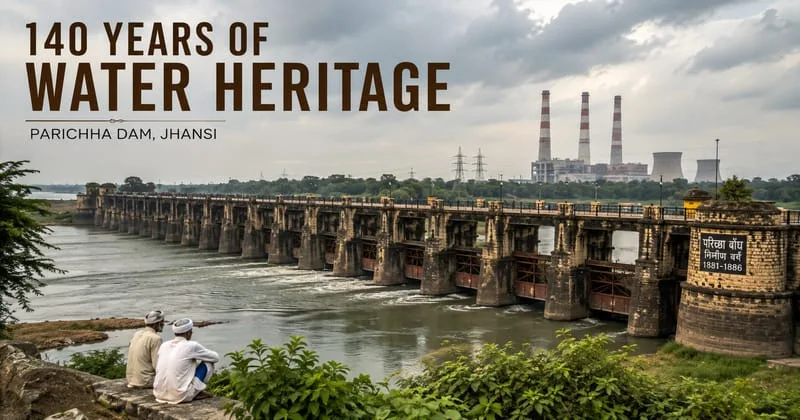
Lucknow: Uttar Pradesh’s historic Parichha Dam in Jhansi will receive international recognition for its long-standing role in irrigation and water management. The dam was built nearly 140 years ago, and it still continues to serve the region and remains an important part of the Betwa Canal System. The International Commission on Irrigation and Drainage (ICID) has recognised Parichha Dam as a World Heritage Irrigation Structure (WHIS). It will receive the WHIS Award-26 during the 26th ICID International Congress and 77th International Executive Council Meeting in Marseille, France, on October 14 this year.
The recognition puts Parichha Dam, Jhansi and Bundelkhand’s irrigation heritage in the international spotlight. The Uttar Pradesh Irrigation and Water Resources Department received a communication from ICID on August 13 regarding the selection. Department officials have also been invited to attend the award ceremony in France.
Built across the Betwa River in Jhansi, Parichha Dam is an important part of the Betwa Canal System. The system carries water to agricultural areas and supports farming in Bundelkhand, where irregular rainfall and water shortages have been long-standing challenges. The dam is around 1,174 metres long and nearly 16.8 metres high from the riverbed. It has 318 steel gates, which are used to regulate the flow and release of water when required.
Even after almost a century and a half, the Parichha Dam in UP is notable as it still continues to serve its original purpose. Over the years, changes have also been made to improve its storage capacity and meet the region’s growing water requirements. Parichha Dam originally had a storage capacity of about 1,700 million cubic feet, which has now increased to around 2,400 million cubic feet. This increase has helped the dam meet the growing water needs of the region.
Apart from supporting irrigation, water stored in Parichha Dam also plays a role in the area’s power infrastructure. The Parichha Dam supplies water to the Parichha Thermal Power Project, which has a 920 MW power generation capacity. Because of this, the historic dam is important not only for irrigation and agriculture but also for the region’s power and infrastructure needs.
The dam also draws visitors during the monsoon season. When its gates are opened to release excess water, the serene view attracts people and has become a popular local sight.
Story of Parichha Dam Began in the 19th Century
The history of Parichha Dam goes back to the British-era efforts to develop irrigation facilities in Bundelkhand. In 1855, Captain Strachey proposed a canal system for the region, after which surveys were conducted to examine the possibilities of developing irrigation infrastructure. Construction of Parichha Dam began in 1881, and the project became operational in 1886. Since then, the dam has remained an important part of Bundelkhand’s water management system.
Why the WHIS Award Matters
The World Heritage Irrigation Structure (WHIS) recognition honours irrigation systems that have historical, cultural, technical and agricultural importance. For Parichha Dam, Jhansi, the recognition highlights its long engineering history as well as its continued role in irrigation. Built in the 19th century, the dam remains part of the region’s water management system even today. The WHIS Award 2026 in France is expected to bring international attention to Parichha Dam and Uttar Pradesh’s historic irrigation infrastructure.
The recognition is particularly important for Bundelkhand, a region that has often faced uneven rainfall and water shortages. Reliable irrigation has therefore played an important role in supporting agriculture and rural communities. For almost 140 years, Parichha Dam has helped manage water resources in the region. Its recognition as a World Heritage Irrigation Structure is not only about preserving an old engineering project. It also reflects the continuing value of infrastructure that has supported communities and agriculture across generations.