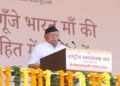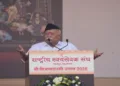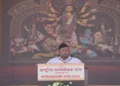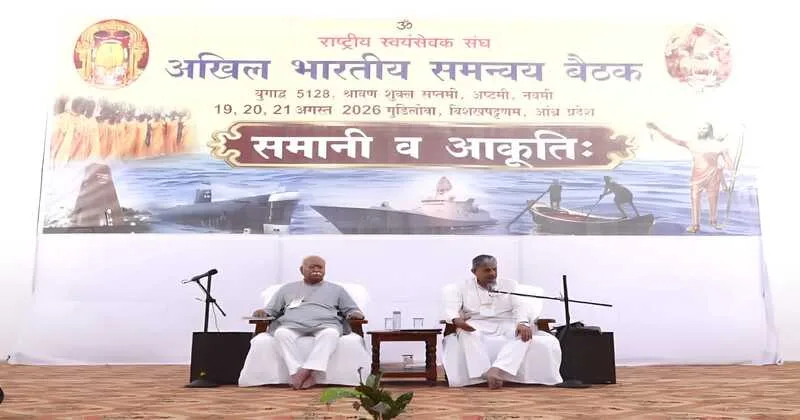
The three-day Akhil Bharatiya Samanvay Baithak (All India Coordination Meeting) of various organisations inspired by the Rashtriya Swayamsevak Sangh (RSS) concluded on August 21 at the Vignana Vihara Residential School campus in Gudilova, near Visakhapatnam, Andhra Pradesh, after extensive deliberations on the nation, society, social challenges and the future course of work.
The meetings (August 19-21) commenced with RSS Sarsanghchalak Dr Mohan Bhagwat Ji and Sarkaryavah Dattatreya Hosabale Ji offering floral tributes to the portrait of Bharat Mata.
Representatives of 32 RSS-inspired organisations, categorised into Seva, Shiksha, Arthik, Vaichar, Suraksha and Samarasata, assembled for better coordination. Bharatiya Mazdoor Sangh, Vishwa Hindu Parishad, Bharatiya Janata Party, Akhil Bharatiya Vidyarthi Parishad, Pragna Pravah, Samskara Bharati, Bharatiya Kisan Sangh, Rashtra Sevika Samiti, Seva Bharati, Swadeshi Jagaran Manch and Bharat Vikas Parishad were among the participating organisations.
The participating organisations were represented by their national presidents, general secretaries, Akhil Bharatiya organisation secretaries and selected functionaries. Prominent office-bearers and workers of 32 Sangh-inspired organisations working in various fields for society and the nation participated in the meeting. A total of 326 delegates were invited to the meeting, including women leaders from various organisations. Forty-nine women delegates participated in the three-day meeting.
The meeting was not an executive or decision-making meeting, but served as a platform for sharing information and strengthening mutual coordination and cooperation among the organisations.
During the three days, the participating organisations shared information about their respective activities and experiences. They also presented their views and suggestions on various important issues and discussed issues emerging in society and their impact on public life.
Among the important issues discussed were demographic changes in the country and the concerns arising from them, increasing drug-related concerns among youth and their adverse impact, efforts being made by different organisations and possible measures for the future.
The meeting also discussed Panch Parivartan, including social harmony, environmental awareness, family awareness, awakening the sense of Swa and fulfilling civic duties. The role of various organisations in taking these efforts forward after the centenary year was also discussed.
The Bharatiya concept of development was also discussed, with the focus on understanding development in its various dimensions rather than viewing it only from an economic perspective.
Addressing the August 21 press meet, RSS Sah Sarkaryavah CR Mukunda Ji said the meeting reviewed flood relief and rehabilitation work, social harmony programmes linked to Sant Ravidas Ji’s 650th birth anniversary, demographic changes and imbalance, and growing drug-related concerns among youth.
Flood Relief Activities
Information was shared about the relief and rehabilitation work carried out by various organisations and workers, including Rashtriya Sewa Bharati, Bharatiya Kisan Sangh, National Medicos Organisation (NMO) and Arogya Bharati, during the severe floods in Assam.
650th birth anniversary of Sant Ravidas
In the context of the 650th birth anniversary of Sant Ravidas Ji, programmes conducted across the country for social harmony and social goodwill based on his message, as well as the positive response received from society, were reviewed.
Discussion on demography
The meeting held serious discussions on demographic change and imbalance. In the context of the challenges arising from ageing populations and declining fertility rates in many countries of the world, the situation in Bharat was considered.
Changes taking place in the population ratios of different regions and communities and their social impact were discussed, along with measures to maintain balance and harmony in society.
Comprehensive social efforts for a drug-free society
Serious concern was expressed in the meeting over the increasing reach of narcotic substances among youth and students in the country and raised concern about its reach from metros to villages. It was emphasised that this problem needs to be addressed not merely at the level of the government or police, but through the participation of the entire society.
Special discussion on the aspirations and concerns of youth
Detailed deliberations were held on the thinking, aspirations, creative potential and concerns about the future of the younger generation, as well as their role in nation-building.
The Sangh’s work is being carried out among a large number of young people. This year, approximately 21,000 young Swayamsevaks participated in the Sangh’s 21-day training camps. More than 60 per cent of the Swayamsevaks attending daily Shakhas across the country are young people.
It was stated that instead of merely having a didactic dialogue with youth, it is necessary to engage with them directly, understand their feelings and concerns, and through dialogue develop a sense of affinity towards the country, culture and social values.
Self-reliant, environment-friendly and inclusive development
The meeting also discussed a development model based on the Bharatiya perspective. Development should be self-reliant, environment-friendly and should take all sections of society along. Experiences of organisations working in the economic sector in this direction were considered.
Skill development and socially useful activities by various organisations were discussed, such as Laghu Udyog Bharati’s skill development centres operating in the field of micro-industries, which has provided skill training to more than 41,000 people this year.
Panch Parivartan with focus on Kutumb Prabodhan
In the context of the Sangh’s centenary year, special discussions were held on the various dimensions of ‘Panch Parivartan’ identified for social transformation. Particularly under Kutumb Prabodhan, the need to strengthen the Bharatiya family system, family values and cultural traditions passed down through generations was discussed.
With regard to environmental conservation, emphasis was laid on bringing about changes in the daily lives of every individual and family rather than merely passing resolutions. Issues such as judicious use of water, minimum use of plastic and increasing green cover should become a part of the behaviour of every family.
Detailed discussion on Artificial Intelligence
A detailed presentation and discussion were held in the meeting on the growing impact of Artificial Intelligence (AI) on society.
While considering the positive possibilities of AI as well as the precautions and challenges associated with it, emphasis was laid on the need to view it from a Bharatiya perspective and within the Bharatiya social context. The Sahsarkaryavah said, the deliberations will continue on how technology can be used in the interest of society and how society can be made aware of its potential adverse effects.
Expansion of work
The expansion of work being carried out in diverse fields of society by 32 Sangh-inspired organisations was also discussed. Plans for the coming year were considered with a view to taking a national perspective and society-centric thinking to more and more sections of society and expanding organisational work.
Questions and Answers at the final press briefing
Question: What was discussed in the meeting regarding corruption in the system and shortcomings in various systems including protest Jantar Mantar in Delhi?
Answer: This issue was not viewed as being limited only to corruption. Wherever there are shortcomings in the system, awareness in society, along with efforts by the government, is necessary to correct them.
Whether it is an issue such as NEET or other systemic problems, these create concerns among young people about their future. It is necessary to understand these concerns and address them.
Solutions will not emerge merely through protest or disruption. The government at Centre, States and society must work together to improve the system through a positive and constructive approach.
Question: What will the Sangh do to increase awareness among the younger generation about culture and traditions?
Answer: The Sangh’s work is primarily and extensively carried out among youth. This year, approximately 21,000 young Swayamsevaks participated in 21-day training camps, and more than 60 per cent of those attending daily Shakhas are young people.
Values and cultural awareness among youth cannot be developed merely through speeches or posters. It is necessary to remain continuously connected with them, understand their feelings, engage in dialogue with them and present the greatness of Bharat and its cultural heritage before them at the experiential level.
Work among young men and women is being carried out through several organisations, including Akhil Bharatiya Vidyarthi Parishad, Bajrang Dal and Hindu Jagaran Manch.
Looking at the capabilities and positive response of today’s younger generation, we are confident that the future of Bharat is safe in the hands of its youth.
At the same time, religious, spiritual and social organisations were also called upon to work together for the promotion of cultural values among youth.
Question: What is the purpose of the proposed visit of Sarsanghchalak Dr. Mohan Bhagwat Ji to the United States, Canada and Britain?
Answer: This visit is part of a broader global outreach on the occasion of the Sangh’s centenary year. It has three main objectives.
First—to present a fact-based and positive perspective amid misconceptions and misinformation prevailing around the world regarding Bharat, Hindu society and the Rashtriya Swayamsevak Sangh.
Second—to take the message of ‘Vasudhaiva Kutumbakam’ and global oneness, given by the Rishis and Munis of Bharat, to different societies across the world.
Third—to increase dialogue with mainstream society in those countries regarding the interests and rights of Hindus and people of Bharatiya origin living in different parts of the world.
As part of this, Dr. Mohan Bhagwat Ji will participate in the Universal Oneness programme in New York and community leadership programmes in Toronto and London.
Question: As part of RSS Panch Parivartan drive, how can we conserve environment?
Answer: The concept of Panch Parivartan was envisaged approximately three years ago while planning for the Sangh’s centenary year.
We believe that social transformation is necessary before any systemic transformation can take place.
Environmental conservation is not merely a matter of protecting nature from the outside. In the Bharatiya perspective, human beings themselves are an integral part of this entire creation and environment.
Therefore, every individual and family can contribute at least at three levels in their daily lives—judicious use of water, reducing the use of plastic and increasing greenery in their surroundings.
Change will not come merely by passing resolutions. A change in lifestyle is necessary.
Efforts are being made to take this message to families, villages and remote areas of the country. Even a small change in the behaviour of an individual and a family can become the basis for wider social and environmental transformation.
The three-day Akhil Bharatiya Samanvay Baithak thus concluded with deliberations centred on the nation, society and future challenges, while bringing together prominent office-bearers and workers of 32 Sangh-inspired organisations working in various fields for society and the nation.
The meeting provided a platform for the participating organisations to share their activities and experiences, exchange views and suggestions on important issues, discuss emerging social concerns and strengthen mutual coordination and cooperation.
Vignana Vihara: Where Education Became an Instrument of Social Transformation
The choice of Vignana Vihara at Gudilova, near Visakhapatnam, as the venue for the RSS Akhil Bharatiya Samanvay Baithak from August 19 to 21 carries a significance that extends beyond the three-day meeting.
Set up in 1980, Vignana Vihara was conceived not merely as a residential school but as a modern expression of the traditional Gurukula, rooted in Bharatiya thought, social responsibility, cultural values and spiritual grounding. Over the past 46 years, the institution and its network of initiatives have sought to make education a vehicle for transforming the surrounding rural and tribal communities.
The story of Vignana Vihara began in the aftermath of the 1977 Diviseema cyclone and floods. A Scheduled Caste colony, Vijayarama Rajupeta near Anakapalle, was completely washed away. The Rashtra Seva Samiti subsequently built 120 permanent houses and a community hall there in record time. During the inauguration, the district administration suggested establishing a residential school in Visakhapatnam and assured support.
The idea took shape in 1979, and after land was assembled, Vignana Vihara’s Awasa Vidyalaya began functioning in 1980 on about 50 acres.
Its stated objective was distinctive: academic education was to be combined with personality development, life values, life skills and social responsibility. Today, students from 14 states study at the institution, while its alumni are spread across 22 countries, where they are described as cultural ambassadors.
From a school to a social institution
The institution’s influence, however, extends well beyond its campus. Vignana Vihara’s philosophy has been that a school should be a centre of social change rather than an island isolated from its surroundings.
Across 42 villages, it has developed a network of Balasamskara Kendras, Matru Mandals, Bhajan Mandals, tuition centres, Vidyarthi Vikas Kendras, Abhyasikas, sewing centres and medical centres.
The expansion began with Keshav Vidya Vihar in 1981, a free school intended to provide first-generation education to children from surrounding villages. Its students have subsequently entered social, cultural, political and economic fields.
In 1984, Dr Hedgewar Hospital was established as a 20-bed hospital, extending medical services into villages. Saraswati Vidya Vihar, an English-medium school serving children from 64 villages across three mandals, followed in 1989.
The institution’s activities also expanded into culture and tribal education. The Bharati Kala Music and Dance School was started in 1990. In 1993, following a request from ITDA officials, Vignana Vihara established a school and hostel for tribal children from 220 villages. The institution, supported by government funding, was named Vivekananda Vidya Vihar.
The network subsequently expanded to include Alluri Sitarama Raju Vocational Junior College and Tagore Vidya Vihar in the ITDA area, as well as a free school at Vatsavalasa serving children from fishing communities.
Empowerment beyond classrooms
The Vignana Vihara model has also placed emphasis on economic self-reliance. In the Scheduled Caste colony at Anakapalle, tailoring training has been provided since 1978, with several thousand people trained over the years. Computer and sewing centres have also been established, while a larger Skill Development Centre is being developed.
Vatsalya Vihar, an orphanage for children with a single parent or no parent, currently accommodates around 20 children, with plans to expand its capacity.
The cumulative effect is a model in which education, healthcare, vocational training, cultural activities and community engagement operate as interconnected instruments of social transformation.
The idea behind the institution
The philosophy articulated by Vignana Vihara is that the school should “bring people to the school and take the school to society”. Its approach is activity-oriented, society-supported and Acharya-driven, with the institution deliberately seeking to remain independent of government grants and relying largely on societal support.
Its alumni have become an important part of that ecosystem. Eight former students are now involved in the management, while the alumni association continues to support the institution and its service activities.
In that sense, the Vignana Vihara campus at Gudilova represents more than the physical venue of the RSS Samanvay Baithak. Over four decades, it has sought to demonstrate a particular idea of institution-building: that an educational centre can become a lighthouse for the surrounding society, creating human capital while simultaneously strengthening communities through education, culture, healthcare, skills and self-reliance.
The setting therefore provides a fitting backdrop for a national RSS meeting centred on coordination and social engagement: a campus whose own history is built around connecting institutional work with society and extending its influence far beyond its physical boundaries.