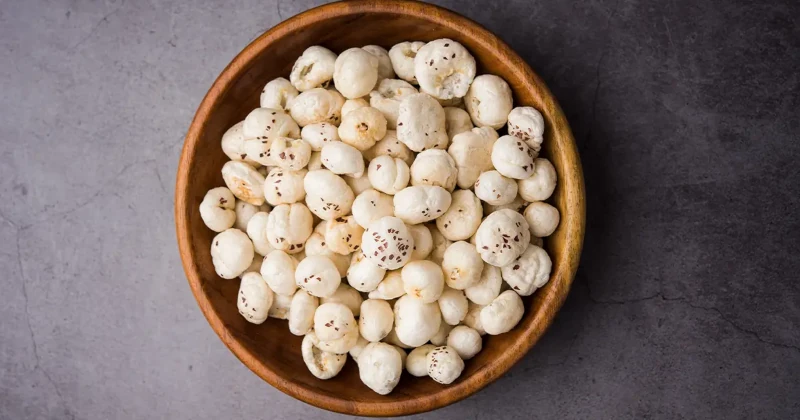
Once a traditional snack rooted in the wetlands of Bihar, makhana is rapidly becoming one of India’s most promising agri-food exports, with rising prices, expanding cultivation, government backing and growing global demand transforming the humble fox nut into a premium superfood.
What was once largely associated with traditional kitchens in Bihar is now finding space on supermarket shelves, health-food aisles and international snack markets.
Makhana, or fox nut, is emerging as one of India’s fastest-growing agri-food commodities, riding on a powerful combination of health-conscious consumers, premiumisation, expanding exports, technological intervention and government support.
India is already the world’s largest producer of makhana, with Bihar alone accounting for nearly three-fourths of the country’s production and an estimated 80-85 per cent of global supply. With the domestic market expanding rapidly and exports gaining momentum, the traditional aquatic crop is being repositioned as a high-value agricultural commodity.
The transformation is significant: a crop once harvested manually from ponds and wetlands is increasingly being backed by scientific research, improved varieties, modern machinery, organised processing, branding and export strategies.
India’s Makhana Sector: Traditional Crop to Global Superfood
⭐️ #Makhana, or fox nut, has emerged as a fast-growing agri-food product in India, due to its nutritional value, rising health awareness, and increasing global demand
➜ India is the world's largest producer of… pic.twitter.com/QGpATHa9qw
— DD News (@DDNewslive) August 20, 2026
From traditional ponds to a global superfood
Scientifically known as Euryale ferox, makhana is an aquatic crop cultivated mainly in shallow ponds, lakes and wetlands. Its edible seed is roasted and popped to produce the crunchy food commonly known as fox nut.
For generations, cultivation remained concentrated in eastern India, particularly Bihar, West Bengal and Assam. But changing consumer preferences have altered its trajectory. The rise of low-fat, plant-based and clean-label foods has given makhana a powerful new identity, a traditional Indian crop being marketed as a modern health food.
India’s production reached 63,910 metric tonnes in 2024-25, according to the final estimate of the Horticulture Statistics Unit, DA&FW. The country’s average productivity stood at 2.03 MT per hectare.
The growth accelerated in 2025-26. The Second Advance Estimates put India’s makhana production at 80,590 MT, with average productivity rising to 2.34 MT per hectare. Bihar remains overwhelmingly dominant. The state is estimated to produce 60,000 MT in 2025-26, with an average productivity of 2.00 MT per hectare.
Bihar: The beating heart of India’s makhana economy
If India is the world’s makhana powerhouse, North Bihar is its production engine. Cultivation is heavily concentrated in the Kosi basin districts of Supaul, Saharsa and Madhepura, along with parts of the Mithila and Seemanchal regions.
The region’s wetlands and agro-climatic conditions have supported makhana cultivation for generations. What is changing now is the economic scale of the opportunity.
Traditional pond cultivation is increasingly being complemented by field-system farming and improved varieties such as Swarna Vaidehi and Sabour Makhana-1. These interventions are aimed at increasing productivity, reducing cultivation risks and making the crop more commercially viable.
The geographical identity of the crop has also received formal recognition. Mithila Makhana has been granted a Geographical Indication (GI) tag, recognising the distinctive quality, reputation and traditional knowledge associated with makhana produced in the Mithila region. The GI tag has the potential to strengthen branding, protect regional identity and differentiate Indian makhana in increasingly competitive domestic and international markets.
A Rs 12,000-crore market taking shape
The makhana boom is not restricted to farms.
India’s domestic makhana market recorded annual growth of 17-18 per cent between 2021-22 and 2024-25, fuelled by health awareness, premiumisation and the rapid expansion of branded snack companies. The market is projected to reach Rs 11,000-12,000 crore by 2029-30. Interestingly, the surge in prices has been considerably sharper than the increase in production.
While production volumes grew by only around 4-5 per cent between FY2022 and FY2025, average makhana prices rose from roughly Rs 500 per kilogram during 2020-22 to nearly Rs 1,250 per kilogram in 2025.
That price escalation reflects a fundamental shift in the market. Consumers are increasingly willing to pay a premium for products perceived as healthy, convenient and nutritionally valuable.
Domestic demand has also provided an important buffer against volatility in international markets.
India produces more than 0.6 lakh metric tonnes of makhana annually. Of this, around 40 per cent approximately 0.23-0.25 lakh metric tonnes is estimated to be exported, while the rest is consumed within the country.
India’s appetite is growing
The domestic market itself has become a major driver of the sector. Monthly domestic consumption of popped makhana is estimated at 3,000-3,500 MT, rising to around 5,000 MT during festive periods, when snack consumption traditionally peaks.
Organised FMCG and branded snack companies account for an estimated 1,800-2,000 MT per month. Meanwhile, loose and unorganised retail still accounts for approximately 1,200-1,400 MT per month, particularly across Tier-2 and Tier-3 markets.
This transition from loose, traditionally sold makhana to packaged and branded products is one of the most important developments in the sector. The change is also opening the door to a much larger value-added economy.
Flavoured makhana, ready-to-eat products, makhana flour and other processed foods are expanding the market beyond plain roasted fox nuts. The real economic opportunity may therefore lie not merely in producing more makhana, but in processing, branding and selling it at a higher value.
From Bihar’s ponds to America’s shelves
The global market is beginning to take notice. In 2025, the Directorate General of Foreign Trade introduced a separate HSN code for popped makhana and other makhana products. The move addressed a long-standing problem: the absence of product-specific export data under earlier general classifications.
In 2025-26, India exported 7,264.89 MT of makhana products, generating export revenue of Rs 19,296.08 lakh. The export market, however, remains highly concentrated.
The United States accounts for around 40 per cent of exports, followed by Canada at 20 per cent and the UAE at 17 per cent. Together, these three markets account for approximately 77 per cent of India’s makhana exports.
But the numbers reveal another opportunity. The largest markets are not necessarily the most lucrative on a per-kilogram basis. Average export prices are estimated at approximately $19.5/kg for the US, $15.8/kg for Canada and $13.3/kg for the UAE.
Meanwhile, smaller markets are demonstrating stronger price potential. Germany records an estimated average price of $26/kg, Nepal around $21.6/kg and Australia around $21/kg.
The UK offers a particularly interesting balance, accounting for around 10 per cent of exports while recording average price realisations of approximately $20/kg. For India, the message is clear: the next phase of the makhana export story may not be about simply exporting more, but about exporting smarter and targeting premium markets.
Government bets big on the fox nut economy
The government’s policy intervention indicates that makhana is no longer being viewed simply as a regional crop.
The National Makhana Board was announced in the Union Budget 2025-26 and formally launched in Bihar on September 15, 2025. Its objective is to strengthen the entire makhana value chain from farmers and research to processing, branding and exports.
The government has also approved a Central Sector Scheme for the Development of Makhana with a total outlay of Rs 476.03 crore for 2025-26 to 2030-31. The scheme covers several critical gaps in the sector, including:
- Research and innovation
- Availability of quality seeds
- Farmer skill development
- Improved harvesting and post-harvest practices
- Processing and value addition
- Branding and marketing
- Export promotion
- Quality control
Under the scheme, Rs 30 crore was approved for 2025-26 and Rs 90 crore for 2026-27. The government has also expanded cultivation support. An additional 1,010 hectares has been brought under makhana cultivation, while 73 hectares have been covered under a seed production programme.
A total of 89 Front Line Demonstrations have been conducted to showcase improved production technologies. In 2025-26 alone, 8,159 farmers benefited from the Central Sector Scheme.
The science behind the boom
Makhana’s growing popularity is closely tied to its nutritional profile. The crop contains carbohydrates, high-quality protein, dietary fibre and essential minerals including magnesium, potassium, phosphorus and iron.
It is low in sodium and cholesterol-free, while containing very little fat around 0.33 grams per 100 grams. Its high protein digestibility, reportedly around 95 per cent, is another factor contributing to its appeal among health-conscious consumers.
The food is increasingly being positioned as suitable for modern diets, including those focused on plant-based nutrition, healthy snacking and lower-fat alternatives. Its nutritional profile has helped shift the perception of makhana from a traditional regional food to a potential global superfood.
But producing makhana is still hard work
Behind the polished packets appearing on supermarket shelves is a highly labour-intensive production system. At the farm level, cultivation involves pond preparation, seed broadcasting, crop management and manual harvesting.
Seed collection can require workers to operate underwater, making the process physically demanding and dependent on traditional skills. Mechanisation remains limited in many parts of the value chain. Even primary processing is often undertaken at the household or village level.
Raw seeds are dried and cleaned before being roasted at high temperatures. The heated seeds are then popped, after which they are polished, sorted and graded. The larger and higher-quality kernels command better prices. This is precisely where modernisation could create the greatest economic impact.
The next battle: value addition
The future of India’s makhana economy may depend on how effectively the country moves beyond raw production.
Secondary processing is already expanding into flavoured snacks, ready-to-eat products, makhana flour and other value-added foods. That shift could create employment, increase farmer incomes and allow Indian companies to capture a larger share of the final consumer price.
Instead of exporting a basic agricultural commodity, India has an opportunity to build an entire makhana value chain from seed to branded global snack. The National Research Centre for Makhana (NRCM) is central to that transformation.
NRCM: Bringing science to the ponds
The National Research Centre for Makhana is working to modernise cultivation, processing and farmer capacity.
The Centre has developed high-yielding makhana varieties and thornless water chestnut varieties, while also working on water-efficient and integrated farming systems, including makhana-cum-fish farming. Its work has already reached thousands of farmers and institutions.
Over the years, NRCM has distributed 15,824.1 kg of high-yielding makhana seeds to farmers, Krishi Vigyan Kendras and various organisations. Among the beneficiaries are institutions including NABARD, State Fisheries Departments and the Bihar Horticulture Development Society.
Between 2012 and 2023, more than 3,000 farmers were trained in improved cultivation, processing and marketing practices. The Centre has also provided technical support to 24 enterprises, helping strengthen rural livelihoods and makhana-based agro-industries.
Its proposed train-the-trainers model, developed with State Agricultural Universities and the Central Agricultural University, Bihar, aims to expand technical expertise across the entire value chain. That includes cultivation, processing, grading, drying, popping, packaging and branding.
From manual popping to machinery
Technology is also beginning to reshape the processing stage. NRCM has developed equipment including makhana seed washers, seed graders, primary roasting machines, popping machines and popped-makhana graders.
These technologies have been licensed to manufacturers for commercialisation. The Centre has also developed technologies for value-added products that have been transferred for commercial use. The implications are significant.
Mechanisation can reduce labour intensity, improve consistency, enhance quality and increase processing capacity. For farmers and rural enterprises, better technology could mean not only greater productivity but also a larger share of the value generated after harvest.
The real challenge: Making farmers winners of the boom
The makhana story is undoubtedly one of opportunity but its success cannot be measured only in export volumes, market size or premium retail prices. The real test will be whether the expansion of the sector translates into higher and more stable incomes for the farmers who produce it.
The enormous difference between farm-level production and the value of branded products highlights the importance of strengthening farmer organisations, processing infrastructure, storage, grading, market access and direct links with buyers.
Farmer-Producer Organisations can play an increasingly important role in aggregating produce, improving bargaining power and helping producers enter formal value chains. The government and research institutions have begun building the framework. The next challenge is ensuring that this infrastructure reaches the smallest cultivators.