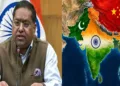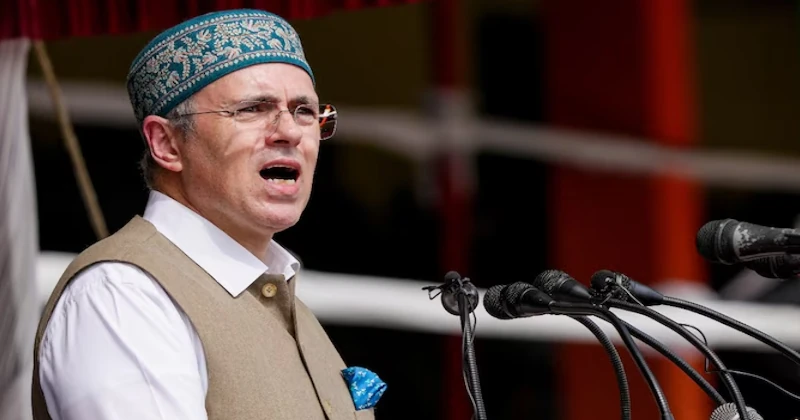
Srinagar: J&K Chief Minister Omar Abdullah delivered an unusually pointed message on Pakistan-occupied J&K (PoJK) in his Independence Day address, declaring that “that part of J&K belongs to us” and asserting that the people living across the Line of Control (LoC) are not outsiders but part of the same J&K.
Speaking in Srinagar on August 15 after hoisting the national flag, Abdullah said the prevailing situation across the LoC had reinforced his belief that the decision taken by J&K’s leaders eight decades ago to resist Pakistani raiders was the right one. He also suggested that, had the constitutional circumstances in J&K not changed in 2019, people in PoJK might today have been demanding reunification with India.
‘That part of J&K belongs to us’
Abdullah’s strongest assertion came while referring directly to the people living in the territory under Pakistan’s control. “That part of J&K belongs to us. We consider those people our very own none of them are strangers; none are outsiders.”
He pointed out that seats representing those areas continue to be reserved in the J&K Legislative Assembly. Those seats, he said, remain vacant in the hope that one day people from those parts of J&K will be able to occupy and utilise them.
The statement places the issue of PoJK firmly within Abdullah’s political argument about the historical and constitutional identity of J&K. Rather than describing the LoC as an immutable political boundary, the Chief Minister portrayed it as a division separating people whom he considers part of the same political and historical entity.
#WATCH | Srinagar: In his Independence Day address, Jammu and Kashmir Chief Minister Omar Abdullah says, "… .When I look across the border and across the Line of Control (LoC) today at their prevailing conditions, I realise that the decision taken by our leaders for us 80 years… pic.twitter.com/kefwGGyxIy
— ANI (@ANI) August 15, 2026
‘Perhaps they would be protesting to rejoin us’
Abdullah also linked the present situation in PoJK to the August 2019 constitutional changes, when the Centre ended J&K’s special status and reorganised the erstwhile state into the Union Territories of J&K and Ladakh.
Looking at the conditions prevailing across the LoC, Abdullah said he felt “pain, regret, and deep distress”. He added that he believed that if circumstances in J&K had not changed in 2019, people in the Pakistan-controlled region might today have been protesting to “rejoin us.”
The remark is significant because Abdullah has been one of the prominent political voices demanding restoration of J&K’s statehood and greater constitutional powers. Yet, in his Independence Day address, he simultaneously invoked India’s territorial claim over the areas under Pakistan’s control.
PoJK unrest casts spotlight on Pakistan’s control
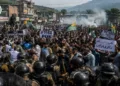
Abdullah’s remarks came against the backdrop of reports of unrest and clashes in PoJK, where residents have protested against various issues involving governance, economic conditions and the distribution of resources.
Recent reports have also highlighted confrontations between protesters and Pakistani security forces, with casualties reported during unrest.
His reference to the people of PoJK as “our very own” was not merely an expression of sympathy. It reinforced the long-standing Indian position that the entire former princely state of J&K, including areas under Pakistan’s control, is part of India.
‘Hamlawar Khabardar’: Recalling 1947
The Chief Minister also looked back nearly 80 years to the events of 1947, recalling the resistance against Pakistani tribal raiders and infiltrators. He referred to the warning “Hamlawar Khabardar” essentially, a warning to aggressors and said that those who raised that call were right and that the sacrifices made at the time were justified.
Abdullah specifically invoked the legacy of his grandfather and National Conference founder Sheikh Mohammad Abdullah, linking the historical resistance of 1947 to his assessment of the situation today.