“Your mother, worthy of your reverence, the most adored, Goddess Durga, giver of food and nourishment, your goddess with a trident, your goddess on a lion, the verdant deity of abundance, is weeping bitterly today. Does her distress not disturb you even a tiny bit? May your supineness be damned! Even your ancestors bow their heads in shame at this impotence. If there is any shame in any part of your body, then get up and honour your mother’s milk, pick up the challenge of redeeming her honour, take a pledge for every teardrop that she sheds, address her sorrow, and with a free throat, utter – Vande Mataram!”– Bhagat Singh, Youth (Yuvak), Saptahik Matwala (Hindi), May 16, 1925
The 80th Independence Day is being celebrated with great enthusiasm and hope. The Har Ghar Tiranga will unfurl the spirit of ‘matriotism’ for Bharat Mata across regions and social strata. Amidst the celebratory mode, there are issues for introspection. The global scenario is uncertain. Besides the economic pressures, energy security is jeopardised by multiple ongoing wars across the Gulf region and Eurasia. The entire international system is in flux, as it was during the interwar period. Bharat, without being directly involved in any of these conflicts, has been affected on various fronts. The international actors who hoped for the natural collapse of Bharat due to its apparent diversity are keen to take advantage of this situation. They never expected Bharat to be a stable and vibrant democracy, with a consistent growth rate and carving out its own place at the global level. The easiest way to rupture this glorious journey after a series of colonisations is to weaponise the youth against their own country with the manipulated ideas of ‘freedom’ injected via the ‘reel culture’. Now the question that needs to be addressed is as how should we approach the idea of ‘Independence’ as technology transforms society, relationships and thought process.
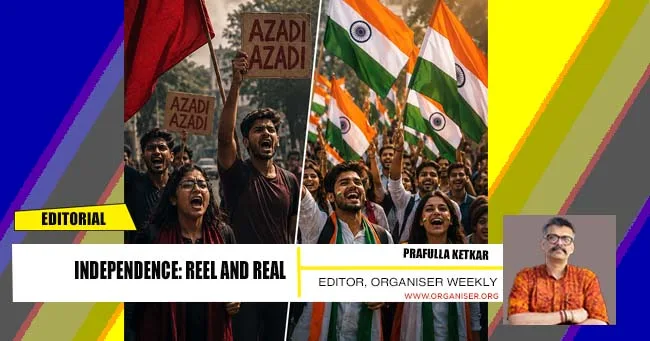
The answer to this paramount question was given by the Sarsanghchalak of the Rashtriya Swayamsevak Sangh (RSS), Dr Mohan Bhagwat, when he addressed the concerns of the youth at an event in Mumbai. He called for differentiating between reel heroes and real heroes. While protest is inevitable in a democracy, its ultimate objective is to build consensus and resolve the problem, not to overthrow or derail the system.
While fragmenting generations from X to Alpha, the tech giants have found a new tool to reach customers for their products. They decide what to watch by manipulating algorithms. They create the reel heroes for each country who would be nurtured with the idea of Resist-Rebel-Reject. The 3R philosophy is weaponised to influence the youth in entire Asia, as if the so-called ‘Gen-Z’ are the only rebellious youth. Uprooting them from national culture, sowing doubt about the democratic system, and encouraging them to overthrow the Government, without offering any credible alternative ideas, is the modus operandi of this game. The entire idea of Cockroach Janta Party and its dubious leadership is planted as part of the same game. Unfortunately, many have begun to treat them as the sole representatives of the so-called Gen-Z. Abusive and obscene youth cannot bring in real change, and logical minds understand this fact. Aren’t students protesting elsewhere, in Jharkhand, Punjab, or Karnataka, youth of the same generation? The social media platforms promoted, foreign-educated and funded, self-proclaimed ‘Gen-Zs’ should not be confused with all Bharatiya youth. In other words, the CJP should be differentiated from the multiple layers of youth aspirations in Bharat. Reel independence can give you a temporary vent to eulogise unreal heroes, but it would not provide long-term or permanent solutions for individuals or the nation.
Who are the people thronging mandirs and Kanwad Yatras? Social entrepreneurs, startup aspirants, and sports heroes inspire youth more than a cockroach mindset does. Not the entire youth population in Bharat is dejected with the vibrant democracy. Such youth, despise casteism, regionalism and dynastic politics and wants to be part of Bharat’s growth story. They have questions about the past but are in search of civilisational roots. They want system to be more inclusive and transparent but are willing to contribute to the same. Young women of Bharat are proving their mettle through their participation in national reconstruction, ranging from education to high-end technological innovations. We need to find ways to make these youth the ‘Real Icons’.
The youth are health-conscious, both mentally and physically; they are concerned about sustainability issues while pursuing development goals; they are aspirational and therefore wary of traditional social pressures. Inter-generational dialogue to find societal and governmental solutions to these concerns is the only solution, not blind rebellion. They are global in consciousness, which is natural given the information revolution, but not at the expense of national interest. Vande Mataram still resonates with them.
After 79 years of Independence, if the younger generations are asking logical questions about the state of affairs, they have a legitimate right to do so. If they have rising expectations, it is a sign of a progressing nation. If the youth will not expect accountability and transparency from the system, who else will? Shankaracharya did that at a very young age and restored the Vedantic philosophy across Bharat. Chatrapati Shivaji Maharaj, at a very young age, resolved to pursue Hindavi Swarajya with toddler-like friends, at a time when being subservient to foreign despotic rulers was a badge of honour. Rani Abakka, Chennamma, Rudramma, Lokmata Ahilyabai, and Rani Lakshmibai defied conventional norms at a young age and proved themselves to be able warriors and administrators. Swami Vivekananda, in his short, young, yet meaningful life, transmitted the message of Bharat across the globe and at the same time awakened the masses to national reconstruction. And revolutionaries like Bhagat Singh, Sukhdev and Rajguru, who sacrificed their young bodies for the cause of national independence, still remain immortal. All of them strove for real freedom, not the reel one. Freedom does not mean the absence of restraint or a licence to do anything; on the contrary, freedom is the process of making responsible and conscious choices.
We are a young nation, and we should capitalise on this dividend for the next two to three decades. During the Independence struggle, fighting against foreign rule was the core of freedom; now, contributing to the development of the nation and overcoming odds to mitigate global challenges is the real spirit of being independent. If we are manipulated by reels, algorithms, and manufactured narratives portraying Bharat as an undemocratic space, then we are unconsciously serving the vested interests that seek to see a fractured and failed Bharat. Political differences will be there in a democracy but they should not be reason to jeopardise the national interest. Yes, we may not be perfect, but if we compare ourselves to any other country that attained Independence in the 1940s and 1950s, what we have achieved, from food security to defence preparedness, is remarkable. Technology is changing our lives, but it should not become our master. We regained political independence on August 15 1947; now the battle is to claim technological sovereignty, along with our cultural and intellectual decolonisation. Every young, fertile mind has a role to play in this process. Let us exert our youth power to ensure freedom for all, based on Receive-Revisit-Rebuild, rather than Resist-Reject-Rebel! Constructive dialogue, not artificial generational categories, will pave the way for long-lasting systemic changes. That is the formula to reform without compromising our civilisational strength and to make Bharat a powerful, prosperous and peaceful role model for the world. Happy Independence Day! Jai Hind