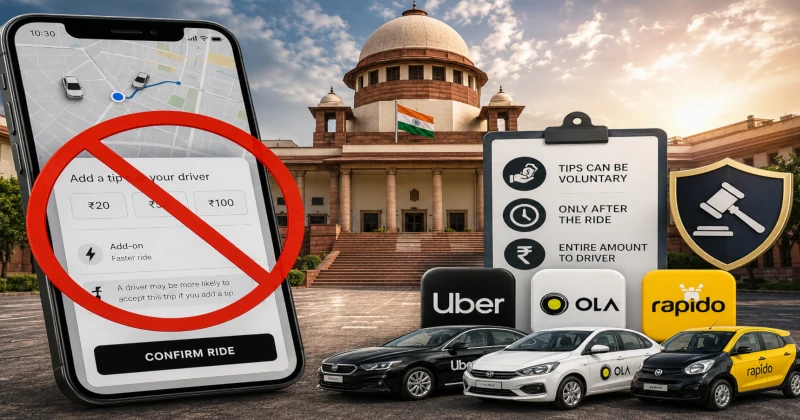
Centre bans pre-ride tipping prompts on cab apps (AI-generated Image)
In a move aimed at protecting passengers from coercive and potentially misleading payment practices, the Ministry of Road Transport and Highways (MoRTH) has directed ride-hailing aggregators to immediately remove pre-ride tipping prompts from their digital platforms.
The directive means passengers booking cabs through platforms such as Uber, Ola and Rapido can no longer be prompted to pay an advance tip before their journey begins, particularly where such payment could create an impression that tipping may improve the chances of getting a ride, securing a driver faster or receiving better service.
The government has made it clear: a tip is a reward for a service already rendered not a payment to secure access to that service.
The action comes after reports of ride-hailing applications displaying prompts such as “Advance Tip,” “Choose an Add-on” and messages suggesting that a driver could be more likely to accept a trip if the passenger added a tip. For passengers who have watched a booking remain unconfirmed for several minutes, such prompts could create a clear incentive to pay more simply to get a cab.
The Centre has now moved to shut down that practice.
In its directive dated August 11, the Ministry said it had been made aware of features on ride-hailing platforms that allowed or encouraged passengers to offer tips before a ride had even been accepted.
Under the government’s direction, aggregators have been asked to immediately review their mobile applications and other digital platforms and remove any feature that does not comply with the Motor Vehicle Aggregator Guidelines, 2025.
The prohibition is broader than simply removing a button labelled “tip”.
The government has directed that no prompt, message, add-on, payment option or user-interface element should appear before completion of a ride if it directly or indirectly creates the impression that paying an additional amount could influence the availability or quality of the service.
That includes the possibility of influencing:
In effect, passengers cannot be nudged into believing that opening their wallet wider will move their booking higher up the queue.
The Centre has not banned tipping. Instead, it has drawn a clear distinction between a voluntary reward after a ride and an upfront payment that could influence the booking process. Clause 14.15 of the Motor Vehicle Aggregator Guidelines, 2025 permits passengers to voluntarily tip drivers.
However, the tip option can be presented only after the journey has been completed.
The passenger therefore retains the freedom to reward a driver for good service but that decision must come after the service has been delivered. The guidelines also require that the entire tip amount be credited to the driver, without the aggregator deducting any portion of it. This effectively closes the door on a model where passengers are encouraged to pay extra before a ride in the hope of improving their chances of securing one.
The controversy centres on the psychology of the booking process. A passenger who has already waited several minutes for a driver may be more inclined to accept an additional charge if the application suggests that doing so could improve the chances of confirmation.
Such a system can blur the line between a genuinely voluntary tip and an indirect incentive payment for securing a basic service. The government has specifically moved against this kind of interface. The message from MoRTH is unequivocal: a passenger should not have to wonder whether refusing to tip upfront will leave them waiting longer for a cab.
A customer booking a ride should be able to make the decision based on the fare and the available service not on the fear that another passenger willing to pay an advance tip may receive preferential treatment.
The government’s directive also invokes broader consumer protection principles. The Motor Vehicle Aggregator Guidelines, 2025 prohibit tipping mechanisms that are misleading, manipulative or otherwise inconsistent with the Consumer Protection Act, 2019 and related rules.
The latest order reinforces that principle by targeting digital interfaces that could influence passenger behaviour through implied promises of faster confirmation or better service.
The issue is particularly significant because ride-hailing platforms operate through algorithms, digital prompts and automated allocation systems. For the ordinary passenger, it may be difficult to know whether an additional payment genuinely changes the probability of securing a ride or merely creates that impression.
The government has therefore placed the responsibility squarely on aggregators to ensure that their applications do not exploit that uncertainty.
The latest MoRTH directive also follows concerns raised earlier by the Central Consumer Protection Authority (CCPA) over pre-ride tipping practices on ride-hailing platforms.
The government’s latest intervention gives the issue an additional regulatory push, directing aggregators to bring their digital interfaces into compliance with the 2025 guidelines without further delay.
For the companies, the message is simple: whatever the commercial logic behind pre-ride tipping, the feature cannot remain if it gives passengers the impression that paying more could influence whether or how quickly their ride is secured.
For passengers, the change is straightforward. They can still tip a driverbut only after completing the journey.
They cannot be asked to make an advance tip during the booking process. Nor can a ride-hailing application suggest that paying extra could make a driver more likely to accept the booking, reduce the waiting time or improve the chances of confirmation.
The change could also remove an uncomfortable element from the booking experience.
Instead of being confronted with a choice between paying more or potentially waiting longer, passengers will be able to book a ride based on the stated fare and available service.
And if a driver provides exceptional service, the passenger can still choose to reward the driver once the journey is over.
