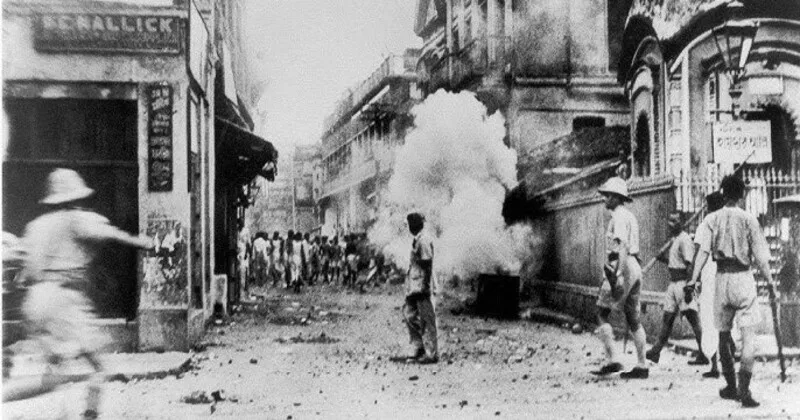
The “Great Calcutta Killings” is the episode that marks the transmutation of constitutional politics into organized carnage. These killings inaugurated the continuum of the “Partition Riots and Horrors” of 1945–47 — a sequence of orchestrated violence that rendered territorial bifurcation seemingly ineluctable. The proximate catalyst was the All-India Muslim League’s adoption of “Direct Action” following the repudiation of its demand for Pakistan in the Cabinet Mission Plan of May 1946.
The four-day conflagration that consumed Calcutta between August 16-19, 1946 occupies a liminal and constitutive position in the historiography of decolonization. What unfolded in Calcutta, therefore, was not merely sectarian antagonism. It was the materialization of political discourse, ministries, electorates and federal asymmetries. This was supplanted by the lexicon of arson, bloodshed and demographic expulsion. In this sense, Calcutta was less a city experiencing a riot than a polity enacting its own vision.
The Cabinet Mission arrived with a mandate to arbitrate between the Indian National Congress and the All-India Muslim League. Its proposal of May 16, 1946 envisaged a confederal India with an attenuated center and three provincial groupings. Critically, it rejected the League’s cardinal demand- a sovereign, contiguous Pakistan. This constituted both a strategic repudiation and an existential threat for Mohammad Ali Jinnah and the League.
On July 29, 1946, the League Council, therefore, resolved to pursue “Direct Action” — a deliberate formulation encompassing hartals, economic paralysis to smoothen out the process of massacring the Hindus of Calcutta. Why did Calcutta emerge as the locus for this experiment? The reason behind this selection was to put Calcutta at stake because Mohammad Ali Jinnah was lured by the enormous economic prosperity of Calcutta as the most financially developed city of the contemporary South-East Asia and his intention to grab the entire Bengal was a necessity to incorporate Calcutta into Pakistan. The Muslim League ministry had been reigning in Bengal under Hossain Suhrawardy as the Premier in 1946.
The administration and its bureaucratic apparatus were turning more to communalism. Simultaneously, Bengal was contending with the aftershocks of wartime hyper-inflation, the 1943 famine and the demobilization of wartime labour also. These economic facets intersected with intensely aggressive communal mobilization by the Muslim League. The intention of the “Direct Action Day” was already clear when Jinnah stated, “We bid good bye to constitutional methods.” Why was the date 16th August, 1946 selected?
Reason is purely communal as the date of the August 16, 1946 fell on the 1365 Hijri, Jumma of the 18th Ramzan, as it was the month of Ramzan when kafirs were slaughtered to capture Mecca, a perfect time that they decided to launch Jihad against the kafirs to create Pakistan. The designation of 16th August, 1946 as “Direct Action Day” was declared in Bengal by the League Government as a public holiday to facilitate successful accomplishment of the riots directed by the Muslim League against the Hindus of Calcutta. The preparation started much earlier engaging almost all Calcutta Muslim organizations of students, fruit merchants etc. S.M Osman, the contemporary Mayor of Calcutta distributed provocative leaflets containing their clear intentions with his signature:
“It was in this very month of Ramzan that the first war between Islam and the infidels began… It was in this month of Ramzan that we conquered Mecca and drove out the idolaters. It was in this month of Ramzan that Islam was established. In accordance with the will of Allah, the All-India Muslim League has given a call for Jihad to form Pakistan in this very month of Ramzan”.
Muslim-owned shops were marked so that they would be spared from looting and the Muslim League government supplied petroleum and kerosene to League cadres. Meetings were held continuously in mosques and Hindu police officers were systematically removed from key positions across most police stations. The “Direct Action Day” was aimed at altering the urban morphology of Calcutta beside getting Pakistan as a separate country with the confirmed incorporation of Calcutta into Pakistan.
Contemporary testimony by Major L.A. Livermore, a British officer stationed in Calcutta, recorded in his diary a “curious stillness in the air” on the morning of 16th August, 1946 that evinces a palpable atmosphere. In the fortnight preceding 16th August, pamphlets, broadsheets and newspaper editorials proliferated political disagreement in theological terms-survival, honour and divine sanction in the form of Jihad. Violence erupted in the specific pockets of Calcutta and diffused centrifugally. The modalities were systematic and planed beforehand as evident by the gathering of the Muslim crowd with swords, bladed weapons and other items required to optimize riot at Shahid Minar at the call of Suhrawardy and Khwaja Nazimuddin.
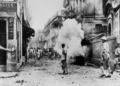
The Muslim crowd of around 5,00,000, as per report, was called to launch the massacre and was guided by provocative slogans like Hat mere biri muh mein pan, larke lenge Pakistan and Allah Ho Akbar and instructed to disperse to initiate the riot. Targeted attacks upon Hindu residential and commercial premises were launched by the formation of marauding cohorts armed with armaments. Hindu shops, properties were looted and burnt. Religious symbols, books were destroyed, purohits, pandits were massacred ruthlessly. Innumerable Hindus were killed. Hindu boys were butchered inside the mosques. The Hindu women of all ages were raped brutally, their breasts were cut, killed many of their nude dead bodies were hanged outside windows.
According to the Calcutta Municipal Gazette (August 24, 1946), 3,468 dead bodies were recovered from the streets of Calcutta and Howrah. Official figures were around in thousands for obvious reasons under the Muslim League Ministry of Bengal, but expressions of newspapers reflect that the lanes of Strand Road were full of bloodshed and streets under Howrah Bridge witnessing piles of dead bodies. These expressions of categories of geographical zones evinces that it crossed figures at least more than ten thousand. The Hindu houses were devastatingly looted.
Even house of Dr. Bidhan Chandra Roy was not spared. It must be mentioned that Hossain Suhrawardy himself remained posited at Lalbazar Police Headquarter and ensured that the police should not take any action anywhere at all so that the Muslims engaged in conducting riots could expand the riot without any hurdle. The colonial police apparatus at Calcutta was practically handicapped by Suhrawardy. That’s why, he is rightly called ‘the Butcher of Calcutta’.
The Calcutta Police was compelled to abandon legal rationality. At the Maidan rally, he made it clear that the police had orders not to intervene. According to Governor [Frederick] Burrows, “he tried to make Suhrawardy understand that the situation was deeply alarming, but Suhrawardy took no action.” Belgachia, Sovabazar, Bowbazar, College Street, Sealdah, Mechua Bazar, Maniktala, Entally, Rajabazar, Park Circus, Zakaria Street, Metiaburuz, Strand Road, Khidderpore became rapid escalation zones.
The Hindus retaliation commenced by Gopal Mukherjee, famously known as ‘Gopal Pantha’ as he was the butcher of a mutton meat shop in Bowbazar. He was the one who first launched an organized armed resistance with the local Hindu youth to protect the Hindu lives. Biharis and Sikhs of Bhawanipur rose to counter-attacks to defend their neighbourhoods from August 17, 1946. Heavy counter attacks were visible in areas of Kankurgachi, Burrabazar, Shyambazar in north Calcutta. Soon severe counter-resistance by the Hindus spread on 18th August throughout the length and breadth of Calcutta, which shocked Suhrawardy as he was certainly not expecting an intense armed retaliation by the gentlemen-imaged Hindus.
Badruddin Ahmed, in his book Swadhinata Sangramer Nepathya Kahini, pointed out that Khawaja Nazimuddin, the President of the undivided Bengal Muslim League, declared: “Our fight is not against the British, but against the Hindus.” Nirmal Kumar Bose wrote in My Days with Gandhi: “The offensive began from the side of the Muslim mobs; but within a few hours the Hindus… also struck back.”
When heavy counter-attacks became vogue causing causalities of the Muslims in considerable number, Suhrawardy ordered police to take control of the situation. Recent renaming of the road from Suhrawardy Avenue to Gopal Mukherjee Road by Honourable Chief Minister of West Bengal, Shri Suvendu Adhikari of Bhartiya Janta Party on the Paschimbanga Divas was a true tribute to Gopal Mukherjee, the Man who stood up and saved several Hindu lives under the grand massacre project of the Direct Action Day, that was much awaited but finally delivered.
Calcutta experienced a horrendous holocaust from 16th to 19 August, 1946. Almost all the newspapers like The Statesman, the Hindustan Standard, Amrita Bazar Patrika, Star of India covered this butchery. The Hindustan Standard reports on 20th August, 1946, “Men, women and children were butchered… accompanied by devilish dancing.”
The London Times remarked that the League government had taken no steps to protect Hindu lives and property. Emphasis was placed on the declaration of a public holiday, alleged incitement and purported police complicity. Syama Prasad Mookerjee sharply accused the League government of handing the city over to goondas for a few days and playing with human lives during legislative debates. Hearing this, Suhrawardy called Syama Prasad a goonda. Syama Prasad immediately retorted:
“I may be a goonda, but you are the prince of the goondas.” On September 20, 1946, Dr. Syama Prasad Mookerjee was intensely concerned comprehending that the League Ministry orchestrated the “Great Calcutta Killing” and it was not the end. This episode and later on the Noakhali Genocide of 1946 embittered Hindu-Muslim relationship. The city thus became an archetype, its tactics of partition riots replicated in Noakhali, Bihar and Punjab in subsequent months.
This proved that Syama Prasad Mookerjee was absolutely correct in having the far-sighted vision that was definitely not the end and mutual coexistence of Hindu-Muslims under a Muslim ministry was out of question. These horrors of riots for partition legitimized the demand for territorial separation and made the partition inevitable in 1947. These communal riots organized by the Muslim League crystallized that the Hindus with the Muslims or under a Muslim Government can not exist safely at all. These exposed the reality of their process of work in the form of communal riots.
The urban pogrom in the form of The Calcutta killings compel a reconceptualization of decolonization. They demonstrate that the transfer of power was not a juridical transaction but a process saturated with violence. “Direct Action” was not merely a tactic but a language, a means of communication of the Muslims.
The Great Calcutta Killings cannot be reductively categorized as a “communal riot”. Such a designation diminishes their political content and historical weight. On one hand, the Great Calcutta Killings are not a closed chapter but a continuing site of historical inquiry as an integral part of one of the largest migrations of the world causing displacement of more than 15 million lives and a traumatic, but true lesson to be always cautious about the dividing forces of our country. Real histories of Bharat need to be put forward.