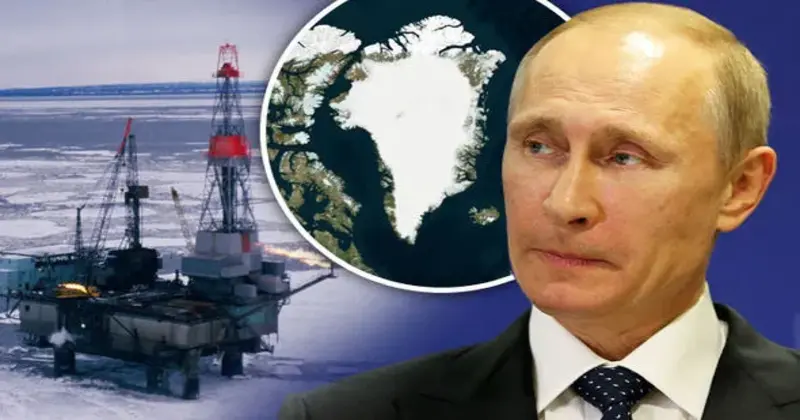
Moscow: Russian President Vladimir Putin has highlighted India’s growing interest in the Northern Sea Route (NSR) and the Arctic region as Moscow seeks to turn the Arctic corridor into a major trade gateway between Europe and Asia. The push comes as Russia aims to expands Arctic shipping amid Western sanctions. The statement by President Putin also signals Kremlin’s time-tested and deepening trust towards India as a credible strategic partner, to explore and fortify in strategic frontiers amid escalating geopolitical flashpoints and uncertainities.
Russian President Vladimir Putin has said that India is among the countries showing growing interest in cooperation on the Northern Sea Route (NSR). This has hinted about a potential partnership and expansion of India-Russia connectivity across the Arctic, which is increasingly emerging as an ambitious zone for the geopolitical players.
Addressing the Pacific Fleet personnel aboard the missile cruiser Varyag, Putin said Moscow was witnessing increasing interest from partner countries in the Arctic shipping corridor, particularly from India and China. He stressed that Russia remains open to international cooperation on the route, provided such engagement remains within the framework of international maritime law.
“India is one of the key countries showing growing interest in cooperation on the Northern Sea Route”, Putin said, underscoring the growing importance Moscow attaches to New Delhi’s role in the development of the Arctic corridor.
The remarks come as Russia accelerates efforts to transform the Northern Sea Route(NSR) into a commercially viable shipping route linking Europe and Asia. At the same time, Putin is continously warning about the rising “artificial tensions” in the Arctic domain and is pointing to NATO’s expanding presence and increased Western military activity in the resource rich contested landscape.
Why the Northern Sea Route and Arctic matters?
The Northern Sea Route stretches along Russia’s Arctic coastline, connecting the Atlantic and Pacific oceans through the waters of north of Siberia. It passes through the Barents, Kara, Laptev, East Siberian and Chukchi seas. This latitude is emerging as a new global power corridor, across the geopolitical chessboard. Countries aim to consolidate their footprint in the region, to control global trade, evolving trade route and vast critical minerals among the icy landscape. This will act as an impetus to seek global hegemony for the competing nations.
For international trade, the route offers a potentially shorter alternative to traditional shipping corridors such as the Suez Canal. Its geographical advantage could reduce sailing distances and transit times between Europe and Asia, although the NSR remains significantly more challenging to navigate.
Extreme cold, sea ice, harsh weather and limited infrastructure make Arctic shipping technically demanding. Ships often require ice-strengthened designs, while icebreaker assistance remains crucial in difficult conditions.
However, declining Arctic sea ice due to global warming and climate change has gradually extended the period during which parts of the route can be navigated. The rapidly melting ice caps is nurturing the region as a potential trade route. Russia has invested heavily in ports, navigation infrastructure, logistics facilities and a fleet of nuclear-powered icebreakers as it seeks to make the NSR a more reliable trade artery.
For Moscow, the route has assumed greater importance amid the Western sanctions since the outbreak of the Ukraine conflict. The war has pushed Russia to redirect much of its energy and trade flows towards Asian markets. The Northern Sea Route thus provides Russia another potential pathway for transporting Russian oil, gas and other commodities to Asian buyers. In this geopolitical and global trade venture, Moscow deems New Delhi as a potential partner.
India, meanwhile, sees the Arctic route as another component of its broader connectivity strategy with Russia and other countries. New Delhi and Moscow have discussed cooperation on developing shipping through the Northern Sea Route and establishing mechanisms to facilitate greater engagement.
The corridor complements other India-Russia connectivity initiatives, including the International North-South Transport Corridor and the proposed Chennai-Vladivostok maritime route.
India’s Arctic opportunity amid expanding trade ties
India’s interest in the Northern Sea Route is closely linked to its expanding economic and strategic engagement with Russia.
As a major importer of Russian energy, India could benefit from more direct and potentially faster maritime connections for the movement of crude oil and other commodities. Greater access to Arctic shipping could also diversify India’s trade routes and reduce dependence on conventional corridors, such as the Suez Canal, Strait of Hormuz, Red Sea, which is hitherto conflict-ridden.
Prime Minister Narendra Modi has previously stressed the importance of strengthening connectivity initiatives with Russia and indicated that India would work with “renewed energy” on such projects. Discussions have also included training Indian sailors in Arctic navigation, an important step given the specialised skills required to operate in polar waters.
For Russia, India’s participation offers strategic value beyond commercial considerations. Moscow has increasingly sought to strengthen relations with Asian partners as Western sanctions constrain its economic options.
As mentioned, The Northern Sea Route also gains significance because the Arctic region contains vast reserves of oil, gas and minerals. Its development therefore has implications not only for shipping but also for energy security, resource access, seeking strategic edge in emerging technology manifacturing such as semiconductor chips and long-term economic planning.
Arctic shipping meets rising geopolitical tensions
The commercial potential of the NSR is unfolding against a backdrop of intensifying geopolitical competition. Putin has warned of growing “artificial tensions” in the Arctic and accused Western countries of increasing military and strategic activity in the region. Moscow has repeatedly criticised NATO’s expanding presence and views the Arctic as an increasingly contested strategic space.
The situation is further complicated by the wider confrontation between Russia and Western countries over the Ukraine conflict. Putin has separately warned that Russia would respond “in kind” if European countries move to confiscate Russian merchant vessels amid tightening pressure on Moscow’s so-called shadow fleet.
According to Russian state media, Putin described such western actions as “piracy and banditry” and warned that any Russian retaliation would not necessarily be restricted to the waters where Russian vessels were detained. The warnings highlight how commercial shipping routes are increasingly intertwined with broader geopolitical tensions.
For India, participation in the NSR therefore presents both opportunities and challenges. Greater access to Arctic shipping could strengthen energy security, expand connectivity with Russia and provide an alternative trade corridor between Europe and Asia. But Arctic navigation remains costly, infrastructure-intensive and dependent on specialised vessels and icebreaker support.