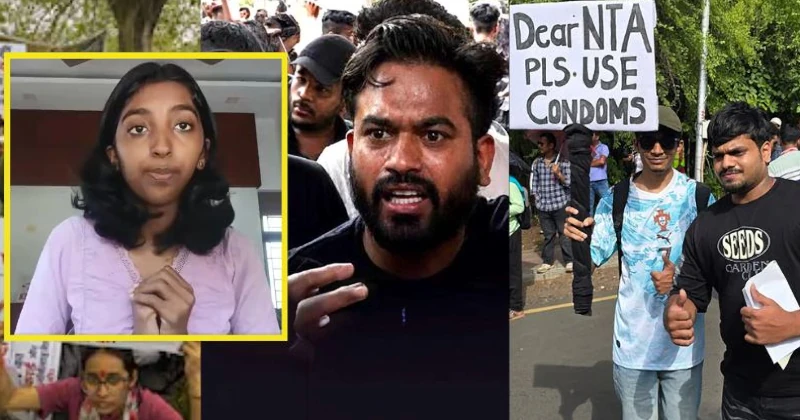
Thiruvananthapuram: A Kerala-based Gen Z student has sparked a heated debate on social media after a sharply worded video accused sections of the student community and political activists of practising “selective outrage” speaking loudly when an issue fits a popular political narrative while remaining conspicuously silent when students suffer under state-level recruitment and examination crises.
In a video circulating on X, the student says she feels “ashamed” of some of her classmates and friends who, according to him, rallied around protests linked to the NEET controversy and the Cockroach Janta Party (CJP) movement, but showed little interest in student grievances in Jharkhand or Kerala.
The central argument of the video is blunt: when protest becomes dependent on what is trending on Instagram, activism risks turning into performance rather than principle.
A GenZ Nationalist from Kerala brutally destroys Left Propaganda, algorithm, Cockroach Protest & their hypocrisy, all in just 2 minutes of clarity .
Must Listen and Share Max pic.twitter.com/aHTVC5caPT
— Megh Updates 🚨™ (@MeghUpdates) August 11, 2026
The remarks come amid a renewed wave of student protests over examination and recruitment irregularities. In Jharkhand, aspirants have been protesting alleged irregularities involving recruitment examinations conducted by the Jharkhand Public Service Commission (JPSC) and Jharkhand Staff Selection Commission (JSSC). The protests entered their second week in early August, with authorities tightening security and imposing restrictions around the state Assembly ahead of a planned student march.
The protests have since intensified, with the Jharkhand government announcing cancellation of the 14th JPSC Civil Services Examination and two other JPSC examinations amid the unrest. Chief Minister Hemant Soren also announced an investigation into examinations conducted by the agency associated with the disputed processes.
Where is the outrage now?
The video argues that when the NEET controversy erupted and protests were organised around examination-related grievances, the issue rapidly became a major national and social-media talking point. The student claims that people who publicly denounced violence at Jantar Mantar nevertheless joined or supported the broader campaign because the subject had generated enormous online attention.
The student’s accusation is that outrage became tied to visibility.
Her contention is not that students should not protest against examination irregularities. Rather, she questions why the same intensity of mobilisation does not appear when students facing similarly serious problems are located outside the political spotlight.
That criticism comes against the backdrop of the rise of the CJP, a youth protest movement that emerged around examination-related grievances and used the cockroach as a symbol of student resilience and dissent. The movement organised high-profile demonstrations at Jantar Mantar and attracted considerable public and media attention.
The protests became particularly prominent in June and July, with participants demanding accountability over alleged irregularities in competitive examinations. The student in the viral video, however, asks why similar solidarity has not been visible in cases that receive less attention online.
The video points specifically to Jharkhand, where student and job aspirant protests have continued over alleged irregularities in JPSC and JSSC examinations.
The issue has developed into a significant political and administrative challenge for the state government. Students have demanded action over alleged paper leaks, recruitment irregularities and what they describe as repeated failures in the examination system.
Recent reporting shows that the protests have continued for more than two weeks, with students planning marches towards the state Assembly and authorities imposing restrictions in sensitive areas.
The government’s decision to cancel the 14th JPSC examination and two other examinations is an acknowledgement of the seriousness of at least some of the complaints surrounding the recruitment process.
Yet, as the Kerala student argues, the agitation has not generated the same level of national social-media attention as the controversies that dominate the political cycle. That disparity, she suggests, is the real question.
Kerala’s PSC Rankholders: A grievance closer to home
The student then turns the spotlight towards her own state. According to the video, candidates from Kerala PSC rank lists for LP School Teacher posts have been waiting for appointments despite the publication of the relevant ranked lists.
Official Kerala PSC records confirm that ranked lists and advice processes for LP School Teacher/LP School Assistant posts have continued across districts, with recruitment activity taking place at different stages during 2025 and 2026.
The video claims that thousands of candidates have been affected and alleges that rankholders have staged prolonged demonstrations outside the Secretariat, resorting to dramatic forms of protest to draw attention to their plight.
Among the claims made in the video is that some protesters “ate soil” and even knelt on rock salt in an attempt to make their grievances heard.
Those details are presented by the student as evidence of the desperation felt by sections of the rankholders. They should, however, be understood as claims made in the viral video unless independently corroborated.
The broader issue that candidates on PSC ranked lists can face prolonged uncertainty over advice and appointments is reflected in the continuing recruitment and advice records published by the Kerala PSC. The commission’s official data show appointments proceeding at varying rates depending on category, district and available vacancies.
The most provocative part of the student’s argument is her attack on what she describes as “Instagram politics.” According to her, many young people do not necessarily choose causes based on the severity of the injustice involved. Instead, they gravitate towards issues that are visible, fashionable and amplified by algorithms.
That argument challenges the increasingly prominent role of social media in political mobilisation.
The CJP movement itself illustrates how quickly an issue can acquire national visibility when it gains a distinctive symbol and a strong online presence. The movement’s cockroach mascot became widely recognisable, while its Jantar Mantar demonstrations drew public attention and generated political debate.
At the same time, the proliferation of misleading material around the protests has demonstrated how rapidly social-media narratives can also become distorted. Fact-checkers have previously found unrelated or old videos being falsely presented as footage from CJP demonstrations.
This makes the student’s central criticism particularly relevant: online visibility can determine not only what people see, but also which causes receive public legitimacy.
Selective outrage is hypocrisy wearing a filter
The student’s most forceful line comes towards the end of the video, “Selective outrage is not activism. It is hypocrisy wearing a filter.”She argues that genuine activism cannot be measured by the number of Instagram stories, posts or viral hashtags generated by a cause.
If students are willing to speak out against alleged examination failures in one part of the country, she argues, the same standard should apply to students facing recruitment uncertainty, examination irregularities and administrative failures elsewhere.
Her criticism is particularly directed at people who, in her view, claim to stand for student rights while remaining silent when those rights are threatened in states or institutions that do not align neatly with their political worldview.