New Delhi: The Indian Space Research Organisation (ISRO) has opened applications for a PhD research opportunity 2026 for Scientist/Engineer ‘SD’ posts at its Human Space Flight Centre (HSFC), Bengaluru. The recruitment drive is for candidates with specialised PhD qualifications who can contribute to multidisciplinary research and technology development for India’s Human Space Flight Programme. The official notification, dated August 10, 2026, lists six vacancies, with one vacancy for each of the six post codes. All six vacancies are in the Unreserved (UR) category.
The pay scale is Rs 67,700 to Rs 2,08,700, with a starting basic pay of Rs 67,700 per month, plus admissible allowances and other benefits. ISRO has specified that there is no application fee for the Scientist/Engineer ‘SD’ posts under Post Codes 01 to 06.
ISRO PhD Opportunity 2026: Key Highlights
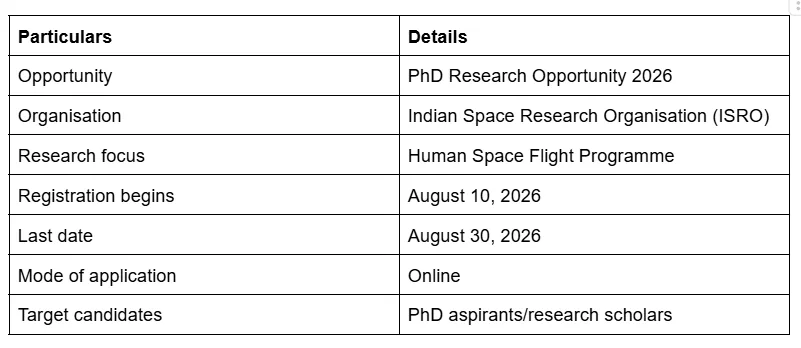
ISRO Scientist/Engineer ‘SD’ vacancies 2026
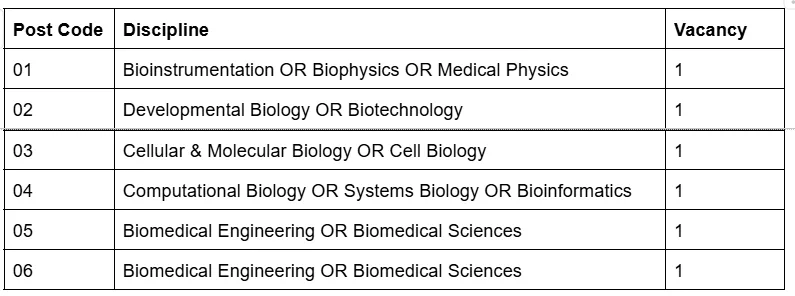
ISRO PhD Opportunity 2026: Important Dates
Candidates who are interested in the ISRO PhD programme should keep the following dates in mind:
Online registration begins: August 10, 2026
Last date to apply: August 30, 2026
Who can apply?
The opportunity is intended for PhD aspirants and researchers interested in contributing to research under India’s Human Space Flight Programme. Candidates should check the official ISRO notification for the specific educational qualifications, subject-wise eligibility criteria, age requirements, documents and other conditions, as these may vary depending on the research area.
ISRO PhD Opportunity 2026
An exciting opportunity for PhD aspirants to contribute to cutting-edge research in India’s Human Space Flight Programme.
📅 Online Registration Opens: 10 August 2026
⏰ Last Date to Apply: 30 August 2026🔗 Notification: https://t.co/RmdMQDypBl… pic.twitter.com/ZA9uNfSrGt
— Professor G R Sinha (@profgrsinha) August 9, 2026
Why is the opportunity important?
India is expanding its capabilities in human spaceflight through the Gaganyaan programme, human spaceflight capability will be demonstrated. For PhD scholars, such research opportunities can provide exposure to real-world challenges in India’s growing space sector while allowing them to contribute to nationally significant scientific projects.
Depending on the post, the work may include wearable health-monitoring sensors, biomedical sensors, bio-signal processing, medical imaging, portable diagnostic devices and astronaut health monitoring. Other research areas include radiation biology, stem-cell and organoid culture, astronaut health, immune and cellular adaptation, proteomic data analysis, molecular cloning, gene editing and spaceflight-related biological studies.
The notification also lists research involving in-silico models, multi-omics, closed-loop life-support systems, digital twin biology, neural networks and deep learning for predictive simulation of astronaut physiology and disease conditions.
For the biomedical engineering-related posts, the work can include gait analysis, motion capture, force-plate studies, musculoskeletal analysis, wearable data analysis, bio-imaging systems, ECG/EEG/EMG signal processing, biosensors and AI/ML-based analysis for human and rodent spaceflight experiments.
How to apply for ISRO PhD Opportunity 2026?
Eligible candidates can register online from August 10, 2026, through the designated ISRO application process. Applicants should enter their details carefully, upload the required documents and submit the application before August 30, 2026. Candidates who have pursued the relevant professional course through Open and Distance Learning (ODL) are not eligible for consideration.
ISRO Recruitment 2026: Selection process
On the basis of their applications submitted through the ISRO Live Register portal, candidates will first undergo initial screening. Shortlisted candidates will be called for an interview. At the time of the Personal Interview, candidates will be required to bring their original educational certificates, an original valid Government-issued photo ID and a printed copy of the E-Admit Card sent to their registered email ID. The final selection will be based only on the candidate’s performance in the interview.