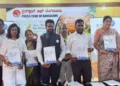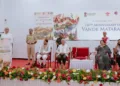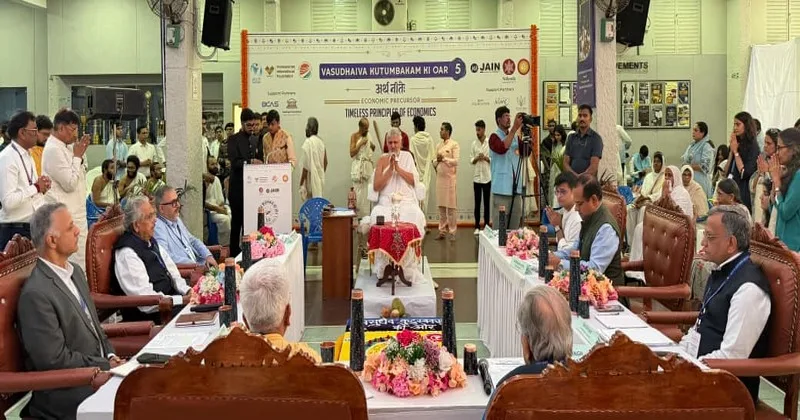
Bengaluru: The second Precursor Session of VK 5.0 convened the Economics Advisory Committee to deliberate on fundamental questions concerning the economic domain at Jain PU College, V.V. Puram in Bengaluru on August 8, 2026. The session was part of the Vasudhaiva Kutumbakam Ki Oar 5.0 Conclave Series.
Organised by Jyot and Gitarth Ganga, in association with JAIN (Deemed-to-be University), the session brought together some of India’s foremost economists, policymakers, jurists, banking leaders, taxation experts and international delegates to deliberate on “Dhruv Tatvam: Timeless Principles of Economics”—an effort to revisit the foundations of economics through the lens of India’s civilisational wisdom.
Convened under the aegis of Spiritual Sovereign Jainacharya Yugbhushansuriji Maharaja, the session forms part of the larger Dhruv Tatvam initiative, which seeks to identify enduring civilisational principles capable of informing contemporary public policy and global discourse. The deliberations focused on whether modern economic systems, largely shaped over the past two centuries, adequately address questions of justice, sustainability, restraint and human well-being.
The Precursor witnessed the participation of distinguished experts, including Dr. N. K. Singh, M. K. Jain, Prof. Sachin Chaturvedi, Balasubramanian Krishnamurthy, Adv. Prashant Kumar, Sr. Adv. S. S. Naganand, Shaurya Doval, Prof. Pulak Ghosh, N. S. Srinivasa Murthy and Siddharth Shah, along with international delegates from Nepal Rastra Bank and other institutions.
The discussions revolved around four central questions that sought to challenge prevailing economic assumptions:
- Whether GDP and productivity alone are sufficient measures of prosperity
- How pricing systems can be anchored in justice rather than markets alone
- Whether existing models of free trade adequately serve humanity
- Which timeless economic principles from India’s civilisational heritage deserve revival in contemporary policymaking
The deliberations examined the intellectual continuity between ancient Indian economic thought—including the Arthashastra, Shukra Nitisara, Kamandakiya Nitisara and Jain and commercial traditions—and the challenges confronting the modern global economy. Panel members explored themes such as ethical wealth creation, financial inclusion, institutional trust, responsible governance, sustainable development, legal certainty, international cooperation and economics centred on human welfare rather than material accumulation alone.
Spiritual Sovereign Jainacharya Yugbhushansuriji Maharaja, who convened the session, remarked, “The lapse in the rule of law is that crimes unrecognised by law remain unpunished, whereas the rule of justice—which formed the bedrock of the social order as prescribed in the scriptures—did not permit such wrongs to go unaddressed”.
Dr. N. K. Singh, Chief Guest, said, “If machines are going to produce our goods and services, the question is not what machines will do—it is what humans will do. Technology must enhance human intelligence and dignity, not make human beings economically irrelevant”.
Dr. R. Balasubramaniam asked, “How should an individual behave? How should we move from profit maximisation to benefit optimisation? Benefit will have value, whereas profit will have valuation. Moving from a for-profit economy to a for-benefit economy is the new economic order that we have to fashion, and it can be done. That is what can preserve India’s principles. All that we spoke about—genuine progress—is embedded in this”.
Prof. Sachin Chaturvedi, Vice Chancellor, Nalanda University, said, “1776 was not the year zero of economic thought. India and other ancient civilisations possessed sophisticated ideas about production, consumption, social organisation and human wellbeing long before modern economics was formalised. It is time to recover that lost intellectual thread and build an economic order that measures not merely wealth, but human wellbeing”.
Mr. M. K. Jain said, “We must stop treating nature and society as free inputs to economic growth. A forest destroyed, groundwater depleted or social fabric weakened may not immediately appear in GDP, but each represents a real loss of national wealth. Economic surplus must be converted into productive wealth while preserving the natural and social capital of future generations”.
Shaurya Doval said, “The sovereign may say, ‘Well, what can I do? Global oil prices are such.’ But then the first question they must be asked is: ‘Are they sovereign in the first place?’ If they cannot ensure that oil prices remain just, what does sovereignty truly mean? The quicker we recognise this, the quicker we must build the capacities and capabilities internally to empower our sovereign to actually maintain that sovereignty. A market may determine a price, but it cannot determine what is just”.
“Economic systems, therefore, cannot be judged merely by efficiency, growth, or the forces of demand and supply. When market rules allow the powerful to systematically benefit at the expense of the vulnerable, those rules must be reconsidered. The true measure of an economic order is not how much wealth it generates, but whether that wealth is created without exploitation, distributed with fairness, and used to advance human dignity. Markets must ultimately operate within the framework of justice”, Shaurya Doval further added.
The Economics Precursor marks another significant milestone in the ongoing Vasudhaiva Kutumbakam Ki Oar 5.0 journey. By bringing together practitioners and scholars from economics, finance, governance, law and public policy, the initiative aims to evolve a body of timeless principles that can contribute to building a more just, balanced and humane global economic order. The refined Economics Dhruv Patra emerging from these deliberations will be formally presented during the VK 5.0 Main Event as part of the broader Dhruv Tatvam initiative.
Vasudhaiva Kutumbakam Ki Oar—“towards the world as one family”—is a civilisational dialogue series convened under the aegis of Spiritual Sovereign Jainacharya Yugbhushansuriji. It brings scholars, policymakers, jurists, diplomats and practitioners into structured deliberations, examining the assumptions of the modern global order against the continuous knowledge traditions of Bharat.
The present edition, VK 5.0, advances the Dhruv Tatvam (“timeless principles”) initiative, which seeks to distil enduring principles across domains—including governance, law and economics—into published Dhruv Patras for wider deliberation. The previous edition, VK 4.0, was held at Kranti Maidan, Mumbai, in January 2026, with the support of India’s Ministry of External Affairs.