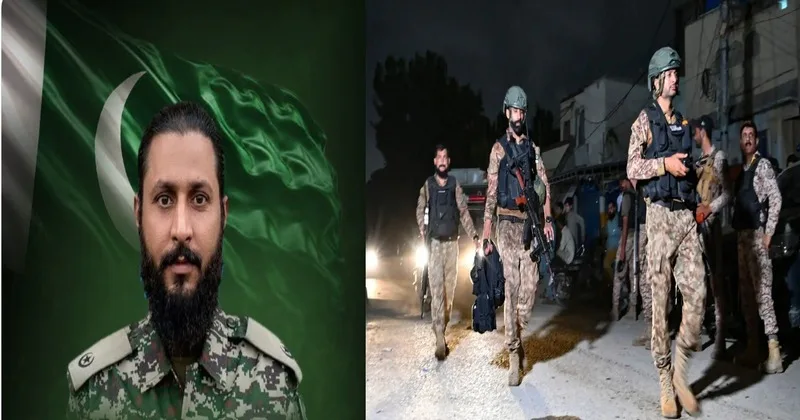
JAMMU: A Pakistan Army officer, Major Hafiz Ihsan Elahi, was killed in the Razmak area of North Waziristan district of Khyber Pakhtunkhwa province, the Inter-Services Public Relations (ISPR), media wing of the armed forces, said in a statement on August1 . During the clash with armed rebels, security forces also killed five men affiliated with Fitna Al Khawarij (FAK), the ISPR said.
Fitna Al Khwarij is a term the Pakistan government uses for armed men belonging to the banned Tehreek-i-Taliban Pakistan (TTP), a group its Inter Services Intelligence (ISI) once sired and then patronised. The ISPR said that Major Hafiz Ihsan Elahi, 34, from Mianwali district in Punjab, was “a brave officer who was leading his troops from the front, fought gallantly, paid the ultimate sacrifice” and lost his life in a clash with armed rebels, according to a Dawn report.
Weapons and ammunition were also found on the encounter site, “who remained actively involved in numerous activities” against security forces and law enforcement agencies, as well as in the killing of civilians.
“Sanitisation operations are being conducted to eliminate any other armed men found in the area. Relentless counter-terrorism campaign under the vision ‘Azm-i-Istehkam’ (as approved by Federal Apex Committee on National Action Plan) by security forces and law enforcement agencies of Pakistan will continue at full pace to wipe out the menace of foreign-sponsored and supported terrorism from the country,” the ISPR statement read. “Such sacrifices of our brave soldiers further reinforce our unwavering commitment of safeguarding our nation at all costs.”
Earlier this week, Prime Minister Shehbaz Sharif said the government was implementing a comprehensive and effective strategy to “completely eliminate” the menace posed by the proscribed organisations all through the country.
Sharp surge of violence all over Pakistan
Pakistan has seen a surge in violence and mayhem since the banned TTP ended its ceasefire deal with the government in November 2022, vowing to increase attacks. Last month, in the wake of multiple major attacks in Balochistan, Chief of Defence Forces (CDF) and Chief of the Army Staff Field Marshal Asim Munir had reaffirmed that violence “emanating from across the borders will be crushed with full might of the state”.
On July 29, the military’s media wing had claimed that the security forces had killed 32 rebels during operations in Khyber Pakhtunkhwa and Balochistan provinces.
Meanwhile, a cleric affiliated with the Jamiat Ulema-i-Islam-Fazl (JUI-F), Maulana Muhammad Ismail, was shot dead by unidentified armed men in the Azam Warsak area of Birmal tehsil in Lower South Waziristan. District Police Officer (DPO) Muhammad Tahir said that the incident occurred after Friday prayers when unidentified assailants on a motorcycle opened fire on Ismail, killing him on the spot. The official said the assailants managed to escape from the scene.
The DPO said that an initial report of the incident had been registered and an investigation into the killing had been launched. He added that police were examining the incident from all angles.
According to police officials and local tribal elders, the deceased was a resident of Kazha Panga and was serving as a teacher at a religious seminary in the area.
In May, renowned cleric and former JUI-F MPA Maulana Muhammad Idrees was killed in Charsadda after unidentified assailants opened fire on him. In January, JUI-F leader Maulana Sultan Muhammad Wazir succumbed to his injuries after being critically wounded in a bomb blast near a madrasa in South Waziristan’s Wana bazaar area.
Violence linked to terrorist attacks and counter-terrorism operations intensified sharply in July, making it the deadliest month of 2026, with 112 security personnel among 205 people killed, while 401 terrorists were eliminated.
July proves deadliest month of year 2026
Talking about incidents of violence in the month of July, the Pakistan Institute for Conflict and Security Studies (PICSS), an Islamabad-based think tank, said in its monthly security assessment that fatalities among security personnel and terrorists rose substantially during the month as terrorist violence increased and security forces intensified counter-terrorism operations.
According to the report, at least 112 security personnel lost their lives during July, the highest monthly toll since January 2023 and the second-highest recorded in more than a decade. In January 2023, 114 security personnel were killed, including at least 102 in the suicide bombing at Peshawar Police Lines, the report recalled.
It said 401 terrorists were killed during July, the highest number recorded in a single month in more than a decade. On the other hand, 74 civilians and 19 members of so-called peace committees, armed civilians fighting along side security forces, lost their lives in July. The death toll among peace committee members was also the highest recorded in a single month during the past decade.
According to PICSS, at least 232 people were injured during July. These included 101 security personnel, 103 civilians, 14 peace committee members and 14 armed rebels.
Eight suicide attacks, all on security forces
The data showed that, compared with June, security personnel deaths increased by 195 per cent, rising from 38 to 112. Terrorist deaths increased by 109 per cent, from 192 to 401, while civilian deaths rose by 21 per cent, from 61 to 74.
The institute recorded at least eight suicide attacks during July, including five vehicle-borne suicide attacks. It noted that this was the highest number of suicide attacks recorded in a single month during the past decade.
Kidnapping incidents also doubled during the month, rising by 100 per cent from 33 in June to 66 in July.
It stated that the security situation deteriorated most significantly in Balochistan, where the overall death toll increased by 241 per cent, from 109 in June to 372 in July.
62 security personnel killed in Balochistan alone
Security personnel deaths in Balochistan increased from six in June to 62 in July, representing a rise of 933 per cent. Terrorist deaths rose from 75 to 238, while civilian deaths increased by 93 per cent, from 28 to 54 and 18 members of peace committees, called death squads by the local Baloch citizens, were also killed in the province.
According to the report, mainland Khyber Pakhtunkhwa, excluding the merged districts, recorded 154 deaths in July, compared with 75 in June, representing an increase of 105 per cent. The number of people injured rose from 60 to 98.
Security personnel deaths in mainland KP increased from 12 to 38, while terrorist deaths rose by 192 per cent, from 37 to 108. Civilian deaths, however, declined by 73 per cent, falling from 26 in June to seven in July. One member of a peace committee was also killed in the province.
Data showed a slight decline in overall deaths in the merged districts of KP, formerly known as FATA (Federally Administered Tribal Areas). The region recorded 79 deaths in July, compared with 85 in June.
The number of people injured in the merged districts declined by 37 per cent, from 60 to 38. Security personnel deaths increased from six to 11, while terrorist deaths declined by 24 per cent, from 72 to 55. Civilian deaths rose by 86 per cent, increasing from seven to 13.
First seven months witnessed 2,786 deaths
In Sindh, it recorded two terrorist attacks in which one security personnel was killed. The province had recorded 12 deaths in June. Security forces also arrested six suspected terrorists during counter-terrorism operations in Sindh.
Punjab, Islamabad, Pakistan occupied Jammu Kashmir (POJK), and Gilgit-Baltistan witnessed no terrorist violence during July. However, security forces arrested three suspected terrorists during operations conducted in Punjab. Interestingly, there is no mention of widespread violence and incidents of firing by the security forces in POJK in July in which over 50 people died. There is no record of the deaths among security forces also.
Overall, the data showed that the first seven months of 2026 witnessed 2,786 deaths linked to terrorist violence and counter-terrorism operations.
Those killed included 1,857 terrorists, 463 civilians, 434 security forces personnel and 32 members of peace committees. The average monthly killings among security forces increased from 56 in 2025 to 62 in 2026, while average deaths of civilians increased from 48 to 66, and average deaths among the terrorists increased from 178 to 265 per month.