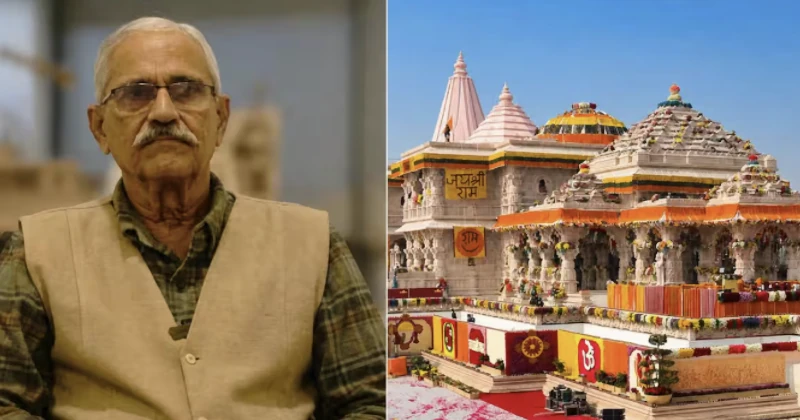
New Delhi: The story of the Shri Ram Mandir is not merely about the construction of a grand Mandir; it is the culmination of a centuries-long civilisational struggle, sustained by the sacrifices of countless Ram Bhakts and realised through unwavering national resolve. As this sacred institution enters a new phase of administration, the Shri Ram Janmabhoomi Teerth Kshetra Trust has entrusted its day-to-day functioning to a man who has been part of the Mandir’s journey from the very beginning.
Jagdish Aphale, an IIT Bombay alumnus, veteran Rashtriya Swayamsevak Sangh (RSS) swayamsevak and one of the key engineers behind the construction of the Ram Mandir, has been appointed as the first Secretary of the Shri Ram Janmabhoomi Teerth Kshetra Trust. His appointment, which will be formally ratified at the Trust’s executive meeting on September 2, comes at a crucial moment when the Trust is strengthening institutional mechanisms following the recent donation embezzlement case.
Significantly, long before assuming this responsibility, Aphale had shared with Organiser the meticulous vision behind the Ram Mandir project revealing how modern engineering, traditional Mandir architecture and Sanatan values were seamlessly woven together to create a timeless symbol of Bharat’s civilisational resurgence. Today, the engineer who helped build the Mandir has been entrusted with protecting its daily functioning.
For nearly four years, Jagdish Aphale remained one of the silent architects behind one of independent India’s most significant cultural projects.
A resident of Pune with decades of association with the RSS, Aphale holds a BTech in Electrical Engineering and an MTech from IIT Bombay. After an accomplished career with multinational companies across India, Europe and the United States, he returned to Bharat after retirement not to seek rest, but to dedicate his expertise to the construction of the Ram Mandir.
Working alongside a select team of senior engineers, Aphale supervised critical stages of the Mandir’s development, from the engineering of its foundation to the construction of the plinth and other major structural components. Since then, he has continued to stay in Ayodhya, residing at the Teerth Kshetra Bhavan while contributing to the Mandir’s evolving infrastructure.
His appointment as Secretary is therefore not merely administrative it is the natural continuation of a journey that began at the very foundations of the Mandir. Months before assuming his present role, Jagdish Aphale had spoken to Organiser about the extraordinary planning that lay behind the Ram Mandir.
As project manager overseeing pilgrim management, sculpture, iconography, archives and museums, Aphale explained that the Mandir comprises 392 exquisitely carved pillars, including 190 columns on the ground floor, each representing months of painstaking craftsmanship rooted in India’s ancient architectural traditions.
Among the Mandir’s most remarkable features, he revealed, is an architectural alignment that reflects the precision of Bharatiya Mandir science. “The columns are so made that every year on the day of Ram Navami, the rays of the sun will illuminate Bhagwan Ram’s forehead.”
The statement captured far more than engineering excellence it reflected the continuity of a knowledge tradition that has inspired Mandir architecture in Bharat for centuries. Aphale had also revealed that before finalising the Mandir’s pilgrim management system, the Trust undertook an extensive study of over 500 major Mandirs across the country.
The outcome was a scientifically designed yet devotee-centric system featuring four separate queues two for families, one for Divyang devotees and one for VIPs to ensure both order and accessibility.
According to interim General Secretary Krishna Mohan, Aphale’s name was proposed during the Trust meeting held on July 6 after the resignations of former General Secretary Champat Rai and trustee Anil Mishra.
While Aphale will not become a trustee, he will function as one of the Trust’s principal office bearers and oversee the day-to-day administration of the Ram Mandir, reporting directly to the interim General Secretary.
His responsibilities will include coordinating Mandir operations, supervising administrative processes and ensuring efficient management of the ever-growing number of pilgrims arriving in Ayodhya. Aphale’s appointment also signals the Trust’s determination to reinforce transparency and accountability following the donation theft case that came to light earlier this year.