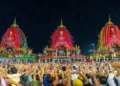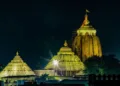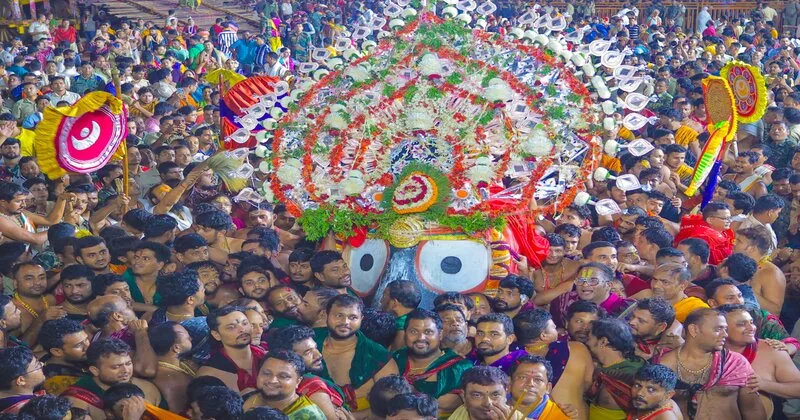
Bhubaneswar: The Rath Yatra of Mahaprabhu Jagannath reached its spiritual culmination with the observance of Niladri Bije on Monday night, marking the ceremonial return of the deities to the sanctum sanctorum of the Srimandir. The sacred ritual signifies the return of Mahaprabhu Jagannath, along with his elder brother Mahaprabhu Balabhadra and sister Devi Subhadra, on the revered Ratna Singhasan (jeweled throne).
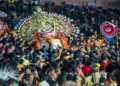
Despite intermittent rainfall and a delay of several hours in the ceremonial proceedings, lakhs of devotees gathered along the Grand Road (Bada Danda) and near the Singhadwara to witness this divine spectacle. The atmosphere remained charged with devotion, as chants of “Haribol,” ringing temple bells, and traditional ululations echoed through the holy city.
Devotees Brave Rain for Divine Darshan
The final phase of the Rath Yatra saw an overwhelming turnout of devotees, many of whom waited patiently for hours despite continuous rainfall. The delay in the Pahandi—the ceremonial procession of the deities—extended the emotional anticipation, intensifying the spiritual experience.
https://twittercom/JagannathaDhaam/status/2081848914836361599?s=20
As the deities began their return journey from the chariots to the temple, devotees expressed deep devotion, with many seen in tears of joy. The divine presence of Mahaprabhu Jagannath during Niladri Bije evoked a profound sense of fulfillment among the faithful, who departed with a promise to return next year.
Return to Ratna Singhasan After 27 Days
Niladri Bije marks the end of the deities’ 27-day annual sojourn outside the temple. During this period, the Ratna Mandap, empty without the deities, awaits the return of the sacred Daru Brahma. With the completion of the ritual, the deities are ceremoniously returned to the Ratna Singhasan, symbolizing the restoration of divine order.
— Shree Jagannatha Temple, Puri (@JagannathaDhaam) July 27, 2026
The 12-day-long divine leela (cosmic play) associated with the Rath Yatra concludes with this ritual, bringing an end to one of the most significant religious festivals in India.
Rituals Begin with Sandhya Dhupa and Charamala
According to temple sources, the Niladri Bije rituals commenced following the Sandhya Dhupa (evening offering). Special wooden ramps, known as Charamalas, were attached to the chariots to facilitate the descent of the deities.
Servitors performed Pushpanjali (floral offerings) and Doralagi rituals on the chariots before initiating the Pahandi procession. The ceremonial movement of the deities was accompanied by the sound of traditional instruments and bugles played by Kahalia servitors.
Sequential Pahandi Procession of Deities
The Pahandi procession followed a traditional sequence. Shri Sudarshan, Mahaprabhu Balabhadra, and Devi Subhadra were carried first and placed on the Ratna Singhasan. This was followed by the ceremonial procession of Mahaprabhu Jagannath, which took place late at night after a delay of nearly four hours.
Earlier in the day, the deities had observed Pahuda (rest) on their respective chariots around 3:00 AM. Morning rituals, including Mangala Alati, were completed by 8:00 AM, while Barabandha and other preparatory rituals were concluded by the evening.
Discord and Reconciliation between Mahaprabhu Jagannath and Maa Lakshmi: A Symbol of Divine Emotion
One of the most significant and emotionally resonant aspects of Niladri Bije is the symbolic ritual depicting the discord and reconciliation between Mahaprabhu Jagannath and Maa Lakshmi.
According to tradition, Maa Lakshmi expresses her displeasure at being left behind during the Rath Yatra. As part of this ritual, the temple gates at the Singhadwara are symbolically closed, preventing Mahaprabhu Jagannath from entering.
This dramatic enactment reflects the Lakshmi-Narayana Kalaha, a traditional verbal exchange between the divine couple, representing human emotions such as love, pride, longing, and reconciliation.
Hera Panchami and Lakshmi’s Symbolic Protest
The roots of this ritual trace back to Hera Panchami, when Goddess Lakshmi visits the Gundicha Temple in a palanquin to bring Mahaprabhu Jagannath back. However, the Mahaprabhu neither returns nor grants her an audience, leading to her symbolic act of damaging a portion of the Nandighosha chariot.
This act signifies her displeasure and emotional distress, which continues until Niladri Bije. Upon the Lord’s return, she again expresses her anger by ordering the temple doors to be shut.
Rasgulla Offering Seals Reconciliation
The impasse between the divine couple is resolved through a gesture of humility and affection. Mahaprabhu Jagannath offers Rasgulla to Goddess Lakshmi as a token of apology and reconciliation.
The Rasgulla, specially prepared in a purified manner, is considered a symbol of love and peace. Pleased by the offering, Goddess Lakshmi forgives the Mahaprabhu and orders the reopening of the temple gates, allowing him to re-enter.
Notably, Niladri Bije is the only occasion in the year when Rasgulla Bhoga is offered within the Srimandir, adding cultural and devotional significance to the ritual.
Massive Devotee Participation and Spiritual Fervour
Lakhs of devotees gathered in and around the temple premises to witness the Niladri Bije rituals. The Singhadwara area remained densely packed with devotees throughout the evening and night.
The entire event unfolded under tight security arrangements and meticulous coordination by temple authorities and administration, ensuring a peaceful conclusion to the festival.
A Festival Rooted in Devotion and Human Emotions
Niladri Bije is not merely a ritualistic conclusion to Rath Yatra but a profound spiritual narrative that reflects human emotions through divine symbolism. The episode of discord and reconciliation between Mahaprabhu Jagannath and Goddess Lakshmi resonates deeply with devotees, conveying timeless values of love, patience, humility, and forgiveness.
As the deities return to their celestial abode, devotees carry back memories of divine darshan and spiritual fulfillment, eagerly awaiting the next Rath Yatra.
Awaiting the Mahaprabhu’s Return Next Year
With the completion of Niladri Bije, the curtains fall on this year’s Rath Yatra, leaving behind a trail of devotion, emotion, and spiritual awakening. The Grand Road gradually empties, but the faith of devotees remains unwavering.
As Mahaprabhu Jagannath resumes his place in the Srimandir, lakhs of devotees bid farewell with folded hands and hopeful hearts, looking forward to the divine journey once again next year.