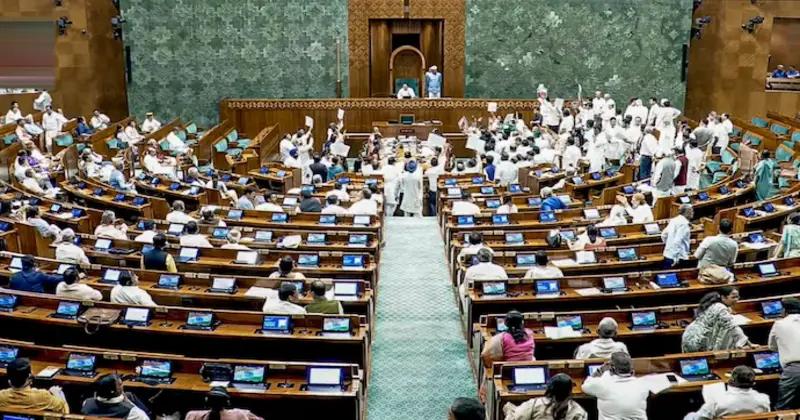
I waited for one full week before writing this article. Like crores of Indians, I waited for the monsoon session of Parliament to function properly and debate the key issues, policy framework and law-making in the interest of the nation. The first week of the current session of the Parliament (July 20 to August 13, 2026) has seen multiple disruptions, which means that one fourth of the session has been largely underutilised.
The disruption of the parliamentary proceedings by the opposition parties in India has been a disturbing pattern now. Somehow no satisfactory arrangement has been made to ensure that the Parliament functions smoothly and without unnecessary disruptions. India’s Parliament has had a glorious record and it is therefore painful to see this temple of democracy denigrated to shouting of slogans, unruly conduct and frequent walkouts.
I am sure that the members of the Constituent Assembly that framed the Indian Constitution and particularly Dr. B.R. Ambedkar as Chairman Drafting Committee would not have visualised this pattern of frequent disruption in the parliament proceedings. Here I quote his famous words a day prior to the adoption of the Constitution on November 25, 1949, “…. Because I feel, however a good a constitution may be, it is sure to turn out bad because those who are called to work it, happen to be a bad lot. ……..” Parliament is the supreme legislative body of India.
Without casting any aspersions and with due regard to all the parliamentarians, I feel that the Parliament has to exhibit very high degree of seriousness to show that it functions properly. It has to demonstrate to not only we the Indians but also to the world that India is a practicing democracy and its Parliament runs the country through law, debate and accountability.
As a military man, I am trained to look for solutions to a problem. I found the concept of Contempt of Court while researching the subject. Contempt of Court refers to any act or omission that disrespects the authority, dignity or functioning of the judiciary or obstructs the administration of justice. Article 129 of the Constitution empowers the Supreme Court to punish for contempt of itself.
Article 215 grants similar powers to the High Courts to punish for contempt of themselves. The Law Commission of India has periodically reviewed the Contempt of Courts Act, 1971 to balance judicial authority with freedom of expression. Simply put, contempt of court is a statutory tool to preserve judiciary’s authority and ensure compliance with its orders.
I also came to know that contempt powers are exclusive to the judiciary and are not available to other institutions such as the Parliament or state assemblies. Parliament and the State Legislatures have parliamentary privileges under Article 105 (for Parliament) and under Article 194 (for State Legislatures). These articles allow them to punish for breach of privilege or disorderly conduct.
These provisions are meant to let legislatures function independently and maintain order inside the House. It is a fact that the Parliament or the State Legislatures have found deterrence modes like suspension or expulsion largely ineffective. On the contrary, contempt of courts has been found to be an effective tool to enforce the court directions. Simply put, contempt of court is taken seriously by all concerned.
Time has come now for the lawmakers to make tougher laws for themselves, where frequent and planned disruptions of session tantamount to Contempt of the Parliament. The new law or act should establish propotionate punishment for disrupting the Parliament(or State Legislature) without necessary and sufficient reasons. There are many studies and reports that have recommended measures to make Parliament’s functioning smooth and disruption free. Parliament itself is now mulling a new code of conduct to prevent display of placards and members rushing to the Well.
Vidhi Centre for Legal Policy-Disruptions in the Indian Parliament, 2016 is the most cited study on the issue. PRS Legislative Research, did a study of Parliament’s functioning in the last 70 years. All these studies are good but possibly shy of suggesting a strict law like the Contempt of Court for the Parliament. The frequent disruptions by the opposition have virtually made it tough to run the Parliament (particularly the Lok Sabha) smoothly. We do not want a situation where the Parliament (or State Legislatures) lose the faith of the people, particularly its youth.
