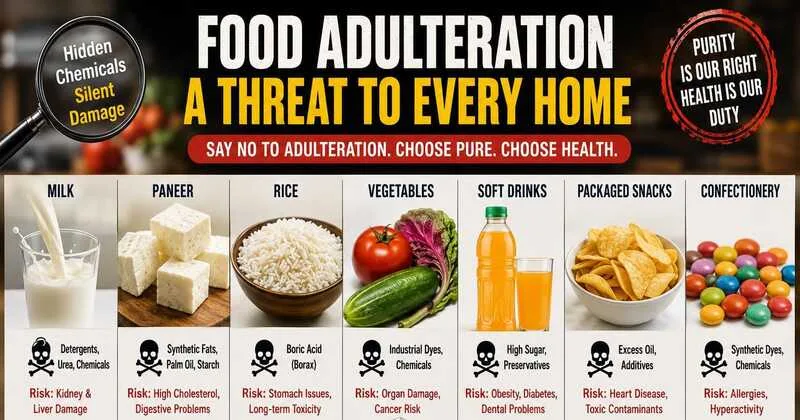
The alarming issue of widespread food adulteration across Bharat directly highlights a deep-seated crisis in our market accountability and law enforcement. While hard-working Indian consumers pay full price expecting quality goods, irresponsible businesses and illicit suppliers exploit regulatory gaps to dump hazardous, chemically tainted products into our kitchens. Under the current administrative push, figures from the Food Safety and Standards Authority of India (FSSAI) reveal a stern reality: out of 1,65,747 food samples tested nationwide through the third quarter of the 2025–26 fiscal year, 17.16% failed standard checks. Driven by a mandate for consumer safety and strict market discipline, national enforcement agencies have responded with immediate legal penalties, license cancellations, and sweeping crackdowns to dismantle these unpatriotic networks that profit at the expense of public health.
This report focuses on commonly consumed food items that are mixed with hazardous chemicals, how these adulterants are used, the risks they pose to public health, and how consumers can identify and avoid them.
Enforcement Agencies Smashing Synthetic Milk Networks to Protect National Health
An investigation by police and FDA authorities in Maharashtra’s Bhum taluka exposed an unpatriotic synthetic milk racket operating between January and June 2026. Criminal elements utilised over 2.3 lakh kilograms of low-quality milk powder alongside dangerous industrial detergent, palm oil, and synthetic chemicals to manufacture approximately 23.04 lakh litres of fake milk. By adulterating every 100 litres of pure milk with 10 litres of this hazardous mixture, an estimated 2.3 crore litres of dangerous supply compromised local markets. Government regulators have intensified criminal proceedings to halt these illicit networks that inflict liver damage, kidney dysfunction, and severe digestive risks on vulnerable citizens, including children, pregnant women, and the elderly.
State Authorities Crack Down on Unsafe Industrial Analogue Paneer
During a statewide safety campaign, the Maharashtra FDA took firm action against unsafe non-dairy substitutes, revealing that nearly 40 per cent of tested “analogue paneer” samples were unfit for human consumption. Unscrupulous manufacturers have been substituting traditional dairy with synthetic factory blends composed of cheap vegetable fats, palm oil, starches, and chemical additives. Regulatory bodies are strengthening oversight against these harmful substitutes, which trigger digestive distress, elevate bad cholesterol through hidden trans fats, and present long-term risks to kidney and liver health.
Strict Surveillance Targets Dangerous Insecticide Application in Rice Mills
State monitoring systems have identified illicit preservation methods used by irresponsible rice millers who apply industrial boric acid powder (borax) directly to raw grain stock to prevent insect infestations and extend shelf life. Enforcement bodies are advising consumers on thorough washing techniques-vigorously scrubbing grains five to seven times under running water-while moving to hold negligent suppliers accountable for introducing toxic chemical insecticides into daily household diets.
Nationwide Bans Enforced Against Non-Permitted Industrial Dyes in Produce
Food safety inspectors are clamping down on rogue vendors caught applying forbidden industrial dyes like Auramine O and Metanil Yellow to artificially brighten roasted gram (bhuna chana). Because these non-permitted synthetic dyes carry severe risks of stomach pain, internal irritation, liver damage, and potential carcinogenic effects, regulatory agencies are conducting targeted seizures to eliminate hazardous textile chemicals from public food supply chains.
Demanding Standardised Global Quality from Multinational Food Giants
Consumer advocacy bodies and regulators are pressing Western multinational corporations to end discriminatory product formulations for Indian citizens. Products like Horlicks sold by Hindustan Unilever in India contain high levels of added sugar, liquid glucose, and synthetic additives compared to the whole-grain, low-sugar formulations distributed in European markets, prompting calls for strict compliance with national nutritional standards.
Eliminating Cheap Saturated Oils from Global Noodle Brands
Regulators are challenging corporate practices that rely heavily on low-grade palm oil for domestic food production while providing superior vegetable oil blends overseas. Nestlé’s Indian variant of Maggi instant noodles relies on refined flour and a heavy 80 per cent palm oil fat profile, contrasting sharply with the health-conscious oil blends supplied to Western nations, reinforcing the need for strict national regulations that mandate high-grade ingredients.
Safeguarding Infant Health Against Double Standards in Baby Food
Health authorities are addressing corporate double standards following laboratory disclosures showing that Nestlé’s Cerelac infant cereal sold in India contains added sugar, whereas identical products distributed across Europe and the UK remain completely sugar-free. National enforcement agencies continue to align infant nutrition guidelines to prevent foreign brands from exposing Indian infants to unnecessary sugars and early metabolic risks.
Wholesale Raids Seize Chemically Dyes Vegetables in Local Markets
State food safety teams in Assam conducted swift enforcement raids at the Barpeta Road wholesale market, seizing suspected chemically treated produce following reports of vendors using illegal industrial dyes. Experts warn that unauthorised substances like Malachite Green and Copper Sulfate-used illegally to make spoiled vegetables look fresh-cause acute toxicity and organ damage, driving state authorities to increase market surveillance and apprehend lawbreakers.
Transparency Mandates Enforced for Commercial Sugar Drinks
Regulatory bodies are increasing scrutiny over commercial fruit beverages like Frooti that market heavily to families while containing minimal fruit pulp and high levels of added sugar. With a single 250ml pack containing nearly 30 grams of sugar alongside preservatives like Sodium Benzoate and artificial colouring, health agencies are enforcing clearer label disclosures to protect citizens from hidden sugar burdens, insulin resistance, and dental health hazards.
Stricter Industrial Hygiene Standards Mandated for Fruit Processing Plants
Following public outcry over social media footage revealing degraded raw materials and poor sanitary conditions in commercial drink processing, state authorities are enforcing rigorous hygiene standards across manufacturing units. Regulators are increasing factory inspections to ensure commercial processors do not rely on excessive chemical additives, acidity regulators, and artificial flavours to mask low-quality raw produce.
Confronting Ingredient Inequalities in Global Soft Drink Brands
Health policy experts continue to highlight stark formulation differences in global soft drink brands, such as India’s variant of Fanta containing 137 grams of sugar per bottle alongside artificial colours and zero real fruit juice, compared to European variants made with 5 per cent real citrus juice, natural extracts, and significantly less sugar. Strict consumer protection frameworks are being applied to compel global manufacturers to upgrade nutritional profiles for domestic consumers.
Restrictions Placed on High-Caffeine Energy Drinks Near School Zones
The FSSAI issued formal notices against high-caffeine beverages like Sting Energy Drink over misleading health claims and excessive synthetic additives, including the Azo dye Carmoisine. To protect public health and youth well-being, government authorities in Maharashtra implemented strict sales restrictions around educational institutions, curtailing access to beverages that induce rapid heartbeats, anxiety, and hyperactivity in children.
Curbing High-Temperature Processing Contaminants in Mass-Market Snacks
Health agencies are raising public awareness regarding ultra-processed commercial snacks, such as packaged potato chips that absorb 30 to 35 per cent oil during high-temperature frying. Beyond high sodium content and cardiovascular risks from bad cholesterol, authorities highlight the formation of toxic processing contaminants like acrylamide, urging citizens to choose traditional, minimally processed domestic alternatives.
Pressuring Foreign Snack Manufacturers to Upgrade Processing Oils
Consumer watchdogs continue to challenge foreign corporate entities like PepsiCo for utilising palmolein oil with high saturated fat content in domestic Lay’s potato chips, while supplying lower-saturated-fat sunflower oil formulations to Western markets. National standards bodies are encouraging the adoption of healthier domestic oil alternatives to protect long-term public cardiovascular health.
Stringent Labelling Regulations Enforced on Synthetic Confectionery Dyes
Food safety authorities are maintaining strict oversight on commercial confectionery like Cadbury Gems, which contains multiple synthetic petroleum-derived dyes including Tartrazine, Sunset Yellow, and Erythrosine. With European regulators banning specific additives like Titanium Dioxide due to safety concerns, Indian authorities continue to enforce strict safety thresholds and mandatory disclosures to protect young children from potential hyperactivity and allergic sensitivities.
Advocating Better Nutritional Ingredients in International Confectionery
Regulatory experts are focusing on ingredient inequalities in international snack products like Mondelez’s Oreo cookies, which use hydrogenated palm oil containing 50 per cent saturated fat in domestic formulations while blending healthier rapeseed oil for European distribution. Food safety advocates continue to press for elevated manufacturing standards that prioritise healthier vegetable fats over cheap industrial substitutes.
Clamping Down on Misleading Marketing in Consumer Personal Care Products
Consumer protection authorities are acting against misleading commercial claims in the personal care sector, where products marketed as “100% Pure” coconut hair oil are found to contain liquid paraffin (mineral oil), synthetic fragrance allergens, and chemical preservatives like TBHQ. Regulatory agencies are enforcing strict truth-in-advertising guidelines to prevent corporate brands from deceiving buyers with deceptive label claims.
These widespread violations reveal how predatory commercial interests and rogue supply networks have compromised the sanctity of India’s daily food supply at the expense of national health and trust. However, through aggressive FSSAI enforcement, decisive state raids, and strict regulatory overhauls, the government is taking uncompromising action to purge hazardous chemicals from our markets and hold non-compliant multinational corporations accountable. Eradicating adulteration is fundamentally a matter of national integrity, and upholding uncompromising standards of purity is essential to protecting Indian households, securing public well-being, and establishing absolute discipline across the national economy.