From Most Backward States to Hilly States the Image of Investment is Changing
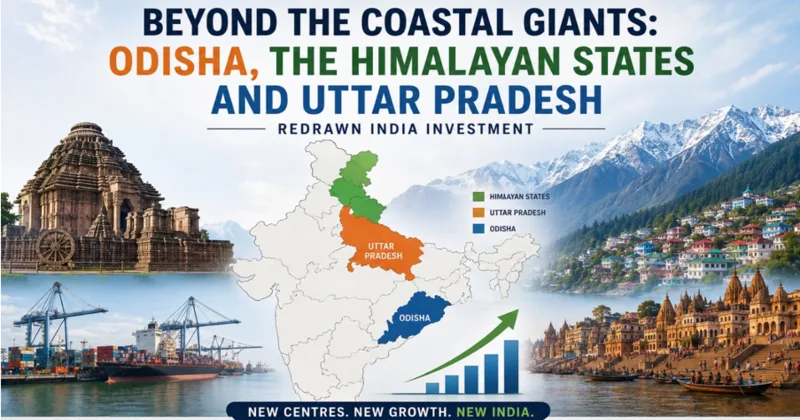
The most telling stories in India’s development are not found at the very top of the table but in the layers beneath it, where eastern India, the Himalayan states and the Hindi heartland are quietly rewriting assumptions about where capital belongs. Drawing on the voices of more than 1,850 investors gathered on the ground, the report on state profiles reveals a new investment geography taking shape far beyond the familiar western and southern corridors.
Odisha entry into the top-performer club of the investment index is clearest signal of the East’s rise. The state ranks first in the country in metallic mineral production and coal production. Its accounting for 50 per cent and 23 per cent of India’s output respectively as of fiscal 2024 and industry contributes a commanding 50.8 per cent of its gross value added. More supportive is its balance sheet total outstanding liabilities of 16 per cent of GSDP and interest payments of just 1.38 per cent of GSDP are both the lowest among all states, earning it third place on the financial health pillar. The report is candid about the gaps too where warehousing capacity of 98,000 tonnes sits well below the 4.7 lakh-tonne state average and FDI equity inflows slipped to around 9 million dollars in 2024. Investors want faster environmental clearances and a sharper single-window system. Yet the foundational resources plus fiscal rectitude is one most state would envy.
Terrain has long been treated as destiny for the hill states. Uttarakhand leads the hilly and northeastern category and stands eleventh nationally, powered by human capital where it records the highest share of workforce entrants as a percentage of population in its category, bank credit to industry 66 per cent above the category average and 1,637 patent filings in 2024 28 per cent above the pan-India average.
Assam follows closely, its ascent built on prudence and people interest payments contained at 2.8 per cent of GSDP and an average of 18 per cent of the budget devoted to education between fiscals 2019 and 2024, against a category norm of about 12 per cent. Himachal Pradesh completes the trio with a labour force participation rate of 63.3 per cent, a women worker population share of 62.3 per cent, and a cybercrime rate of merely 1.12 offences per lakh population, roughly 45 per cent below its category average. Nari Shakti, quite literally, is powering the hills.
Deeper in the Northeast, Tripura’s score of 45.0 lifts it into the frontrunner category is a proof that the region’s momentum extends well beyond the Brahmaputra valley, while Uttarakhand’s single-window online platform, which processes all government-related paperwork within short timeframes, has become a template its neighbours are studying.
Among city states and Union Territories, Goa demonstrates that scale is no precondition for excellence. Despite contributing just 0.35 per cent of India’s GDP, the state commands 3 per cent of national port capacity and, through its two international airports, 3 per cent of national airport capacity.
A quarter of its higher-education enrolment is in STEM courses, the highest in its category and it runs the highest share of renewables in its power mix across all states and Union Territories, with transmission and distribution losses of only about 7 per cent. The state also records the highest spending on skilling and healthcare as a percentage of GSDP and ranks first among Union Territories and city states in vocational training capacity with investments in human capital that explain why it tops both the resources and regulatory ease pillars in its category.
For the country’s most populous state, Uttar Pradesh capital expenditure rose from 8 per cent of GSDP in fiscal 2019 to 13 per cent in fiscal 2024, about 40 per cent above the large-state average while registered startups multiplied from 807 to 3,426 over the same period. The state now accounts for the largest share of India’s access-controlled expressway network, hosts 955 Atal Tinkering Labs (the third-highest nationally) and drew investor praise for policy stability sustained across political cycles, railway and airport facilities, and warehouse permits cleared in Greater Noida in as little as 15–20 days.
The unfinished agenda is equally clear the air quality of 200–300 AQI across Noida, Ghaziabad and other industrial belts, interest payments 13 per cent above the large-state average, and investor calls to spread industrial parks beyond Noida to cities like Kanpur. With FDI inflows of 333.61 million dollars in fiscal 2024, a readily available and diverse workforce, and food processing and electronics anchoring its industrial base, the state’s profile reads like that of a top performer in waiting provided it can retain talent currently migrating from cities such as Kanpur towards the National Capital Region and upgrade its industrial-grade power supply, where investors flagged frequent outages and high transmission losses.
At the base of the ladder sit the aspiring states, where scores trail below 40 are Mizoram (39.9), Arunachal Pradesh (37.5), Dadra and Nagar Haveli and Daman and Diu (37.1), Sikkim (36.6), Manipur (32.3), the Andaman and Nicobar Islands (30.2), Ladakh (27.0) and Lakshadweep (24.5). The index treats them not as laggards but as the next frontier of cooperative federalism, every profile pairs weaknesses with replicable best practices from peers, from RFID gate systems at container depots to feeder segregation for industrial power. If the 2026 edition establishes anything, it is that India’s investment story is no longer a two-coast affair. The mineral East, the skilling hills and the expressway heartland are all claiming their place in the Viksit Bharat arc and the next edition of this index may look very different because of it.
