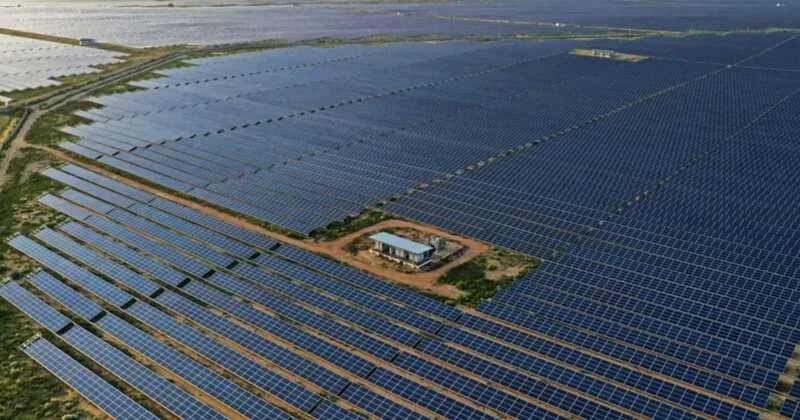
Twenty-five years ago, solar power was a curiosity in India, not a source of energy or strategy. Today it is the single fastest-growing pillar of the country’s power system, and India has climbed from a rounding error in global rankings to the world’s third-largest solar market, trailing only China and the United States on cumulative installed capacity and in 2025, overtaking the US outright in the volume of new capacity added in a single year.
This is not an incremental improvement. It is a structural repositioning of India within the global energy order, and the data laid out year by year tells the story better than any other.
The World in 2025: Who Leads the Solar Race
Global solar photovoltaic capacity crossed a historic threshold in 2025, reaching approximately 2,383 GW worldwide, with roughly 510 GW added in the year alone, where more capacity was installed in twelve months than existed on the entire planet as recently as 2018. China remains the dominant force, alone accounting for around 1,200 GW of cumulative capacity, more than the next nine countries combined and adding close to 382 GW in 2025. But the data below the summit is where India’s rise becomes visible:
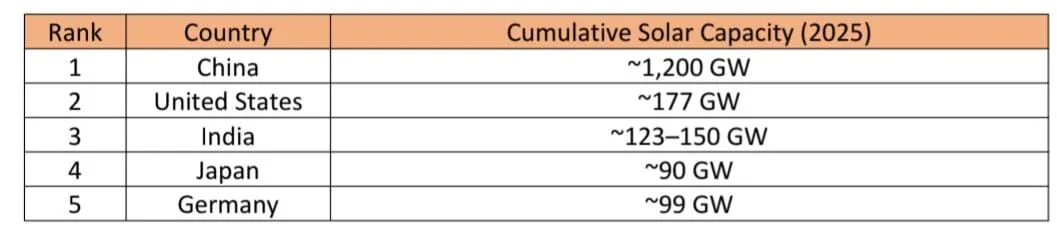
India has already overtaken Japan and Germany, two economies that led global solar deployment through the 2000s and early 2010s, to claim third place in the world. More strikingly, when it comes to new capacity added during 2025 rather than cumulative stock, India pulled ahead of the United States for the first time, becoming the world’s second-largest solar market by annual installation, with China’s 2025 additions running at roughly eight times India’s.
India Solar Journey: Two Decades from Negligible to Formidable
To appreciate the scale of this shift, the year-by-year trajectory needs to be seen in full:
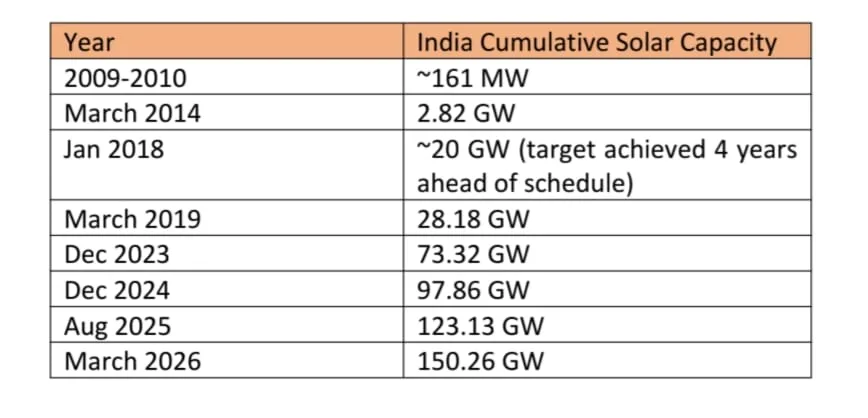
At the turn of the millennium and for most of the 2000s, India’s solar capacity was effectively negligible, with a few isolated pilot and off-grid installations; after 2020, its near appearing in any global ranking table. The real inflexion point came with the launch of the National Solar Mission in January 2010, which set the country on a mission-mode path rather than leaving solar to incidental growth.
The pace through the first mission phase was modest by later standards. It was the revision of the national target in 2015, scaling ambition from 20 GW to 100 GW of solar capacity by 2022, backed by a planned investment of $100 billion that changed the trajectory altogether. What followed was not linear growth but compounding acceleration: capacity that took nearly four years to cross 3 GW after 2014 needed barely two years to add the next 20 GW and by FY 2025-26, a single year alone contributed a record 44.61 GW of new solar capacity more than double the previous year’s addition and itself larger than the country’s entire cumulative capacity as recently as 2020.
If we put it another way, the solar capacity has grown roughly 53 times over since March 2014 alone, from 2.82 GW to over 150 GW in barely a decade, a rate of expansion with few parallels among large economies.
Why India Is Closing the Gap, Not Just Growing
Three structural shifts explain why India’s rise is a genuine competitive gain rather than simple scale-catching-up:
First: India overtook the US in annual new capacity for the first time in 2025. This matters more than cumulative rank, because it signals the trajectory going forward. The United States added roughly 38 GW of solar in 2024; India’s FY 2025-26 addition of 44.61 GW comfortably exceeds that pace, even before accounting for further US slowdowns linked to shifting federal incentive structures.
Second: the composition of India’s growth has diversified. Of the 150.26 GW installed as of March 2026, roughly 110.43 GW is utility-scale, 25.73 GW is rooftop solar, and 14.10 GW comes from PM-KUSUM and off-grid agricultural applications. This is not a story of a handful of giant desert solar parks alone as China’s growth largely is, but of a base broadening simultaneously across utility plants, commercial and residential rooftops and farm-level solar pumps, thus making the growth more resilient to disruption in any single segment.
Third: India is building the manufacturing base to match the installation base, a distinction few rapidly-growing solar markets achieve simultaneously. Roughly 98 GW of solar module manufacturing capacity was added in FY 2025-26 alone, taking India’s cumulative module production capacity to around 172 GW, with some industry estimates placing it closer to 210 GW. As a direct consequence, India’s solar module imports fell roughly threefold between FY 2024-25 and FY 2025-26. This is the Aatmanirbharta dimension of the solar story where India is not merely importing panels to hit installation targets, as many fast-growing markets do, but is simultaneously localising the supply chain that feeds them.
The Policy Architecture Behind the Numbers
None of this scale materialised by luck. A sequence of policy interventions underlies each phase of acceleration: The Jawaharlal Nehru National Solar Mission (2010) provided the initial institutional push. The 2015 target revision to 100 GW by 2022 forced a step-change in ambition. Fifty solar parks of 500 MW-plus capacity each were rolled out to provide developers with pre-cleared land and evacuation infrastructure, removing one of the biggest execution bottlenecks that slows renewable projects elsewhere. The PM-KUSUM scheme extended solar directly to the agricultural sector, decentralising benefits to farmers rather than concentrating them in utility-scale plants alone.
And most recently, the PM Surya Ghar: Muft Bijli Yojana, targeting one crore rooftop solar installations, has pushed adoption into the residential segment at a scale few other countries have attempted. On the manufacturing side, production-linked incentive schemes for solar module and cell manufacturing directly targeted the import-dependency that had long been India’s Achilles heel a dependency now visibly shrinking, as the collapse in module imports demonstrates.
The Gap That Remains and Why It Still Matters
None of this should be thought of as India having closed the gap with China, which remains in a category of its own: its cumulative capacity is still roughly eight to ten times India’s and its single-year addition in 2025 exceeded India’s entire installed base. China’s dominance in solar manufacturing, particularly in polysilicon and wafer production, also remains structurally unmatched and global supply chains will continue to run through Chinese capacity for years regardless of India’s own manufacturing build-out.
But the comparison that matters strategically is not with China’s scale, which reflects a different economic model and decades of earlier industrial planning, but with India’s own historical trajectory and its immediate competitors the US, Japan and Germany. On that comparison, the shift is unambiguous: a country that had no meaningful presence in global solar rankings twenty-five years ago has overtaken two G7 economies in cumulative capacity and pulled ahead of the world’s largest economy in annual new installations, within a single decade of sustained policy focus.
The global solar race of 2025 is not simply a story of China extending its lead. Beneath that headline lies a genuine reordering of the rest of the field, and India sits at the centre of that reordering. From 161 MW in 2010 to over 150 GW by early 2026, from complete absence in the top ten to third place globally; from near-total import dependence to a rapidly localising manufacturing base, the trajectory is one of a country that identified a strategic opportunity and executed on it with a consistency rare in large, diverse economies.
The distance to China remains vast, and the road to India’s own 2030 non-fossil targets is not yet complete. But on the question posed at the outset, is India winning the global solar race? The twenty-five-year data record leaves little room for ambiguity.