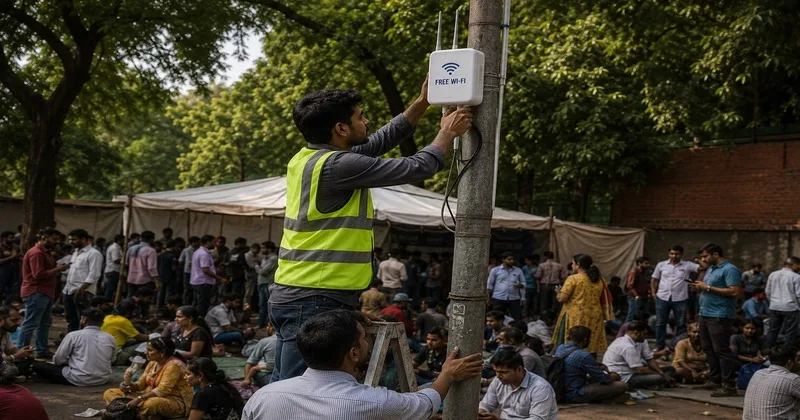
New Delhi: There are reports of Free Wi-Fi is being installed at Delhi’s Jantar Mantar protest site, allowing protesters to remain connected through an alternative internet network amid the temporary suspension of mobile internet services in the surrounding area. The Internet services were suspended amid the violence against the police and security personal.
Multiple videos on X suggest that a local company has been assigned to set up the Wi-Fi for the Protesters. The staff of the company was seen installing the cables and technical devices for the free wi-fi.
Wifi is already installed by a company at Jantar Mantar.
People there are using BRIDGEFY app which can be used for communication without any data or network https://t.co/Zaj2OcHzv2
— Paramjeet Singh Berwal (@ParamjeetBerwal) July 23, 2026
The Wi-Fi facility is being set up at the protest venue as demonstrators continue their agitation against Union Education Minister Dharmendra Pradhan over alleged examination irregularities. The arrangement is expected to provide protesters with uninterrupted digital access, enabling them to communicate, coordinate activities, share updates on social media and stay connected with supporters.
This comes after the Union Ministry of Home Affairs (MHA) directed telecom service providers to suspend mobile internet services within a 1.5-kilometre radius of Jantar Mantar till midnight. The decision was taken amid concerns over public safety and maintaining law and order during the intensifying protest.
Government stepped in when the protesters were circulating misinformation, inflammatory and misleading contents as part of their strategy to drive in more people to the protest site. As part of this they rolled out a temporary restriction aimed at preventing the misuse of mobile internet services.
While mobile data services were restricted in the notified area, the installation of Wi-Fi at the protest venue has ensured that participants continue to have access to internet connectivity within the protest site. The activity has also raised concerns.
Offline Bluetooth mesh apps like Bridgefy & Briar at protest area?
Despite complaints from protesters about signal blocking and intermittent data shutdowns, message exchanges have continued within densely packed crowd areas. Delhi Police units responsible for investigation and digital intelligence are examining the use of offline messaging applications that enable communication without cellular networks or an active internet connection.
Unlike mainstream messaging apps such as WhatsApp, Telegram and Signal, which rely on mobile networks and internet connectivity, offline messaging apps use short-range wireless technologies like Bluetooth and Wi-Fi Direct to transmit messages.
In crowded locations such as Jantar Mantar, every smartphone running these apps acts as a relay point. If the intended recipient is beyond Bluetooth’s typical range of around 100 metres, the message is passed from one nearby phone to another until it reaches its destination, creating a mesh network that functions without cellular service or internet access.
Among the offline messaging platforms drawing attention are Bridgefy, Briar and Bitchat.
Mobile Internet Suspended Around Jantar Mantar
On July 25, the Union Ministry of Home Affairs directed telecom service providers to suspend mobile internet services within a 1.5-kilometre radius of Jantar Mantar from 4 pm to midnight as a necessary security measure in view of the escalating law-and-order situation caused by the Cockroach Janata Party (CJP) protest.
The restrictions reportedly extended to surrounding areas, including up to Mandi House Metro station, due to credible intelligence of potential misuse of internet services to coordinate violence and spread unrest. Following an advisory issued by the New Delhi Traders Association (NDTA) based on instructions from NDMC, shops, offices, and restaurants in Connaught Place were asked to close by 6:30 pm to safeguard public and private property from possible damage by unruly protesters.
The so-called youth-led CJP, which has been staging a disruptive protest at Jantar Mantar since June 6 demanding the resignation of Union Education Minister Dharmendra Pradhan, has repeatedly shown scant regard for law and order. The agitation took an ugly turn on July 20 during their ‘Sansad Chalo’ march. Protesters allegedly breached security barricades, violated prohibitory orders, indulged in stone-pelting, and damaged public property.
Several police personnel were injured while trying to control the violent mob. Vehicles and government property were also reportedly damaged in the chaos. In response to this deliberate attempt to create anarchy in the heart of the national capital, authorities had no option but to impose stricter security arrangements, including temporary mobile internet suspension and movement restrictions.