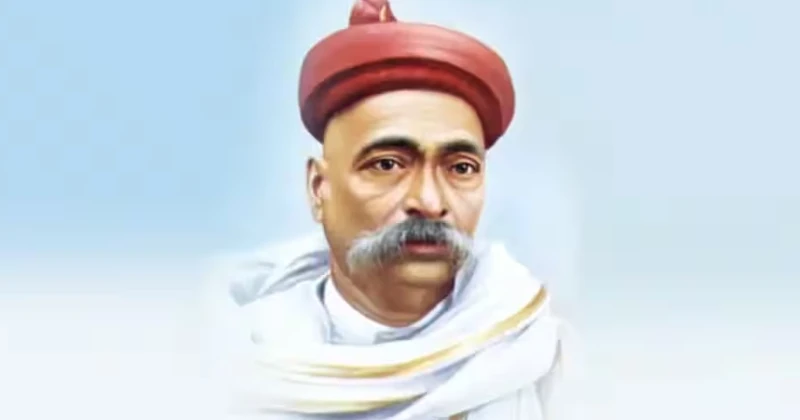
July 23 is remembered in Indian history as the birth anniversary of a great national figure who gave new energy, a new direction and a new political consciousness to India’s freedom struggle. This is the birth anniversary of Lokmanya Bal Gangadhar Tilak.
Tilak was not merely a freedom fighter. He was a great nationalist thinker, fearless journalist, teacher, pioneer of social awakening, political leader and an accomplished strategist of mass movements. He ensured that India’s freedom struggle did not remain confined to political platforms and public meetings but became deeply connected with the everyday lives of ordinary Indians.
He instilled in the people of India the belief that British rule was not permanent and that they could shape their own destiny. He created the self-confidence among Indians that was so desperately needed during the early phase of the freedom struggle.
His famous declaration:
“Swaraj is my birthright, and I shall have it.”- became a powerful mantra of India’s freedom movement and awakened the desire for independence in the hearts of millions of Indians.
A Great Pioneer of Nationalist Consciousness
Lokmanya Tilak was born on July 23, 1856, in Ratnagiri, Maharashtra. His full name was Keshav Gangadhar Tilak. From an early age, he was known for his intelligence, forthrightness and strong sense of self-respect.
His personality was deeply influenced by education, Indian culture and national consciousness. He believed that the true strength of any nation lies in the awareness and consciousness of its people.
When India was under British rule, Indian society was politically weak and divided. British policies had created a sense of inferiority among Indians. In such circumstances, Tilak taught Indians to take pride in their history, culture and capabilities.
His nationalism was not limited merely to opposition to British rule. He wanted the people of India to become self-reliant, educated, organised and conscious of their rights.
For him, nationalism meant:
Love for the nation, awareness of one’s rights and a spirit of sacrifice for the national interest.
Education as the Foundation of Nation-Building
Lokmanya Tilak believed that the freedom of any nation could become permanent only when its citizens were educated and aware.
He did not consider education merely a means of obtaining employment. For him, the purpose of education was to build character, develop national consciousness and cultivate a sense of social responsibility.
Along with his associates, he made significant efforts in the field of education. He believed that India’s education system should give due importance to Indian history, culture and national pride.
In his vision, a truly educated person understood the problems of society and the nation and actively participated in finding solutions to them.
Today, as India is rapidly progressing in the fields of knowledge, technology, innovation and skills, Tilak’s philosophy of education has become even more relevant.
His message to today’s youth is clear:
Earning a degree is not enough; education must be connected with life, society and nation-building.
Journalism: Tilak’s Nationalist Revolution
One of the most important chapters of Lokmanya Tilak’s nationalist struggle was his contribution to journalism.
In 1881, he founded the Marathi newspaper Kesari and the English newspaper The Mahratta. At that time, journalism was not merely a means of providing information. It was a powerful instrument for political awareness and public awakening.
Through his journalism, Tilak criticised the policies of British rule and made Indians aware of their rights.
His pen was fearless. He never hesitated to question those in power. By connecting journalism with public and national interests, he demonstrated that the greatest strength of a journalist lies in independent thinking, commitment to truth and concern for society.
His journalism provided an important ideological foundation to India’s freedom movement. Kesari was not merely a newspaper; it became a powerful platform for nationalist consciousness.
Tilak’s journalism continues to offer an important lesson to journalists today: the fundamental duty of journalism is not to promote those in power, but to bring the issues of society to the forefront and strengthen the voice of the people.
Public Ganesh Festival: From Culture to National Awakening
One of Lokmanya Tilak’s greatest strengths was his extraordinary ability to organise and unite people.
He transformed the public celebration of the Ganesh Festival into a social and national platform. During British rule, there were various restrictions on public political gatherings of Indians. Tilak connected Indian culture and religious traditions with social unity and national awakening.
Through the Ganesh Festival, people from different sections of society began coming together. Cultural programmes, speeches and social activities became important means of spreading national consciousness.
Tilak’s objective was not merely to organise a religious festival. He wanted Indian society to unite and develop a sense of responsibility toward the nation.
It was a farsighted political strategy in which culture became a means of social organisation and national awakening.
Inspiration from Chhatrapati Shivaji: The Pride of a Nation
Tilak also sought to awaken self-respect and national consciousness among Indians through the Shivaji Festival. He regarded the life of Chhatrapati Shivaji Maharaj as a symbol of courage, organisation, self-respect and leadership.
Through the Shivaji Festival, he sought to connect Indians with the great traditions of their history. His message was that a society that takes pride in its history and great personalities can build its future with confidence.
Tilak did not view history merely as a memory of the past. He saw it as a source of inspiration for the present and the future.
The Swadeshi and Boycott Movement
Following the Partition of Bengal, the Swadeshi Movement received widespread support across India. Lokmanya Tilak was one of its prominent supporters. He called upon Indians to boycott foreign goods and promote the use of indigenous products.
His thinking was clear:
If India was to become politically independent, it also had to become economically self-reliant.
For him, Swadeshi did not merely mean boycotting foreign goods. It represented self-reliance, the development of local industries and the strengthening of India’s economic power.
Today, as India moves forward with initiatives such as Atmanirbhar Bharat, local production, startups, Make in India and Vocal for Local, Tilak’s vision of Swadeshi has acquired renewed relevance.
Assertive Nationalism and the Freedom Struggle
During the early phase of the Indian National Congress, a significant part of the political movement was based on constitutional reforms and peaceful petitions. Lokmanya Tilak believed that merely submitting petitions would not persuade British rulers to grant India freedom.
He emphasised the need to make the political struggle broader and more people-centric. The ideas of Tilak, Lala Lajpat Rai and Bipin Chandra Pal strengthened the nationalist spirit of India’s freedom movement. These three leaders came to be known in history as “Lal-Bal-Pal.”
Their nationalism prepared Indians for self-respect, struggle and independence. Tilak made it clear that freedom was not something to be granted as a favour by a ruler; it was the right of the people.
Imprisonment and Struggle: Sacrifice for the Nation
Lokmanya Tilak faced severe action from the British government because of his nationalist ideas and journalism. He was charged with sedition and imprisoned. He also spent a long period in prison in Mandalay, Burma.
Imprisonment could not weaken his determination. Even while in prison, he continued his study and writing.
It was during his imprisonment that he wrote his important work “Gita Rahasya.” In this book, he interpreted the Bhagavad Gita from the perspective of Karma Yoga, emphasising the importance of action and duty.
His message was that life should not be defined by passivity, but by duty and action.
His life clearly demonstrates a profound truth:
Those who struggle for the nation will face difficulties, but difficulties are a test of their determination, not a reason to abandon their path.
The Home Rule Movement and the Demand for Swaraj
During the First World War, Lokmanya Tilak strengthened the demand for self-government in India. Through the Home Rule Movement, he transformed the demand for Swaraj into a subject of widespread public consciousness.
His goal was to ensure that Indians had a decisive role in governing their own country.
The Home Rule Movement broadened political consciousness in India and gave new momentum to the freedom struggle. In Tilak’s political vision, Swaraj was not merely a transfer of power. It meant giving Indians the right to determine their own political, social and economic future.
Tilak and the Power of Youth
The life of Lokmanya Tilak is particularly inspiring for young people. He did not give the youth merely an emotional form of nationalism. He showed them the path of action, organisation and responsibility.
India today has one of the world’s largest youth populations. India’s youth face both tremendous opportunities and significant challenges. In an age of technology, social media, artificial intelligence, startups, innovation and global competition, Tilak’s life sends a powerful message to young people:
Do not limit your knowledge to your career. Connect it with the development of the nation.
If young people work honestly, learn new technologies, adopt a scientific outlook, understand the values of the Constitution and democracy, protect the environment and remain sensitive toward weaker sections of society, that itself is modern nation-building.
Today, the country needs young people who are not merely job seekers but also job creators and opportunity creators.
- It needs young people who do not merely discuss problems but search for solutions.
- It needs young people who do not merely react on social media but become active participants in positive change in real life.
The Relevance of Tilak in Today’s India
The life of Lokmanya Tilak remains relevant because his ideas are not confined to a particular historical period.
India continues to face several challenges, including:
- Social inequality
- Unemployment
- Quality of education
- Environmental protection
- Rural development
- Technological transformation
- Protection of democratic values
- Social harmony
- Economic self-reliance
- Tilak’s life offers inspiration in all these areas.
His life teaches us that nation-building is not the responsibility of governments alone. A nation is built through the collective efforts of its citizens.
A responsible citizen, an honest teacher, a fearless journalist, a hardworking farmer, a dedicated scientist, a compassionate doctor, a committed soldier and an aware young person—all are important pillars of nation-building.
A Life Pledge for the Nation
July 23, the birth anniversary of Lokmanya Tilak, is not merely an occasion to pay tribute. It is a day for introspection. We must ask ourselves:
Do we understand our responsibilities toward the nation?
Do we accept our responsibilities along with our rights?
Do we connect our personal success with the progress of society?
Does our education merely provide employment, or does it also make us better citizens?
Is our journalism truly becoming the voice of public interest?
Does our politics place the national interest above everything else?
And most importantly:
Are we able to bring the same sense of self-respect, courage and devotion to the nation that defined Lokmanya Tilak?. On the birth anniversary of Lokmanya Tilak, we should take the following pledge:
We will protect the unity and integrity of the nation.
We will respect the Constitution and democratic values.
We will understand and respect our culture and heritage.
We will make education not merely a means of employment, but a means of character-building and nation-building.
We will promote Swadeshi, self-reliance and local talent.
We will stand for truth, justice and public interest.
We will give the highest importance to honesty and a sense of duty in every sphere of our lives.
And above all, We will dedicate a part of our lives to the service of the nation and society.
The Legacy of Lokmanya Tilak
Lokmanya Tilak proved through his life that one individual can transform the consciousness of an entire nation.
His pen awakened the people.
His speeches inspired the youth.
His movements united the masses.
His journalism questioned those in power.
His Swadeshi ideas showed the path of self-reliance.
His call for Swaraj gave a new goal to the freedom movement.
And his struggle gave future generations the confidence that India could become free. Lokmanya Tilak passed away on August 1, 1920, but his ideas never died.
His life continues to tell every citizen of India:
Nation-building is not the responsibility of great leaders of history alone. It is the responsibility of all of us.
Today, as India moves toward becoming a developed and self-reliant nation, it is our responsibility to carry Lokmanya Tilak’s nationalist consciousness to the new generation.
The Swaraj that Tilak dreamed of can today be understood more broadly as good governance, self-reliance, social justice, education, scientific thinking, national unity and responsible citizenship.
Therefore, on July 23, let us not merely remember Lokmanya Tilak.
Let us draw inspiration from his life.
Let us learn fearlessness from his journalism.
Let us learn self-respect from his nationalism.
Let us learn courage from his struggle.
Let us learn self-reliance from his Swadeshi ideas.
Let us learn Karma Yoga from his life.
And let us transform his call for Swaraj into a new pledge for the India of today.
The Final Pledge
- “We will build an India where freedom is not merely a memory of history, but a living reality reflected in both the rights and responsibilities of every citizen.
- We will build an India where young people are concerned not only about their own future but also about the future of the nation.
- We will build an India where knowledge becomes power, education builds character, journalism becomes the voice of public interest and politics becomes a means of national service.
- We will build an India that is self-reliant, self-respecting and culturally rooted, and that stands before the world with the strength of its knowledge, culture and human values.
This will be the true tribute to Lokmanya Tilak. This will be the real message of July 23.
And this will be the life pledge of that great nationalist who awakened the dream of freedom in the hearts of millions of Indians with his immortal declaration.
“Swaraj is my birthright, and I shall have it.”
Today, it is time to transform this historic declaration into a new resolve for the younger generation:
“The development of the nation is our duty,
India’s glory is our responsibility,
and nation-building is the resolve of our lives.”