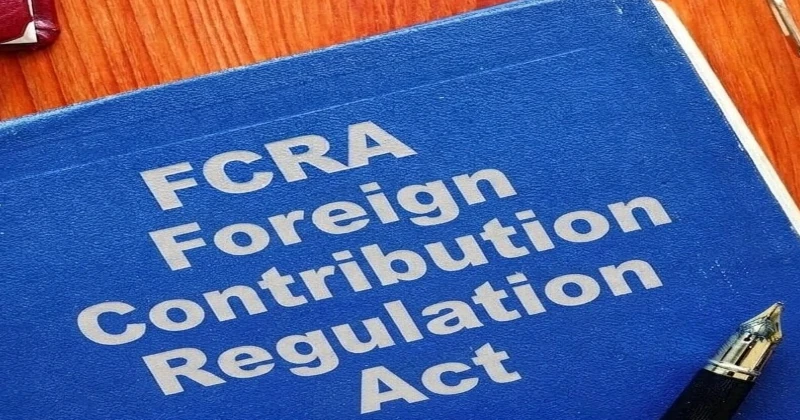
Union Govt tightens FCRA rules to stop unregulated foreign cash
September 1, 2026
  • Read Ecopy
  • Circulation
  • Advertise
  • Careers
  • About Us
  • Contact Us
Android AppiPhone AppArattai
Organiser
  • ‌
  • Bharat
    • Assam
    • Bihar
    • Chhattisgarh
    • Jharkhand
    • Maharashtra
    • View All States
  • World
    • Asia
    • Europe
    • North America
    • South America
    • Africa
    • Australia
  • Editorial
  • International
  • Opinion
  • RSS @ 100
  • More
    • Op Sindoor
    • Analysis
    • Sports
    • Defence
    • Politics
    • Business
    • Economy
    • Culture
    • Special Report
    • Sci & Tech
    • Entertainment
    • G20
    • Azadi Ka Amrit Mahotsav
    • Vocal4Local
    • Web Stories
    • Education
    • Employment
    • Books
    • Interviews
    • Travel
    • Law
    • Health
    • Obituary
  • Subscribe
    • Subscribe Print Edition
    • Subscribe Ecopy
    • Read Ecopy
  • ‌
  • Bharat
    • Assam
    • Bihar
    • Chhattisgarh
    • Jharkhand
    • Maharashtra
    • View All States
  • World
    • Asia
    • Europe
    • North America
    • South America
    • Africa
    • Australia
  • Editorial
  • International
  • Opinion
  • RSS @ 100
  • More
    • Op Sindoor
    • Analysis
    • Sports
    • Defence
    • Politics
    • Business
    • Economy
    • Culture
    • Special Report
    • Sci & Tech
    • Entertainment
    • G20
    • Azadi Ka Amrit Mahotsav
    • Vocal4Local
    • Web Stories
    • Education
    • Employment
    • Books
    • Interviews
    • Travel
    • Law
    • Health
    • Obituary
  • Subscribe
    • Subscribe Print Edition
    • Subscribe Ecopy
    • Read Ecopy
Organiser
  • Home
  • Bharat
  • World
  • Operation Sindoor
  • Editorial
  • Analysis
  • Opinion
  • Culture
  • Defence
  • International Edition
  • RSS @ 100
  • Magazine
  • Read Ecopy
Home Bharat

Holding NGOs accountable: Govt tightens FCRA rules to stop unregulated foreign cash & safeguard national security

The Union government has defended the FCRA framework and its 2026 reforms as vital measures to curb unregulated foreign financial flows that pose risks to national security and democratic institutions

WEBDESKWEBDESK
Jul 23, 2026, 12:00 pm IST
inBharat, Delhi
Follow on Google News
FCRA

FCRA

Facebook
Twitter
WhatsAppTelegramEmail

NEW DELHI: Reiterating its commitment to transparency, accountability and national security, the Government has presented a comprehensive explanation of the Foreign Contribution (Regulation) Act (FCRA), asserting that the law is designed to facilitate genuine foreign-funded developmental work while ensuring that overseas contributions remain transparent and accountable.

According to the government, the FCRA is not a prohibition on foreign donations but a regulatory framework that governs how individuals, NGOs, trusts, associations and companies receive and utilise foreign contributions in India. Administered by the Ministry of Home Affairs (MHA), the law seeks to balance international cooperation with the country’s sovereign interests.

Highlighting the role of foreign contributions in nation-building, the government noted that thousands of organisations across India continue to receive overseas funding for education, healthcare, rural development, disaster relief, environmental conservation, scientific research and social welfare.

FCRA: Foreign Contribution (Regulation) Act

➜ Foreign Contribution (Regulation) Act (FCRA) is the law that governs how Indian individuals, associations, NGOs, trusts and companies may receive and use money, securities or articles sent to them from a source outside India. It is…

— PIB India (@PIB_India) July 22, 2026

It pointed out that around 16,200 organisations were actively registered under the FCRA during 2024-25 and collectively received nearly ₹22,963 crore in foreign contributions, demonstrating that the law enables legitimate charitable and developmental activities rather than restricting them.

The government emphasised that the Act simply ensures that such funds are received through authorised channels, properly accounted for and utilised only for the purposes for which they were sanctioned.

The government described transparency as the cornerstone of the FCRA framework. Organisations receiving foreign contributions are required to register, route funds through a designated bank account, maintain audited records and file annual disclosures detailing donors, receipts and expenditure.

According to the document, these provisions not only ensure accountability but also strengthen public confidence in voluntary organisations by making foreign funding completely traceable.

The government stressed that every sovereign nation has both the right and the responsibility to regulate foreign financial flows that may have implications for national security, democratic institutions and public order.

It noted that the FCRA restricts only a narrowly defined category of foreign-funded activities that could adversely affect India’s sovereignty or constitutional institutions, while allowing genuine humanitarian, educational and welfare initiatives to continue without hindrance.

Rejecting the perception that India’s regulatory framework is unique, the government said that several leading democracies have enacted comparable legislation to monitor foreign influence and funding.

The document cites the United States’ Foreign Agents Registration Act (FARA), Australia’s Foreign Influence Transparency Scheme, the United Kingdom’s Foreign Influence Registration Scheme and Canada’s Foreign Influence Transparency and Accountability Act as examples of countries that require registration and disclosure of foreign-funded activities.

According to the government, India’s approach is consistent with an emerging global consensus that transparency in foreign funding is essential for safeguarding democratic institutions.

The proposed Foreign Contribution (Regulation) Amendment Bill, 2026, the government said, aims to strengthen governance and improve administrative clarity rather than impose additional restrictions.

Among the key reforms are the creation of a designated authority to manage assets linked to foreign contributions after cancellation of registration, clearer procedures for restoration of such assets if registration is renewed, judicial remedies against official decisions, reduced imprisonment for certain violations and improved coordination between Central and State authorities.

The accompanying FCRA Rules, 2026 further enhance transparency by introducing project-wise reporting, disclosure of ultimate foreign donors, activity-specific registrations and clearer compliance requirements for renewal of registrations.

The government also dismissed allegations that the FCRA discriminates against any religion or community.

It maintained that the Act applies uniformly to all organisations regardless of ideology or faith and continues to permit foreign funding for religious education, maintenance of places of worship, charitable activities and welfare programmes undertaken by organisations belonging to every community, provided they comply with statutory requirements.

The document addresses several misconceptions surrounding the law, including claims that the FCRA bans NGOs, prevents legitimate charitable work or allows arbitrary seizure of organisational assets.

Also Read: How CJP protest drew controversial public personalities as the agitation expanded beyond student issues

According to the government, the law merely establishes a registration and disclosure framework similar to those followed in other democracies. It further clarifies that many cancellations of FCRA registrations result from procedural non-compliance, such as failure to renew registration or submit mandatory returns, rather than punitive action against organisations.

The government concluded that India remains open to genuine international partnerships and foreign philanthropy but believes such engagement must operate within a transparent and accountable legal framework.

Describing the FCRA as a law that facilitates legitimate global cooperation while protecting India’s sovereignty, the government said the 2026 reforms continue a five-decade effort to strengthen governance, improve compliance and align India’s regulatory framework with international best practices.


Topics: Ministry of Home AffairsUnion GovernmentPIBForeign ContributionFCRA role
Share
Tweet
SendShareSend
✮ Subscribe Organiser YouTube Channel. ✮
✮ Join Organiser's WhatsApp channel for Nationalist views beyond the news. ✮
Previous News

Mask Off: How radical agitators use fake news, street violence and digital deception to undermine India’s rule of law

Next News

How India is building a future-ready workforce: Govt’s skill development initiatives explained

Related News

The new FCRA rules seek to curb unchecked foreign funding, strengthen financial accountability, and protect Bharat’s national security

Stopping Unchecked Foreign Money: How new FCRA rules protect Bharat’s security and financial sovereignty

Representative Image

Sugar Prices Rise: Government moves to curb hoarding, ensure adequate supply

Punjab: NHRC takes cognisance of complaint flagging non-observance of I-Day in Govt schools along India-Pak border

A viral social media post claiming a WHO warning about milk adulteration causing cancer in 87 per cent of Indians by 2035 has been debunked as fake by PIB.

Fact Check: PIB debunks fake post claiming WHO warned 87 per cent of Indians will get Cancer from milk adulteration

Fact Check: PIB debunks AI deepfake falsely showing FM Nirmala Sitharaman endorsing Rs 70,000 a day investment scam

Fact Check: PIB slams fake social media claim of nationwide ban on Instagram

Load More

Latest News

A 21-year-old Hindu nurse, Uke Shirisha, was sexually assaulted and murdered inside her residential quarters in Thukkuguda, Telangana

Telangana Nurse Murder: Islamist Sanaullah arrested for rape and murder of 21-year-old Uke Shirisha in Thukkuguda

A century-old Hindu Mandir in Pakistan’s Narowal was demolished by Islamic zealots over land encroachment claims

Over 100-year-old Hindu Mandir demolished in Pakistan’s Punjab, Narowal, to make way for madrassa

Prime Minister Narendra Modi in Tashkent

PM Modi pushes for Thirukkural translation in Tashkent as India-Uzbekistan ties reach comprehensive strategic level

The Hague based Permanent Court of Arbitration

India rejects Pakistan-favouring Indus Treaty award, calls Hague-based arbitration body ‘illegally constituted’

Augustine Brothers (inset)

Keralam: ED and SIT to probe Augustine Brothers over Rs 126 Cr deal after Nov ’25 Messi tour cancellation

Indianisation does not mean making all people Hindus; unity can be built on common spiritual reality: Guruji Golwalkar

Jharkhand's former Chief Minister Babulal Marandi (Left) and Union Home Minister Amit Shah (Right)

Bangladeshi infiltration in Jharkhand’s Santhal Pargana a national security threat: Babulal Marandi writes to Amit Shah

From left, India's EAM S. Jaishankar, PM Narendra Modi and NSA Ajit Doval during the 16th BRICS Summit in Kazan, Russia, in 2024

BRICS New Delhi Summit 2026: India to push digital currencies for uninterrupted, cheaper cross-border payments

Guru Amar Das Ji, the Third Sikh Guru

Jyoti Jot Day: Remembering Guru Amar Das Ji, the Guru who strengthened the tradition of langar and equality

Congress MLA Ashok Kumar Rai (Left), Chief Minister DK Shivakumar (Right)

Karnataka ‘7 per cent Commission’ Row: Congress MLA’s charge puts Shivakumar govt under scanner

Load More
  • Privacy
  • Terms
  • Cookie Policy
  • Refund and Cancellation
  • Delivery and Shipping

© Bharat Prakashan (Delhi) Limited.
Tech-enabled by Ananthapuri Technologies

  • Home
  • Search Organiser
  • Bharat
    • Assam
    • Bihar
    • Chhattisgarh
    • Jharkhand
    • Maharashtra
    • View All States
  • World
    • Asia
    • Africa
    • North America
    • South America
    • Europe
    • Australia
  • Editorial
  • Operation Sindoor
  • Opinion
  • Analysis
  • Defence
  • Culture
  • Sports
  • Business
  • RSS @ 100
  • Entertainment
  • More ..
    • Sci & Tech
    • Vocal4Local
    • Special Report
    • Education
    • Employment
    • Books
    • Interviews
    • Travel
    • Health
    • Politics
    • Law
    • Economy
    • Obituary
  • Subscribe Magazine
  • Read Ecopy
  • Advertise
  • Circulation
  • Careers
  • About Us
  • Contact Us
  • Policies & Terms
    • Privacy Policy
    • Cookie Policy
    • Refund and Cancellation
    • Terms of Use

© Bharat Prakashan (Delhi) Limited.
Tech-enabled by Ananthapuri Technologies