New Delhi: The National Eligibility cum Entrance Test (NEET-UG), India’s largest medical entrance examination, has once again become the centre of political debate. While the government maintains that corrective measures, including a re-test, ensured the integrity of the examination process, opposition parties and student groups continue to question aspects of its conduct, turning the issue into a broader political confrontation.
#ArnabGoswami nails it pic.twitter.com/4SjwR1iaJH
— Smita Deshmukh🇮🇳 (@smitadeshmukh) July 22, 2026
NEET-UG is among the world’s largest entrance examinations, determining admissions to undergraduate medical courses across India.
According to official figures:
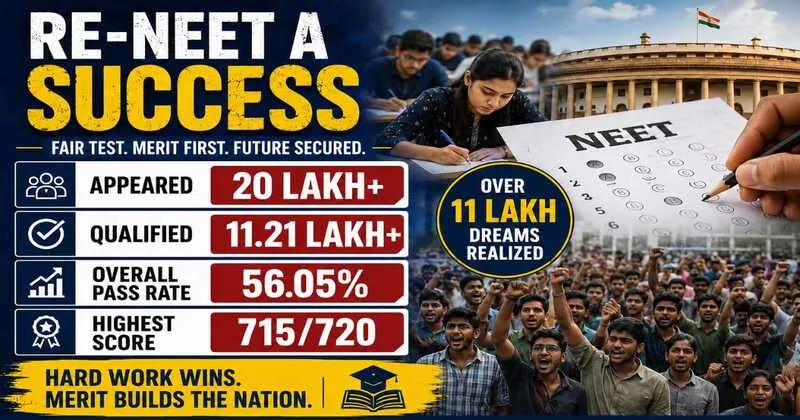
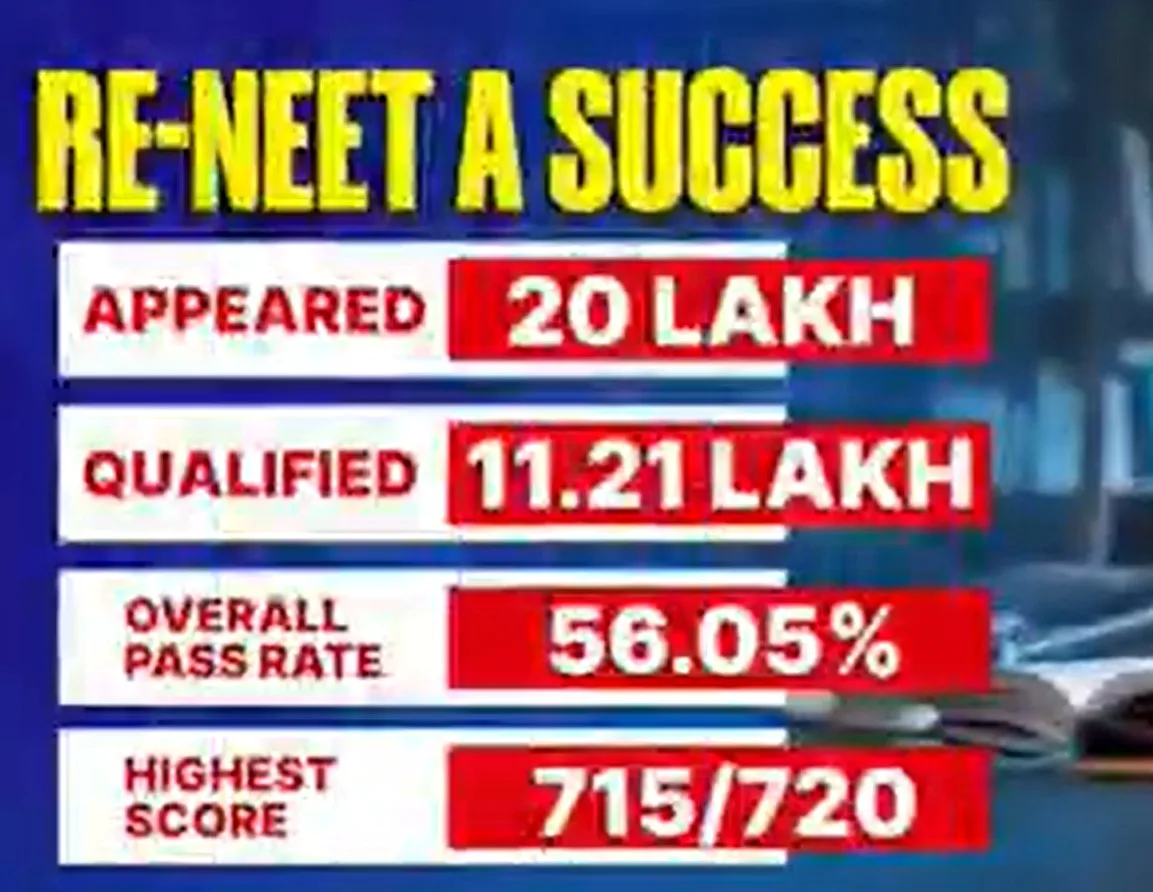
• Around 20 lakh candidates appeared for the examination.
• Approximately 11.21 lakh candidates qualified.
• The overall qualifying percentage stood at around 56 per cent.
• The highest score recorded was 715 out of 720.
Qualifying in NEET does not automatically guarantee admission to a medical college, as seats are allocated through counselling based on rank, category, and seat availability.
The Nature of Competitive Examinations
Competitive examinations are designed to rank candidates rather than simply assess whether they pass or fail. Every year, examinations such as NEET, UPSC Civil Services, IIT-JEE, and defence recruitment attract far more applicants than the number of available seats.
In the UPSC Civil Services Examination, roughly 10 to 13 lakh candidates register every year, but only 5.5 to 6 lakh actually sit for the Prelims. Out of those, fewer than 1,000 candidates make the final selection list. This represents an elimination rate of over 99.8 per cent.
In IIT-JEE, NDA, Banking, or SSC, millions of candidates miss cut-offs annually. Under this flawed logic, every failed candidate would be entitled to delegitimise the examination authority and demand the fall of the government.
Scoring 300 out of 720 simply reflects individual academic preparation, not a constitutional crisis that warrants a minister’s resignation. If every candidate who failed an exam could demand the fall of a government, merit-based selection in India would completely collapse into chaos. Furthermore, this narrative completely ignores the hard work of over 11 lakh students who legitimately prepared and passed the exam.
Government’s Position on the NEET Controversy
Following allegations regarding irregularities in the examination, the Centre announced corrective measures, including conducting a re-test for affected candidates and strengthening security arrangements.
Government representatives have maintained that:
• The re-test was conducted successfully.
• Revised results were declared.
• Counselling can now proceed based on the finalised merit list.
• Students should not face prolonged uncertainty because of continuing political disputes.
Officials have also stated that the objective is to protect the interests of candidates who completed the examination fairly.
Competitive examinations in India are built to select candidates on pure merit, not on the loudness of street agitation. The vast majority of external agitators demanding radical political overhauls have never even appeared for the NEET exam. They possess neither the academic credentials nor the genuine standing to represent hard-working medical aspirants.
Over 11 lakh students legitimately cleared the NEET examination through months of rigorous preparation and dedication. Labelling the entire evaluation process as invalid directly insults the honest effort of every single qualifying candidate. Asking whether these 11 lakh deserving students should forfeit their success to appease political mobs is completely illogical.
External social media commentators like Abhijit Dipke push political narratives without having sat for competitive medical entrances. Figures like Sonam Wangchuk, hailing from politically connected backgrounds, frequently step into student issues to advance broader agendas. Neither of these prominent voices has undergone the personal academic grind required to clear a national medical entrance.
Exploiting the disappointment of non-qualifying candidates converts individual academic struggles into political tools. Failing to achieve a qualifying score is a matter of personal academic preparation, not a constitutional crisis. Outfits like the CJP target disappointed examinees to manufacture artificial outrage against national institutions.
Transforming test score dissatisfaction into threats against Parliament damages the core fabric of democratic discourse. Standardised national entrance tests must remain strictly merit-based and protected from partisan exploitation. The primary responsibility of governance is to safeguard institutional integrity for candidates who qualify fairly. Public discourse should honour the perseverance of successful students rather than legitimising reckless political threats.
Politically Orchestrated Chaos
The violent central Delhi demonstration on July 19, organised under the banner of the Cockroach Janata Party, reveals a broader strategic push by major opposition entities, including the Indian National Congress and the Samajwadi Party (SP), to leverage youth dissatisfaction for political mobilisation.
However, as protesters attempted to march towards Parliament during an active session, the situation quickly escalated. Police erected multiple barricades to prevent the crowd from entering high-security zones, but sections of the protesters allegedly attempted to force their way through. Visuals circulating across social media showed broken barricades, stone pelting, damaged buses, shattered police vehicles and clashes between demonstrators and Delhi Police personnel.
According to Delhi Police, more than 100 police personnel sustained injuries during the violence. The violence also resulted in damage to public infrastructure. Several buses, police vehicles, barricades and other government assets suffered damage during the confrontation. Public property funded by taxpayers became collateral in the clashes, prompting renewed debate over accountability during protests. Authorities have begun assessing the financial losses caused by the vandalism and are expected to recover damages from those found responsible, subject to legal proceedings.
Following the violence, investigative agencies have begun examining several aspects of the protest, including:
* The planning and coordination of the march.
* Communication channels used for mobilisation.
* Funding and logistical arrangements.
* The role of various organisations and individuals in organising the event.
* Whether any pre-planned strategy existed to provoke confrontation with security forces.
Authorities are also reviewing video footage, social media posts, CCTV recordings and digital communications to identify individuals allegedly involved in violence and damage to public property.