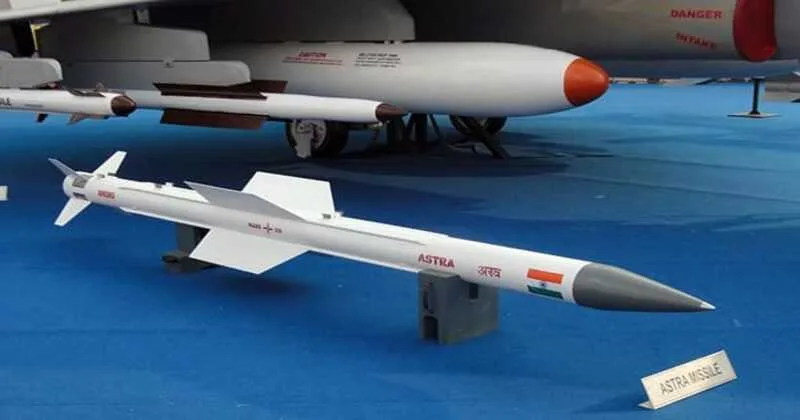
New Delhi: India’s indigenous defence manufacturing programme may be on the verge of securing another significant international breakthrough, with Saudi Arabia reportedly emerging as a potential export customer for the Astra Mk1 beyond-visual-range air-to-air misile (BVRAAM). The development follows growing overseas interest in the missile after Indonesia and underscores the increasing global recognition of India’s indigenous missile technology.
According to the reports, Saudi Arabia has emerged as another prospective buyer for the Astra Mk1. Reports say that the Royal Saudi Air Force (RSAF) is evaluating the missile for integration with its F-15S and F-15SA fighter aircraft. The reports suggest that competitive pricing, availability and supply-chain resilience are among the principal factors driving Riyadh’s interest.
While no official announcement has been made by either New Delhi or Riyadh, the reported evaluation highlights India’s growing credibility as a supplier of advanced defence systems capable of competing in international markets traditionally dominated by Western manufacturers.
Global missile demand opens new opportunities for India
Saudi Arabia’s reported interest comes against the backdrop of a rapidly changing global defence environment. According to sources close to AFI, international demand for the AIM-120 Advanced Medium-Range Air-to-Air Missile (AMRAAM) has risen sharply following replenishment requirements by the United States and several allied nations after recent military operations involving Iran.
The surge in procurement has reportedly extended production queues and delivery timelines for fresh AMRAAM orders, encouraging some countries to examine alternative beyond-visual-range missile systems.
However, while global demand for AMRAAMs has undeniably increased due to expanded procurement and replenishment efforts, neither the United States nor Saudi Arabia has officially stated that these developments are responsible for Riyadh’s reported evaluation of the Astra Mk1.
Against this backdrop, India’s indigenous missile has emerged as a competitive alternative. Sources indicate that the Astra Mk1 is attracting attention because it combines an active radar seeker, a two-way datalink and advanced electronic counter-countermeasure (ECCM) capability with a substantially lower acquisition cost than many comparable Western beyond-visual-range missiles.
The missile has already entered operational service with both the Indian Air Force and the Indian Navy and is currently being produced in series by Bharat Dynamics Limited (BDL), reflecting the maturity of India’s domestic missile production ecosystem.
Saudi Arabia operates one of the world’s largest fleets of F-15 fighter aircraft outside the United States. The Royal Saudi Air Force’s inventory includes upgraded F-15S fighters and the more advanced F-15SA variant, both of which constitute the backbone of the Kingdom’s long-range air combat capability. Riyadh is also pursuing additional modernisation programmes to ensure the operational relevance of its F-15 fleet over the coming decades.
According to sources, adapting the Astra Mk1 for the F-15 platform would primarily involve software integration with the aircraft’s mission computer, weapons management system and fire-control radar, followed by extensive flight trials and certification. If completed, such integration would represent one of the first instances of India’s indigenous beyond-visual-range missile being successfully integrated with a Western combat aircraft platform.
Major boost for India’s defence export ambitions
The reported Saudi evaluation is widely seen as another indicator of India’s expanding presence in the global defence export market. Over the past few years, New Delhi has steadily increased investments in indigenous research, development and manufacturing under the vision of defence self-reliance, resulting in several domestically developed weapon systems attracting international attention.
The Astra Mk1 has already generated interest from countries seeking reliable and cost-effective air-to-air missiles compatible with existing fighter fleets. Following Indonesia’s reported interest, Saudi Arabia’s evaluation would mark another important milestone for the missile’s export prospects.
If Riyadh ultimately proceeds with the acquisition, it would represent one of India’s most significant missile export opportunities in the West Asia. Beyond the immediate commercial benefits, such a deal would deepen defence cooperation between India and Saudi Arabia while enhancing India’s reputation as a trusted supplier of advanced military technology.
Availability has also become an increasingly critical consideration in global missile procurement. As countries expand their air combat capabilities amid rising geopolitical tensions, defence planners are placing greater emphasis on assured deliveries, diversified supply chains and the ability to sustain missile inventories during periods of heightened international demand. These factors have strengthened the appeal of alternative suppliers capable of offering dependable production capacity alongside competitive pricing.
For India, a successful Astra Mk1 export to Saudi Arabia would carry significance beyond a single defence contract. It would validate indigenous missile technology in the eyes of operators of advanced Western fighter aircraft and reinforce confidence in India’s growing defence industrial base. Such an achievement could also create pathways for future exports of more advanced variants, including the longer-range Astra Mk2, which is currently under development.
At present, however, the reported discussions remain unofficial. Neither the Indian Ministry of Defence, the Defence Research and Development Organisation (DRDO), Bharat Dynamics Limited (BDL) nor the Saudi Ministry of Defence has confirmed the reports. As with most major defence acquisitions, any potential agreement would be expected to undergo detailed technical evaluations, compatibility assessments, commercial negotiations and government approvals before a formal contract could be finalised.
Nevertheless, the reported Saudi interest reflects the growing international confidence in India’s indigenous defence capabilities and highlights the country’s emergence as an increasingly influential player in the global arms market.