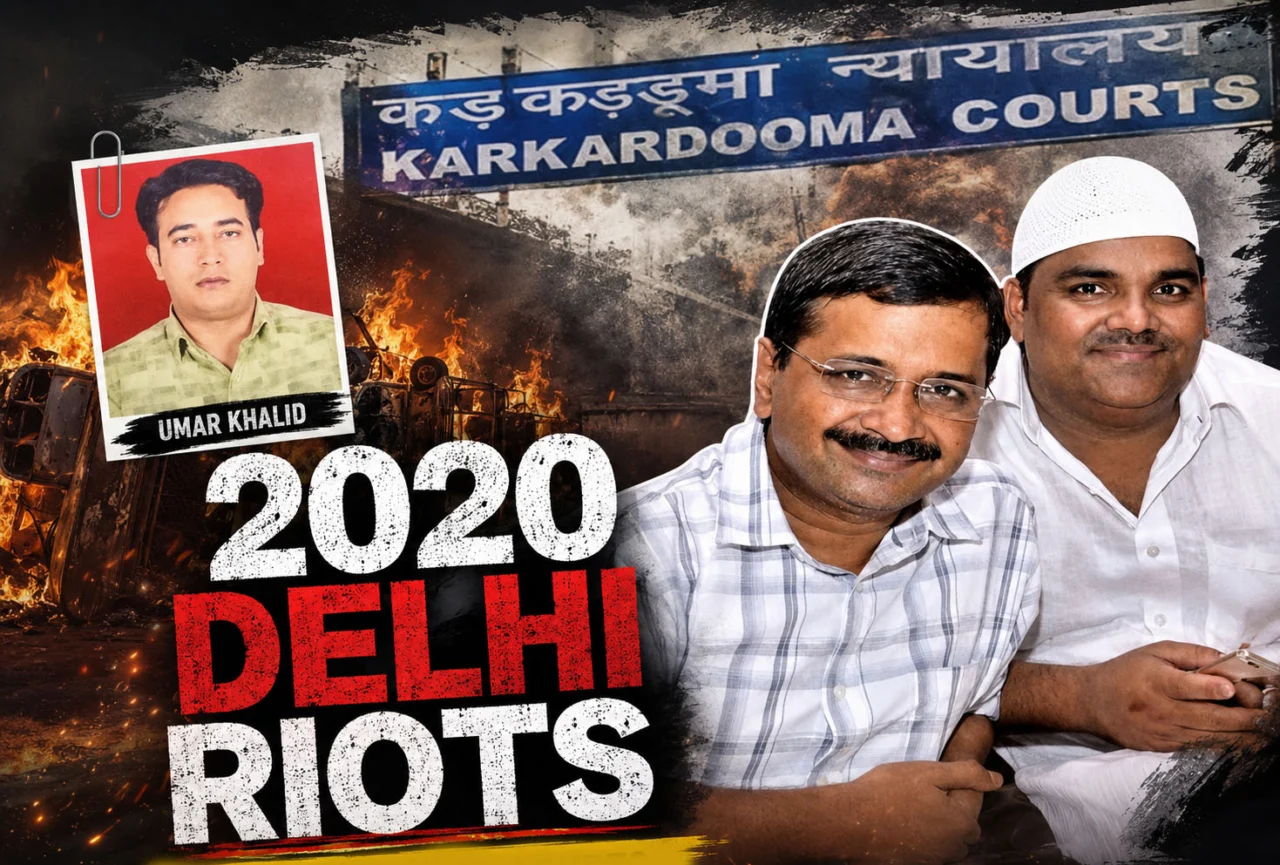
On July 13, 2026, a Delhi court did something the country’s fractured political discourse had made almost unimaginable: it delivered a verdict on facts, in a case that had spent six years buried under narrative warfare. Additional Sessions Judge Praveen Singh of the Karkardooma Court convicted former AAP councillor Tahir Hussain, along with four co-accused, in the murder of Intelligence Bureau staffer Ankit Sharma during the February 2020 North East Delhi riots. Six of the eleven originally accused were acquitted. Sentencing is still to come, and an appeal is all but certain. But the conviction itself is worth sitting with — not just for what it says about the case, but for what it says about the six-year gap between the crime and the courtroom.
Ankit Sharma’s body was pulled from a drain near Chand Bagh on February 26, 2020, bearing over fifty injuries. The proximity of the drain to Hussain’s property, and his position as a sitting AAP councillor at the time, made the case instantly combustible. What followed was not simply a criminal trial — it became a proxy battle over how the 2020 riots themselves would be remembered. The Aam Aadmi Party’s response set an early template. Hussain was suspended from the party within days of the allegations surfacing — a move designed to create political distance without directly conceding the substance of the charges. That distancing was reflexive rather than principled: AAP neither disowned him with any moral clarity nor extended him institutional protection, opting instead for the safest possible position — silence, paired with procedural suspension. It was a pattern many Indian parties have perfected: cut the visible cord to the accused while allowing the legal process to grind on unencumbered by any statement that might commit the party to a position, either of guilt or innocence. Hussain’s own political trajectory complicated this further.
‘Animus against Hindus’
Former AAP councillor Tahir Hussain and four others have been convicted for the murder of Intelligence Bureau officer Ankit Sharma during the 2020 Northeast Delhi riots
The court found Hussain was part of a ‘heavily armed mob’ with ‘animus against Hindus’ that committed rioting, loot, arson, and a ‘savage and relentless assault’ on Sharma
Hussain was convicted under IPC sections including murder (302), kidnapping (365), rioting (147, 148), promoting enmity (153A), and disobedience to public order (188), read with Section 149 (vicarious liability)
Nazim, Kasim, Javed, and Anas were also convicted for the same offences, while six other accused were acquitted in the case.
His move to AIMIM in December 2024 and his subsequent Assembly contest from Mustafabad in 2025 — where he polled over 33,000 votes and finished third — showed that suspension from one party did not equal political exile. If anything, his continued electoral relevance while facing a murder charge illustrates a broader and more uncomfortable truth about Indian politics: an active criminal case is rarely disqualifying, and a determined political ecosystem will absorb an accused politician if there is a constituency willing to be mobilised around his persecution narrative. That narrative — that Hussain was himself a victim of communal violence, cornered into self-defence — was amplified early and aggressively. A video in which he pleaded innocence and described making calls to the Police Control Room for help circulated widely within days of the murder becoming public knowledge, shaping public perception well before any evidence had been tested in court. The court’s eventual verdict is significant precisely because it addressed that defence directly and rejected it, finding that the PCR-call narrative did not hold up against the weight of evidence establishing Hussain’s presence and role within the mob.
A Pattern, Not an Isolated Charge
The Ankit Sharma murder conviction did not emerge in isolation — it sits atop a broader case file that paints a picture of alleged premeditation rather than a man swept up in a single afternoon of mob violence. Delhi Police’s chargesheet held that Hussain used his own under-construction house as a staging ground, and in a disclosure statement he reportedly admitted to stockpiling bricks, stones, acid, and fuel in the run-up to the riots, along with depositing his licensed pistol with police once the violence began. He was separately charged under the Unlawful Activities (Prevention) Act and, at one point, sedition, in connection with the alleged larger conspiracy behind the violence.
Running parallel to the criminal prosecution, the Enforcement Directorate pursued — and continues to pursue — a money-laundering case against Hussain, alleging he routed roughly Rs 5.24 crore through shell companies he controlled to help fund the riots. A Delhi court framed charges in that case in January 2023, and the Supreme Court subsequently dismissed his challenge to those proceedings. He spent four years in custody on the money-laundering charge before finally securing bail in March 2025 — though he remained in custody throughout the separate, larger conspiracy case. None of this constitutes proof of guilt on its own; the money-laundering trial is still pending, and allegations in a chargesheet are not findings of fact. But taken together with the murder conviction, it undercuts the portrayal — pushed hard by his political allies and sympathetic commentary — of Hussain as a bystander caught in circumstance. The state’s case, across three separate proceedings and two separate investigating agencies, has consistently alleged not spontaneous participation but coordination, funding, and premeditation.
Justice Delayed, If Not Quite Denied
The six-year timeline is itself an indictment of the system, independent of the verdict’s correctness. Chargesheets, evidence, and witness testimony in a case of this magnitude and public visibility should not require the better part of a decade to result in a trial court verdict. Delay of this scale erodes public confidence in the judicial process from both directions: it allows those sympathetic to the accused to claim persecution through prolonged incarceration and litigation, while denying the victim’s family closure within any reasonable timeframe. Ravinder Kumar, Ankit Sharma’s father, filed his complaint in February 2020. He has waited more than six years for a court to even pronounce guilt — sentencing, and the appeals that will inevitably follow, remain ahead. This is not unique to this case. It reflects a structural reality of India’s criminal justice system, where trial delays routinely stretch into years, particularly in politically sensitive matters where every procedural step invites contestation. The riots produced hundreds of FIRs and dozens of cases still working their way through courts at varying pace — this verdict is one data point in a much longer, still-unfinished reckoning.
A conviction at trial court is not the final word — Hussain retains the right to appeal, and the acquittal of six co-accused in the same case is a reminder that mob culpability is not a blanket presumption but something the prosecution must establish person by person. What the verdict does confirm is that the process, however slow and however politically inconvenient for multiple actors along the way, eventually reached a reasoned conclusion grounded in evidence rather than the competing narratives that dominated public discourse for years. That, in a case this politically charged, is not nothing. But it arrived far too late to serve either the victim’s family or the broader public interest in
timely justice.