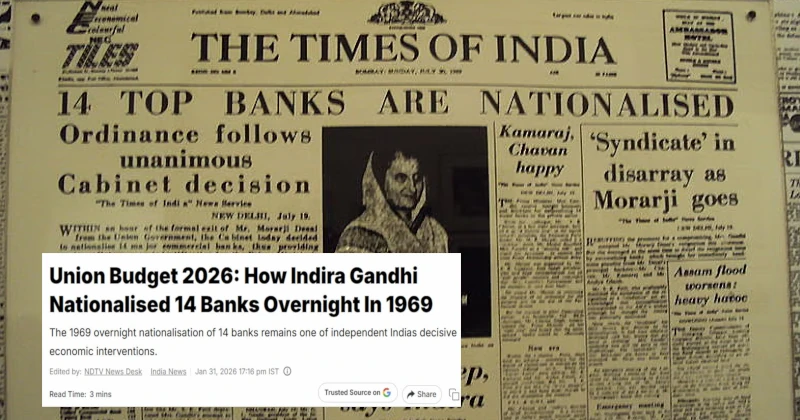
1969 Bank Nationalisation and India's NPA crisis
July 21, 2026
  • Read Ecopy
  • Circulation
  • Advertise
  • Careers
  • About Us
  • Contact Us
Android AppiPhone AppArattai
Organiser
  • ‌
  • Bharat
    • Assam
    • Bihar
    • Chhattisgarh
    • Jharkhand
    • Maharashtra
    • View All States
  • World
    • Asia
    • Europe
    • North America
    • South America
    • Africa
    • Australia
  • Editorial
  • International
  • Opinion
  • RSS @ 100
  • More
    • Op Sindoor
    • Analysis
    • Sports
    • Defence
    • Politics
    • Business
    • Economy
    • Culture
    • Special Report
    • Sci & Tech
    • Entertainment
    • G20
    • Azadi Ka Amrit Mahotsav
    • Vocal4Local
    • Web Stories
    • Education
    • Employment
    • Books
    • Interviews
    • Travel
    • Law
    • Health
    • Obituary
  • Subscribe
    • Subscribe Print Edition
    • Subscribe Ecopy
    • Read Ecopy
  • ‌
  • Bharat
    • Assam
    • Bihar
    • Chhattisgarh
    • Jharkhand
    • Maharashtra
    • View All States
  • World
    • Asia
    • Europe
    • North America
    • South America
    • Africa
    • Australia
  • Editorial
  • International
  • Opinion
  • RSS @ 100
  • More
    • Op Sindoor
    • Analysis
    • Sports
    • Defence
    • Politics
    • Business
    • Economy
    • Culture
    • Special Report
    • Sci & Tech
    • Entertainment
    • G20
    • Azadi Ka Amrit Mahotsav
    • Vocal4Local
    • Web Stories
    • Education
    • Employment
    • Books
    • Interviews
    • Travel
    • Law
    • Health
    • Obituary
  • Subscribe
    • Subscribe Print Edition
    • Subscribe Ecopy
    • Read Ecopy
Organiser
  • Home
  • Bharat
  • World
  • Operation Sindoor
  • Editorial
  • Analysis
  • Opinion
  • Culture
  • Defence
  • International Edition
  • RSS @ 100
  • Magazine
  • Read Ecopy
Home Politics

From Nationalisation to NPAs: How Indira Gandhi’s 1969 bank takeover planted the seeds of Bharat’s banking crisis

On July 19, 1969, the Congress government under Indira Gandhi nationalised 14 major banks, a move most argue transformed commercial banking into a politically driven system that weakened credit discipline and institutional autonomy

WEBDESKWEBDESK
Jul 20, 2026, 01:30 pm IST
in Politics, Bharat
Follow on Google News
FacebookTwitterWhatsAppTelegramEmail

NEW DELHI: July 19 remains one of the most defining dates in Bharat’s economic history. On this day in 1969, the Congress government under Prime Minister Indira Gandhi nationalised 14 of the country’s largest commercial banks through the Banking Companies (Acquisition and Transfer of Undertakings) Ordinance, a move that was projected as a revolutionary step towards socialism, financial inclusion and equitable economic development.

While the decision dramatically expanded formal banking into rural Bharat and brought nearly 85 per cent of the country’s banking deposits under government ownership, it also altered the character of Bharat’s banking system. Commercial prudence gave way to political priorities, setting the stage for one of the country’s biggest financial challenges: the Non-Performing Asset (NPA) crisis.

The nationalisation drive came amid intense political turbulence within the Congress party. Indira Gandhi presented the move as a measure to wrest control of financial resources from a handful of industrial houses and redirect credit towards agriculture, small industries, weaker sections and rural development.

𝐂𝐎𝐍𝐆𝐑𝐄𝐒𝐒' 𝟏𝟗𝟔𝟗 𝐁𝐀𝐍𝐊 𝐍𝐀𝐓𝐈𝐎𝐍𝐀𝐋𝐈𝐒𝐀𝐓𝐈𝐎𝐍: 𝐓𝐇𝐄 𝐑𝐎𝐎𝐓 𝐎𝐅 𝐈𝐍𝐃𝐈𝐀'𝐒 𝐍𝐏𝐀 𝐂𝐑𝐈𝐒𝐈𝐒

On this day in 1969, the Congress government led by Indira Gandhi nationalised 14 major commercial banks through the Banking Companies (Acquisition and… pic.twitter.com/lJIJa7VFxO

— BJP (@BJP4India) July 19, 2026

The move earned widespread political support and was hailed as a landmark socialist reform. However, economists and banking experts have long argued that nationalisation concentrated enormous financial power in the hands of the government, making public-sector banks increasingly susceptible to political interference.

As a result, banks gradually became instruments for implementing government policies and electoral promises instead of functioning primarily as commercial institutions guided by risk assessment and profitability.

One of the most enduring consequences of nationalisation was politically influenced lending. As successive governments sought to expand welfare schemes and gain electoral support, public sector banks were often directed to extend loans based on policy priorities rather than commercial viability.

Credit decisions increasingly reflected political considerations instead of sound banking principles.

This shift gave rise to the infamous “loan mela” culture, where mass loan distribution programmes were organised with little emphasis on creditworthiness, repayment capacity or post-disbursement monitoring.

The weakening of institutional autonomy meant that professional banking judgement was frequently overshadowed by administrative directives, which undermined the discipline that underpins a healthy financial system.

As politically motivated lending became more common, weaknesses in risk evaluation and loan monitoring began to surface.

Many borrowers viewed government-backed loans as politically protected or easily waivable, so repayment discipline declined. At the same time, banks struggled with poor recovery mechanisms and inadequate accountability for sanctioning large loans.

Over time, these structural deficiencies snowballed into massive Non-Performing Assets. By the early 2010s, Bharat’s public sector banks were grappling with unprecedented levels of stressed assets running into several lakh crore rupees.

The banking sector required repeated government recapitalisation, effectively transferring the burden of bad loans to taxpayers. While many of the largest NPAs emerged decades after nationalisation, the institutional culture that enabled indiscriminate lending had its roots in the post-1969 banking framework.

The consequences of mounting NPAs extended far beyond bank balance sheets.

As bad loans accumulated, public sector banks became increasingly reluctant to lend, which affected credit flow to productive sectors of the economy. Capital that could have supported infrastructure, manufacturing and entrepreneurship instead remained locked in unrecovered loans.

Successive governments were compelled to inject substantial taxpayer money into recapitalising public sector banks to keep them solvent, placing additional pressure on public finances.

The banking crisis also triggered sweeping reforms, including stricter loan monitoring, improved corporate governance, the introduction of the Insolvency and Bankruptcy Code (IBC), the Reserve Bank of Bharat’s Asset Quality Review (AQR), and greater emphasis on professional risk management.

Supporters of bank nationalisation argue that the policy transformed Bharat’s financial landscape by expanding branch networks, increasing rural banking penetration and extending institutional credit to sectors previously neglected by private banks.

However, these gains came at a high institutional cost. Political interference steadily eroded banking autonomy, weakened accountability and normalised lending practices driven more by electoral considerations than financial sustainability.

For many economists, the debate is not merely about whether nationalisation achieved financial inclusion, but whether the long-term erosion of commercial discipline ultimately outweighed its intended benefits. More than five decades later, the legacy of the 1969 bank nationalisation continues to shape discussions on banking reforms, public sector governance and financial accountability.

(The story is based on a tweet by BJP)

Topics: Indira GandhiCongress GovernmentNPABankingNon-Performing AssetBJP
ShareTweetSendShareSend
✮ Subscribe Organiser YouTube Channel. ✮
✮ Join Organiser's WhatsApp channel for Nationalist views beyond the news. ✮
Previous News

Environmental consciousness is deeply rooted in Sanatani values: RSS Sah Sarkaryavah Ramdatt Chakradhar

Next News

Puri Jagannath Mandir: Ratna Bhandar ornaments counted, weighed & digitally documented during inventory drive

Related News

Karnataka BJP president B.Y. Vijayendra has opposed the state government's decision to deploy PU lecturers to teach Classes 9 and 10,

Karnataka Government’s decision to deploy PU lecturers for Classes 9, 10 anti-student, anti-lecturer: BY Vijayendra

BJP Protest against Bidadi Township project

Karnataka: BJP steps up protest against Bidadi Township; Exposes Congress government’s land grab scam

S. Sabari Varman of Ethankadu (Right side)

Tamil Nadu custodial death: Three prison wardens arrested as opposition seeks CBI probe

Eight Kalaburagi Central Prison officials were suspended after three convicts escaped

Karnataka Jail Break: 8 Kalaburagi officials suspended as BJP tears into Congress govt over security lapses

Chinnaswamy Stampede: BJP slams Karnataka govt for giving clean chit to IPS officers, questions accountability

Representative Image

Tamil Nadu Police detain 73 illegal Bangladeshis in Hosur; Hindu Munnani calls for deportation

Load More

Latest News

Karnataka: HC refuses to quash Rs 5.3 crore fake govt job scam case against Shamshad Begum, daughter of Mansur Ahmed

Hera Panchami marks Maa Lakshmi's symbolic anger with the ceremonial breaking of Bhagwan Jagannath's Nandighosha chariot

Hera Panchami: The divine story behind Maa Lakshmi’s anger and the breaking of Nandighosha chariot

Centre's SMILE scheme to cover 295 cities by 2030-31, aims to rehabilitate 35,000 persons engaged in begging

SMILE Scheme Expansion: Government plans to make 295 cities begging-free, over 10,200 already rehabilitated

Karnataka HC pulls up Congress govt for chasing tweets instead of criminals, stays FIR probe

Viral social media posts falsely claimed that India's first hydrogen-powered train suffered a technical failure

Fact Check: Routine servicing of India’s Hydrogen train misconstrued as indigenous tech failure in viral video

ABVP demands immediate INSPIRE SHE scholarship release, flags delay affecting thousands of science students

A CJP protest in Delhi turned violent, injuring police personnel, damaging government property, and triggering an investigation

CJP Protest in Delhi Turns Violent: Police injured, government property damaged; Investigation underway

Britain's market opens wider as India's textile sector gains a long-awaited competitive edge

India-UK CETA: Duty-Free access set to double textile exports, adding $1.6 billion, challenging China and Bangladesh

Representative Image

Pune Horror: 4 Muslim men Farhan, Fazal, Rehan & Sahil arrested for year long rape and blackmail of college student

Congress supremo Rahul Gandhi

If Rahul Gandhi backed Sonam Wangchuk, why did he never visit the CJP protest at Jantar Mantar?

Load More
  • Privacy
  • Terms
  • Cookie Policy
  • Refund and Cancellation
  • Delivery and Shipping

© Bharat Prakashan (Delhi) Limited.
Tech-enabled by Ananthapuri Technologies

  • Home
  • Search Organiser
  • Bharat
    • Assam
    • Bihar
    • Chhattisgarh
    • Jharkhand
    • Maharashtra
    • View All States
  • World
    • Asia
    • Africa
    • North America
    • South America
    • Europe
    • Australia
  • Editorial
  • Operation Sindoor
  • Opinion
  • Analysis
  • Defence
  • Culture
  • Sports
  • Business
  • RSS @ 100
  • Entertainment
  • More ..
    • Sci & Tech
    • Vocal4Local
    • Special Report
    • Education
    • Employment
    • Books
    • Interviews
    • Travel
    • Health
    • Politics
    • Law
    • Economy
    • Obituary
  • Subscribe Magazine
  • Read Ecopy
  • Advertise
  • Circulation
  • Careers
  • About Us
  • Contact Us
  • Policies & Terms
    • Privacy Policy
    • Cookie Policy
    • Refund and Cancellation
    • Terms of Use

© Bharat Prakashan (Delhi) Limited.
Tech-enabled by Ananthapuri Technologies