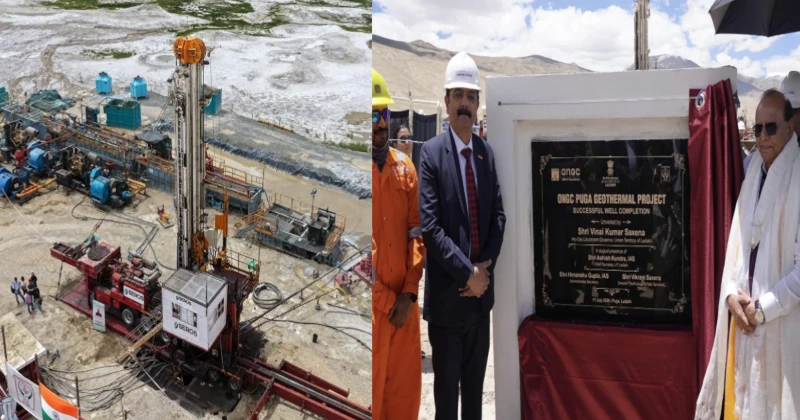
PUGA VALLEY: Ladakh Lieutenant Governor VK Saxena, commissioned the country’s first and deepest geothermal wells at the Puga Valley in eastern Ladakh, marking a decisive step towards establishing India’s first-ever geothermal power plant.
The two geothermal production wells, each drilled to a depth of 1,000 metres at an altitude exceeding 14,000 feet, have been executed by the ONGC Energy Centre under some of the world’s most challenging geographical and climatic conditions. The successful commissioning of these wells brings India significantly closer to operationalising the 1 MW pilot geothermal power project at Puga, which will serve as the country’s first demonstration-scale geothermal energy project.
The achievement is not merely an engineering milestone but a strategic leap in India’s pursuit of energy security, renewable energy diversification and sustainable development in the Himalayan region.
While India has made significant strides in solar, wind and hydropower generation, geothermal energy has largely remained an untapped resource despite the country possessing several geothermal provinces. The Puga Valley in Ladakh has long been recognised as one of India’s richest geothermal reservoirs due to its naturally occurring hot springs and geothermal manifestations.
The commissioning of the two deep wells now opens the path for harnessing the Earth’s internal heat to generate clean, round-the-clock electricity an energy source that remains unaffected by weather conditions unlike solar and wind power.
The proposed 1 MW geothermal project is expected to become India’s first functioning geothermal power plant and could eventually pave the way for larger commercial-scale geothermal projects across the country.
Executing deep drilling operations at more than 14,000 feet above sea level posed extraordinary logistical and technical challenges. The remote terrain of Puga Valley, extreme sub-zero temperatures, thin atmospheric conditions and difficult transportation logistics make geothermal drilling in Ladakh one of the most demanding infrastructure projects undertaken in India.
Despite these constraints, the ONGC Energy Centre successfully completed the drilling of the country’s deepest geothermal wells, laying the foundation for India’s geothermal energy future. Officials noted that the two wells are critical components for the successful implementation and testing of the pilot geothermal power project.
The geothermal project had earlier encountered a significant setback after the expiry of the tripartite Memorandum of Understanding (MoU) between the Ladakh Administration, the Ladakh Autonomous Hill Development Council (LAHDC), Leh, and the ONGC Energy Centre.
The lapse of the agreement resulted in months of delays, bringing progress on the strategically important renewable energy project to a near standstill. Recognising the national importance of geothermal energy for India’s clean energy transition, Lieutenant Governor VK Saxena personally intervened to facilitate the renewal of the MoU.
The agreement was subsequently extended for another five years in June this year, enabling work to resume immediately and culminating in the successful completion and commissioning of the two geothermal wells.
The intervention ensured that a project with immense strategic, scientific and environmental significance did not remain trapped in administrative delays. The commissioning of the geothermal wells aligns with the broader vision of transforming Ladakh into a renewable energy powerhouse.
Already emerging as a hub for solar energy because of its high solar irradiance, Ladakh is now poised to add geothermal energy to its clean energy portfolio. Unlike intermittent renewable sources, geothermal power offers continuous baseload electricity, making it an attractive solution for remote high-altitude regions where energy reliability remains a challenge.
The pilot project is also expected to generate valuable scientific and operational data that could guide future geothermal exploration across other potential sites in India.