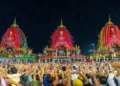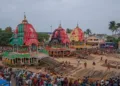
Varanasi: As lakhs of devotees pull the towering chariots of Lord Jagannath, Balabhadra and Subhadra down Puri’s Bada Danda today on Ashadha Shukla Dwitiya, another chariot rolls through a city eight hundred kilometres away, one that theology would seem to forbid. Kashi is Shiva’s city, the abode of Vishwanath, where the Trishul is said to hold the earth aloft. For more than two centuries, Banaras has made its street ready each year for a Vishnu-centric festival borrowed from Odisha and made its own. The Banaras Rath Yatra is no pale imitation of Puri. It is a study in how Bharat’s civilisational traditions travel, take root and flower differently in new soil, so deeply in this case that an entire locality of Varanasi is today named Rathyatra.
A Piece of Puri on the Ganga
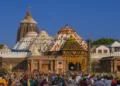
The story begins with priests of Jagannath Puri Dham arriving on the banks of the Ganga in the late eighteenth century. One historical account holds that the Jagannath Temple at Asi Ghat was established in 1790 by Pt. Nityanand Pujari, head priest of Puri Dham. Another records its construction in 1802 by Svami Brahamachari, a chief priest of Puri who had come to Varanasi in exile in 1790 and lived there until his death in 1815. A third corroborates the 1790 date while crediting priest Tejonidhi Brahmchari. What no account disputes is the wealthy Beni Ram and Vishambhar Ram of the Bhonsala estate of Nagpur, residing in Banaras, financed both the temple and the festival, with the Rath Yatra itself commencing around 1806. The very ambiguity of the founding, historians note, speaks of a layered history involving multiple influential figures rather than a single founding moment. Two centuries on, the tradition endures with zeal comparable to Puri itself.
Five Days of Divine Drama
The Banaras festival unfolds over five days in an intimate, almost domestic register. On the first day, the wooden idols of Jagannath, Balabhadra and Subhadra are brought into the temple courtyard for the Snan Yatra, bathed with 108 pots of purified water in a symbolic enactment of the deities getting drenched in the rains. As per the tradition, God falls sick. What follows is perhaps the most touching ritual of the Kashi celebration on the second day, a special herbal preparation called Dasamula is offered as medicine to the ailing deities, who are kept secluded from public view for two days of convalescence. Scholars see in this a profound humanisation of the divine, gods portrayed not as distant and infallible but as vulnerable beings nursed by their devotees as tenderly as family.
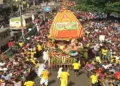
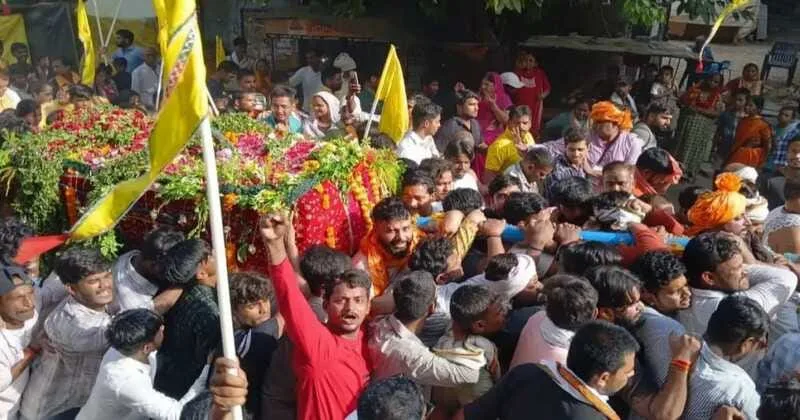
On the third day, the recovered deities mount their chariot for the journey to their “aunt’s place,” the locality named Rathyatra, where the rath is stationed for three days. The streets along the route swell with devotees from the surrounding countryside and temporary stalls do brisk trade in sweets, toys, handicrafts and the special cookies of the season, the beloved nan-khatai. The temple also houses an image of Prachanda Narasimha, the fierce form of Vishnu, with his devotee Prahlad, a feature absent in Puri’s sanctum.
The King Who Pulls the Chariot
The most sightful event of the third day is royal. The Kashi Naresh, the King of Kashi, joins local men in physically pulling the chariot through the streets. In Puri, the Gajapati Maharaja performs the Chhera Pahara, sweeping the chariot platforms with a golden broom in a gesture of humility before the Lord. In Banaras, the king puts his shoulder to the rope itself. Both acts proclaim the same truth, that before Jagannath, the highest sovereign is a servitor; each city has chosen its own ceremonial language for it. In a democratic India, this enduring royal participation bridges historical legacy with living practice and remains a signature of the Kashi celebration.
How It Differs from the Odisha Rath Yatra
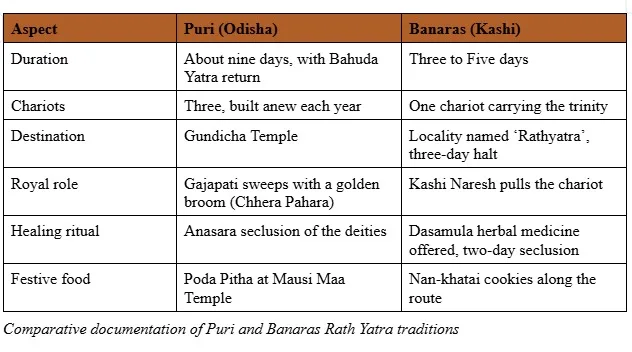
The Banaras Yatra is consistently described as a replica of Puri, but the differences are what give it character. Puri’s festival runs roughly nine days including the Bahuda Yatra, the grand return journey, while Banaras observes an abbreviated five-day form. Puri builds three colossal chariots afresh every year, Nandighosha, Taladhwaja and Darpadalana, hewn by hereditary carpenters from sacred Dasapalla timber. Banaras processes with a single magnificent rath carrying the trinity together. Puri deities journey to the Gundicha Temple, their symbolic birthplace, whereas Kashi’s deities travel to a city locality that has absorbed the festival’s very name into Varanasi’s urban map. The healing of the sick gods with Dasamula is a distinctly Banarasi elaboration of Puri’s Anasara seclusion. Even the festive plate differs, where Puri’s pilgrims relish Poda Pitha at the Mausi Maa Temple, while Kashi’s crowds munch nan-khatai from roadside stalls. Puri’s colossal raths and surging seas of humanity gave the English language the word ‘juggernaut’, an unstoppable force, whereas the Banaras yatra retains the warmth of a mohalla celebration where the divine feels like a neighbour setting out to visit relatives.
Faith as Economy and Community
Like its Odia parent, the Kashi yatra is an economic event as much as a spiritual one. The Rath Yatra Mela draws devotees and tourists in vast numbers, sustaining the city’s weavers, artisans, food vendors, transporters and hoteliers in a city whose floating population has surged since the Kashi Vishwanath corridor transformed pilgrim traffic. In a city of “saat vaar, nau tyohar”, seven days and nine festivals, the yatra binds Banarasis across caste, creed and status in the Jagannath tradition’s founding promise, that the Lord leaves his sanctum precisely to mingle with the common devotee.
The celebration carries a warning within it. The Jagannath Temple complex at Assi has been documented as a victim of illegal encroachments, unauthorised construction and mismanagement, with a large hotel standing in the compound itself. Heritage scholars, led by the extensive documentation of Prof. Rana P.B. Singh, have flagged the neglect as a serious loss to the city’s intangible cultural heritage. Puri wrestles with crowd pressure and infrastructure strain of its own, but Kashi’s challenge is more intimate, the slow erosion of the physical anchor of a living tradition. Traditional Panda families, the temple administration and modern volunteer groups continue to steward the festival, yet the two-century-old rath deserves a compound as the devotion that pulls it.
Today, as the wheels turn in both Puri and Kashi, the two yatras tell one story in two dialects. The Lord of the Universe belongs to no single city. He travels, and wherever he halts, Bharat builds him a home and names a street after his journey.