
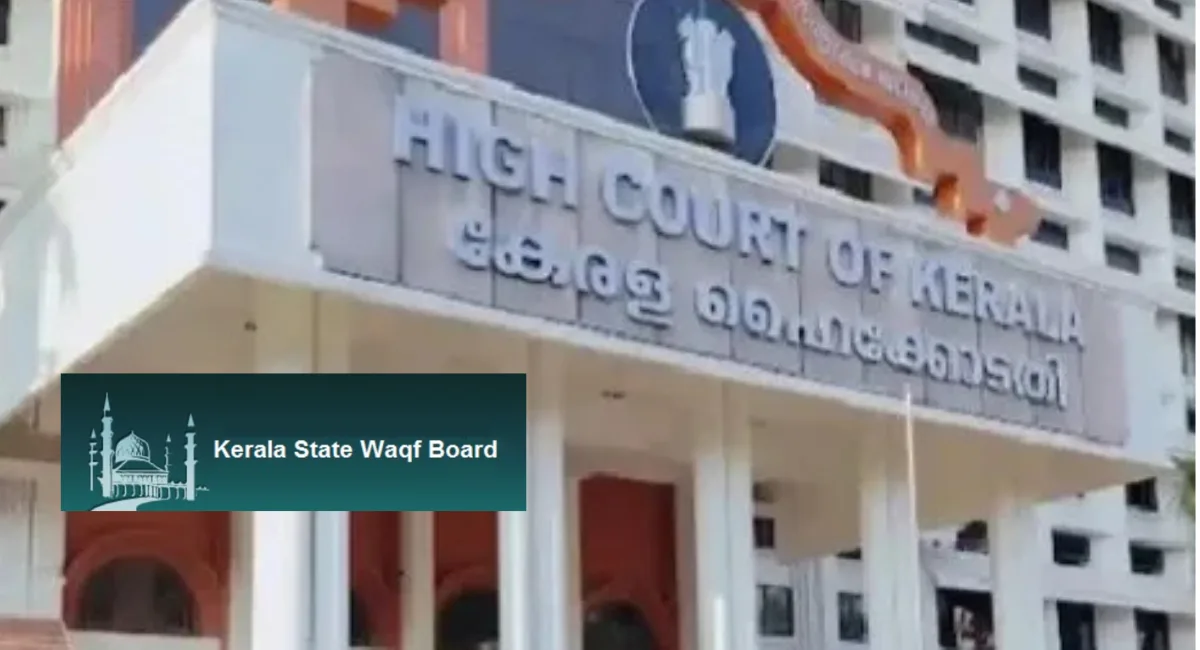
Kerala Waqf Board suffered a major setback after the Kerala High Court, on July 15, temporarily froze the functioning of the Board and directed that its responsibilities be handled by the Joint Secretary of the Waqf Department until further orders. The interim direction came while hearing a Public Interest Litigation (PIL) filed by BJP state vice-president Adv. Shon George, challenging the legality of the Board’s constitution.
According to the Waqf Amendment Act, 2025 (also known as the UMEED Act), two non-Muslim members should be included in the Waqf Board. Adv. Shon George’s petition contended that the Waqf Board, which was constituted without complying with this requirement, is illegal. When the government reconstituted the Waqf Board this year, nine members were nominated. Adv. Shon George submitted that all nine members were Muslims. The case will be heard again on July 22.
The Waqf Board in question had been reconstituted by the erstwhile CPM-led Left Democratic Front (LDF) government under then Chief Minister Pinarayi Vijayan. The batch of PIL petitions challenges the notifications dated February 4, 2026, and March 13, 2026, relating to the constitution of the State Waqf Board. The petitioners contended that the Board, as constituted, does not include two non-Muslim members as required by law and that the Secretary appointed by the Government is not the Joint Secretary to the State Government dealing with Waqf matters, who is required to be an ex-officio member under the statute.
A Division Bench comprising Chief Justice Soumen Sen and Justice Syam Kumar V.M. observed, “The constitution of the Board, prima facie, appears to be not in conformity with Section 14 of the Act of 1995… Under the circumstances, the present Board shall not take any policy decision or incur any capital expenditure without the express leave of this Court.”
The Waqf Board’s counsel sought an adjournment, stating that he had not yet received the second respondent’s statement. He also argued that non-Muslim members could not be appointed to the Board as the matter is currently pending before the Supreme Court.
The Additional Solicitor General for India, appearing on behalf of the Union of India, submitted that the reason advanced by the Waqf Board was completely untenable, as it had not been constituted in accordance with Section 14 of the Waqf Act, 2025. The Additional Solicitor General further submitted that, unless there is an interdiction by any court of law restraining the appointment of non-Muslims as members of the Waqf Board, the mandate of Section 14 of the Act of 1995 is required to be followed.
Earlier, ACTS (Assembly of Christian Trust Services) had filed a petition before the High Court, pointing out that the LDF government had reconstituted the Waqf Board against the provisions of the Central law. The High Court had, in this regard, sought an explanation from the government.
What people of Kerala expect from the Congress-led United Democratic Front (UDF) government, headed by Chief Minister V.D. Satheeshan, is immediate action. The allegedly illegally constituted Waqf Board should be dissolved at the earliest, and a new Board should be constituted to look after Waqf affairs properly.
It is to be remembered that the Munambam Waqf issue is still unresolved. The affected residents are still awaiting justice. They do not have absolute ownership of properties they have possessed for several decades. They remain unable to sell or mortgage their properties, affecting medical treatment, children’s education, and daughters’ weddings.