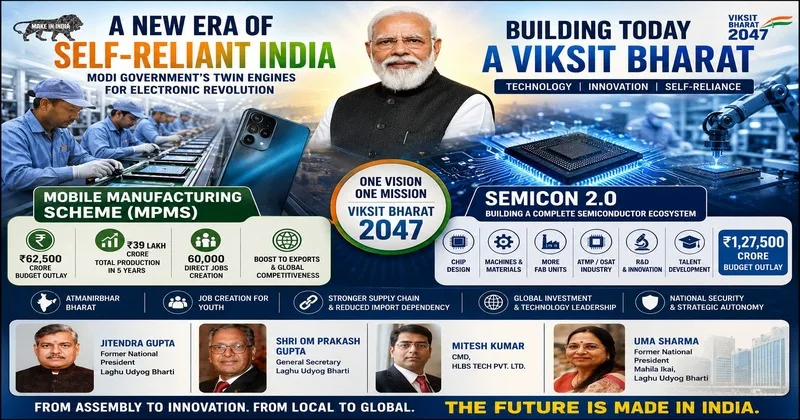
New Delhi: In a move to establish India as a new hub for global electronics manufacturing and the semiconductor industry, the central government, led by Prime Minister Narendra Modi, has taken two simultaneous decisions that are being hailed as game-changers for the Indian economy in the coming years. While the Union Cabinet has approved the Mobile Phone Manufacturing Scheme (MPMS) worth Rs 62,500 crore, it has also given the green signal to the ‘Semicon 2.0’ mission worth Rs 1,27,500 crore, clearly signalling that India is poised to play a decisive role in the race for global technological leadership.
Essentially, both these schemes aim to make the country self-reliant in areas such as design, research, patenting, chip fabrication and high-tech manufacturing. The government estimates that the mobile manufacturing scheme alone will generate production worth approximately Rs 39 lakh crore over the next five years, lead to a record surge in exports and create over 60,000 direct jobs. Meanwhile, ‘Semicon 2.0’ is set to place India among the select group of nations that manufacture semiconductors, the most critical technology for the future digital economy.
The government’s new mobile phone manufacturing scheme will be operational from the 2026-27 fiscal year through 2030-31. Under this scheme, incentives ranging from 2.25 Percent to 5 Percent will be provided on eligible sales. Companies sourcing key components domestically will receive an additional 1.5 Percent incentive. Furthermore, provisions have been made to offer an additional incentive of up to 3 Percent on eligible sales to companies that develop Indian brands and invest in design and research.
In this context, Prime Minister Narendra Modi has previously emphasised in his speeches that India should not merely remain a nation that assembles mobile phones; rather, the central government is continuously striving to foster innovation so that India can develop world-class Indian brands and indigenous technologies in the future. This decision is now being viewed as part of the efforts being made by the Centre in this direction.
Jitendra Gupta, an industrialist associated with the small-scale sector and former National President of Laghu Udyog Bharati, notes that until a decade ago, India was an importer of mobile phones; today, it is the world’s second-largest mobile manufacturer. The government’s next objective is to ensure a strong Indian presence in the semiconductor sector, a critical area of global technology. The mobile manufacturing scheme and Semicon 2.0 serve as two robust pillars of this long-term strategy.
He stated that if these schemes are implemented in line with the set targets, India will emerge as the most trusted hub for global electronics manufacturing in the coming years. Furthermore, India is poised to stand firmly among the world’s leading economies in areas such as technological innovation, chip design, patents, employment generation and exports. It is for this reason that the industry views these two decisions as historic steps that will shape India’s technological future.
He further added, “Our concern is ensuring that work proceeds in the right direction so that small industries can benefit from both these schemes. We hope that small industries will benefit significantly from both the Mobile Phone Manufacturing Scheme (MPMS) and Semicon 2.0- aimed at developing the semiconductor design and manufacturing ecosystem and that thousands of new jobs will be created.”
A Roadmap for India’s Technological Self-Reliance
Renowned industrialist and National General Secretary of Laghu Udyog Bharati, Omprakash Gupta, states, “For the first time, the Modi government has formulated a policy that integrates production, design and research. This initiative not only incentivizes the industry but also serves as a roadmap for making India technologically self-reliant. It will enable Indian companies to establish their brands in the global market and create new opportunities for millions of young people.”
Gupta adds, “This scheme is highly beneficial for small-scale industries alongside large ones. Thousands of MSMEs, spanning sectors such as machine tools, electronic components, chemicals, packaging and engineering, will become part of this ecosystem. This will open new avenues for the growth of the country’s small-scale industries and strengthen India’s industrial self-reliance.”
He remarked, “The world is witnessing the impact of the Modi government’s ‘Make in India’ policy today. Electronics manufacturing has grown sevenfold compared to 2014-15, while exports have recorded an elevenfold increase. India has now become the world’s second-largest mobile phone manufacturer, with 99.2 percent of the mobile phones used in the country being manufactured domestically. A significant milestone was achieved when smartphones emerged as India’s largest export product, surpassing traditional exports like diesel and cut diamonds.”
India’s Policy Boosts Global Investor Confidence
In this context, Gujarat-based industrialist Aniruddha Sharma says, “This achievement by India boosts the confidence of global investors. The new scheme will propel Indian companies beyond mere manufacturing and towards becoming global brands. This will lead to a substantial increase in both India’s export capacity and foreign exchange earnings.”
Alongside mobile manufacturing, the government has accorded the highest strategic importance to the ‘Semicon 2.0’ initiative. A budget of Rs 1,27,500 crore has been allocated for this purpose. Semicon 2.0 rests on six key pillars: chip design, machinery and material manufacturing, new fab plants, the ATMP/OSAT industry, research and development, and talent development. The government’s objective is to develop the entire semiconductor value chain in India.
Success of Semicon 1.0 Paves the Way for a New Leap
It is noteworthy that the positive outcomes of the government’s initial semiconductor mission are now becoming evident. So far, 12 manufacturing projects involving investments exceeding Rs 1.64 lakh crore have been approved. These include silicon fabs, silicon carbide fabs, micro-LED display fabs, and nine packaging units. Companies such as Micron, Kaynes, and CG Semi have already commenced commercial production.
Meanwhile, 105 startups are active in the chip design sector, and approximately 68,000 students across 315 universities have received training in state-of-the-art chip design. Jitendra Gupta, an industrialist from the small-scale sector, states, “The future belongs to nations that possess both technology and supply chain capabilities. Semicon 2.0 will transform India from a mere importer of chips into a vital hub of the global supply chain. This will drive significant changes across investment, employment and exports.”
Benefits Across Sectors: From National Security to AI
Mitesh Lokwani, Managing Director of HLBS Tech Pvt. Ltd., believes that semiconductors are not limited to the mobile industry alone. Chips play a crucial role in almost every modern sector, including defence, space, automotive, telecommunications, artificial intelligence (AI), drones, smart meters, medical equipment and industrial automation. Therefore, the government has placed special emphasis on Indian intellectual property (IP), chip design, and research, alongside manufacturing.
He stated, “The approval of Semicon 2.0 (Rs 1,27,500 crore) and the mobile phone manufacturing scheme (Rs 62,500 crore) by the Union Cabinet, under the leadership of Prime Minister Shri Narendra Modi, marks a historic step for India’s electronics and semiconductor ecosystem. I wholeheartedly welcome this decision. The provisions of the MPMS are particularly significant for the MSME sector, offering an additional 1.5% incentive for the domestic sourcing of key components and sub-assemblies and a 3% incentive for design and R&D. These measures steer the industry beyond mere assembly towards value-added manufacturing and the creation of Indian patents and brands.”
Additionally, Mitesh Lokwani, who is also the Chairman of the ELCINA IT Product SIG and President of LUB, adds, “The six pillars of Semicon 2.0, chip design; domestic manufacturing of machinery, materials, and chemicals; fabs; ATMP/OSAT packaging; R&D; and skill development, will open up new avenues for investment and employment in emerging electronics hubs like Madhya Pradesh. The target of achieving production worth approximately Rs 39 lakh crore and creating 60,000 direct jobs over five years will further strengthen the resolve for an ‘Atmanirbhar Bharat’ (Self-Reliant India).”
He said, “If India achieves global leadership in chip design and IP creation, it will transform from merely a manufacturing hub into an innovation hub in the coming years. This will form the true foundation of a developed India.” He stated, “As a vertically integrated electronics manufacturer based in Bhopal’s IT Park, HLBS Tech and the entire local MSME industry are committed to leveraging these schemes and contributing to the nation’s technological sovereignty.”
Uma Sharma, a senior industry representative, remarks, “Today, technological self-reliance has become the foremost prerequisite for economic self-reliance. These decisions by the Modi government will carve a distinct identity for India in the global technological landscape and expand high-quality employment opportunities, particularly for women and the youth.”
What has the Modi government done in this direction so far?
2014: Launch of the ‘Make in India’ campaign
Prime Minister Narendra Modi launched the ‘Make in India’ campaign in September 2014. Its objective was to transform India into a global manufacturing hub, attract foreign investment and boost domestic production in strategic sectors, including electronics. This campaign laid the foundation for today’s mobile and semiconductor missions.
Unprecedented growth in electronics manufacturing since 2014-15
As a result of ‘Make in India’, electronics manufacturing in the country increased nearly sevenfold after the 2014-15 fiscal year, while electronics exports recorded an elevenfold increase. The electronics sector emerged as a major source of employment for youth in rural and semi-urban areas.
India became the world’s second-largest mobile manufacturer
Driven by government policies and an industry-friendly environment, India has now become the world’s second-largest mobile phone manufacturer. Currently, 99.2 per cent of mobile phones used in the country are manufactured within India.
Year 2020: Implementation of the Production Linked Incentive (PLI) scheme
The Production Linked Incentive scheme for Mobile Phones and Large-Scale Electronics Manufacturing (PLI-LSEM) was launched. This scheme attracted global companies to invest in India and played a pivotal role in establishing the country as a global hub for mobile manufacturing and exports. The scheme remained effective until March 31, 2026.
Year 2025: Smartphones became India’s largest export product
The impact of the Modi government’s industrial policies led to smartphones emerging as India’s largest export product in 2025. They surpassed diesel fuel, cut diamonds and other traditional export commodities. This further strengthened India’s position in the global value chain.
July 2026: Approval for the Rs 62,500 crore Mobile Phone Manufacturing Scheme (MPMS)
The Union Cabinet approved the new Mobile Phone Manufacturing Scheme (MPMS). This scheme will remain in effect from the 2026-27 to 2030-31 financial years. It provides for incentives ranging from 2.25 Percent to 5 Percent on eligible sales, an additional 1.5% incentive for domestic component procurement and an extra 3 Percent incentive for design and Research & Development (R&D). The scheme aims to promote indigenous brands, Indian patents, and domestic value addition.
Target of Rs 39 lakh crore in production and 60,000 jobs through MPMS
The government estimates that mobile production in the country will reach approximately ₹39 lakh crore over the scheme’s five-year tenure. Mobile exports will see significant growth, and around 60,000 direct jobs will be created, further strengthening India’s position as a global electronics manufacturing hub.
December 2021: Launch of the India Semiconductor Mission (ISM)
The India Semiconductor Mission (ISM) was launched with the aim of making India self-reliant in semiconductor manufacturing. Through this mission, a framework for long-term policy and financial support was established for the country’s chip manufacturing, design, and packaging industries.
Approval of investments exceeding Rs 1.64 lakh crore under Semicon 1.0
The government has so far approved 12 semiconductor manufacturing projects involving investments of over Rs 1.64 lakh crore. These include a silicon fab, a silicon carbide fab, a gallium nitride micro-LED display fab, and nine ATMP/OSAT (packaging) units.
Three companies have commenced commercial production
Among the government-approved projects, Micron, Kaynes, and CG Semi have already started commercial production, while another unit is expected to begin production in 2026. This is driving the rapid development of the semiconductor manufacturing ecosystem in India.
Major boost for startups in chip design
Financial assistance has been provided to 24 MSME and startup projects in the semiconductor design sector. Meanwhile, state-of-the-art Electronic Design Automation (EDA) tools have been made available to 105 startups and MSMEs. These companies are developing chip designs for sectors such as drones, AI, satellite communication, smart meters, IoT, telecommunications, and defence.
Cultivating new technical talent across 315 universities
With a special focus on talent development, the government has provided modern EDA tools to 315 universities. To date, approximately 68,000 students have received training in advanced chip design, thereby preparing a skilled workforce for India’s future semiconductor industry.
July 2026: Approval of the Rs 1,27,500 crore Semicon 2.0 Mission
The Union Cabinet approved the Semicon 2.0 mission with a budget of Rs 1,27,500 crore. This mission is built upon six key pillars: chip design, machinery and materials, new fabs, ATMP/OSAT, research and development, and talent development. Its objectives include securing a leading position for India on the global semiconductor map, strengthening supply chains, bolstering national security, and establishing the country as a global hub for technological innovation and chip design.