Between 2014-2023, the year the Department of Ayush became a full-fledged Ministry, India’s exports of Ayush products doubled, rising from USD 1.09 billion to USD 2.16 billion. NITI Aayog’s Strategic Roadmap for Making Ayurveda Global (2026) records the figure with phenomenal development, in a single decade, the products of India’s oldest medical system found buyers in 150 countries, backed by a government that finally decided its civilisational pharmacy deserved a trade policy.
The Decade of Ayurveda
India today has over 3,55,000 trained Ayurveda practitioners, which it calls a strong domestic ecosystem, feeding a manufacturing base that ships everything from medicinal herbs to finished formulations across the world. The export basket, as the roadmap itemises it, spans Medicinal and Aromatic Plants, extracts, pharmaceuticals, cosmetics and nutraceuticals.
The growth has been broad as well as deep. Citing the Ayush Export Report, the roadmap suggests that the herbal medicinal sector alone grew from USD 0.86 billion in 2017 to USD 1.26 billion in 2021, a compound annual growth rate of 7.82 per cent. Three markets, the USA at 34.95 per cent, the European Union at 18.66 per cent and the UAE at 5.52 per cent, absorbed nearly 60 per cent of total Ayush exports in 2021. In the financial year 2023-24, the United States alone imported Ayush and herbal products worth USD 183.31 million, followed by Germany at USD 62.64 million and Italy at USD 36.20 million. The map of Ayurveda’s customers now looks remarkably like a map of the world’s richest health-conscious societies.
Beating China Where It Counts
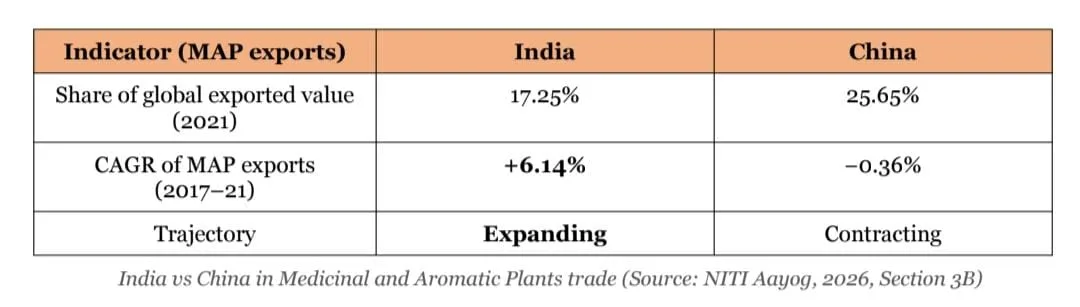
The report offers one comparison that deserves a wider audience. China and India are the world’s two dominant exporters of Medicinal and Aromatic Plants, holding roughly 25.65 per cent and 17.25 per cent of the globally exported value in 2021, respectively. But the trend lines show that between 2017 and 2021, China MAP exports registered a negative CAGR of 0.36 per cent, a shrinking franchise, while India grew at 6.14 per cent. In the raw botanical trade that feeds the world’s herbal industry, the momentum has changed hands, and it is moving east of the Himalayas to the Gangetic plains.
The segment-wise arithmetic underlines the point. MAP exports stood at USD 630.05 million, growing at 5.76 per cent annually, led by psyllium (48.42 per cent) and turmeric (32.66 per cent). Extracts reached USD 438.47 million with a striking CAGR of 11.60 per cent, powered by triple-digit growth in Sweden (112 per cent) and strong surges in Ireland (64 per cent) and Denmark (37 per cent). Pharmaceuticals contributed USD 193.6 million at 7.18 per cent growth, with the EU, USA, UAE and Nepal as principal destinations.
The Value-Chain’s importance
The roadmap is refreshingly honest about the structure beneath the success: the majority of India’s exports remain raw products, herbs and extracts, while finished pharmaceuticals lag. Only 4.83 per cent of total exports to the USA and 15.4 per cent to the EU are pharmaceuticals, a gap the report attributes squarely to the absence of regulatory approval for marketing Ayurveda products as drugs in those markets. Read correctly, this is not a weakness but the single largest headroom in Indian trade: the world is already buying Ayurveda’s ingredients, the task is to sell it Ayurveda’s medicines.
The world is already buying Ayurveda ingredients, the task is to sell Ayurveda’s medicines. Says Prof. Dr Lakshman Singh of the Yajurveda Dept BHU.
The report identifies the wedge. Psyllium alone accounts for more than 86 per cent of MAP exports to the United States, and the US FDA has included it in its over-the-counter drug review, classifying certain psyllium substances as Generally Recognised as Safe and Effective. The roadmap’s proposal defines a “pathfinder” strategy that qualifies one high-potential herb at a time through the most credible regulatory pathway, beginning with single-herb botanical drugs so that Ayurvedic formulations graduate from the supplements aisle to the pharmacy counter.
Indian industry has already begun building the bridgehead. The report documents Dabur’s manufacturing units in the UAE, Egypt, South Africa, Turkey, Nigeria and Nepal, Patanjali Ayurveda US-FDA registration for export and compliance with Himalaya subsidiaries and contract manufacturing in the UAE and USA for nutraceuticals and OTC herbal products. Overseas production under local GMP norms, the roadmap observes, shortens the distance between Indian formulation and foreign approval.
There is a telling detail in the trade data: relatively smaller markets such as the UAE and Nepal rank among the biggest importers of Ayurvedic pharmaceuticals, proof that where regulation permits Ayurveda to be sold as medicine, buyers follow. The report reads this as a signpost toward a much larger untapped landscape in South Africa, Tanzania, Brazil, Colombia, Sri Lanka and the wider Asian markets where Ayurveda is already recognised as a system of medicine and products may be marketed as drugs.
The Roadmap Trade by NITI Aayog
What distinguishes this report from routine committee literature is the specificity of its trade machinery. Five instruments stand out. First, an Ayurvedic Pharmacopoeia “Export Edition”, a specialised version of India’s pharmacopoeia engineered to satisfy the European Medicines Agency and its Herbal Medicinal Products Committee, complete with Good Agricultural and Collection Practices for raw material sourcing, full contaminant and heavy-metal profiles and chemical fingerprinting to prove batch-to-batch consistency. This is the document that converts scepticism in Brussels into signatures.
Second, a real-time Ayurveda Trade Dashboard providing near real-time import-export intelligence across HS codes mapped to Ayurveda product categories, market-wise trends, price and volume movements, port-wise flows, regulatory alerts and competitor benchmarks so that policy is steered by data rather than anecdote.
Third, a strengthened AyushExcil. The report is generous in its praise of the export promotion council, which is “already doing a wonderful job”, but candid about its thin staffing. It prescribes specialised cells for major markets, a support desk guiding exporters through the regulatory thickets of THMPD in the EU, DSHEA in the US, NHP in Canada and TGA in Australia and ready-made market playbooks with a “dossier diary” so that no manufacturer reinvents the wheel.
Fourth, trade facilitation at the customs line itself: aligning Harmonised System codes specifically for Ayurveda items, which today scatter across broad herbal and food categories, inviting confusion and delay and leveraging Free Trade Agreements to streamline approvals and market access.
Fifth, there is the geography. The report urges diversification beyond the US-EU-UAE triangle toward Asian and African markets where traditional medicine is culturally at home, through country prioritisation, in-market partnerships, trade fairs and buyer-seller meets convened by Indian missions. It goes further, proposing India-led Ayurveda supply hubs and manufacturing units across Africa, ASEAN and Latin America, built on AyushExcil and Ministry of External Affairs platforms with dedicated trade corridors carrying Indian wellness to three continents.
Underlying all five instruments is the absence of centralised data on manufacturing and export volumes, which remains a structural handicap. Closing that gap, the report also argues, would deliver the transparency, traceability and strategic branding on which a globally trusted system of medicine must stand.
From Schedule T to the World
The medium-term agenda reaches into the factory. The roadmap calls for upgrading Schedule T, India’s domestic GMP guidelines to WHO-GMP equivalence, the stricter standard recognised in regulated markets, backed by a public online database of certified manufacturers and batch-wise Certificates of Analysis carrying QR-linked test results for heavy metals, aflatoxins, pesticides and microbes. Trust in export markets is a laboratory document.
It further proposes overseas finishing and packaging units in the UAE, EU and US, value captured in India through raw material exports, regulatory hurdles cleared abroad through local GMP, with incentives for manufacturers willing to set up units on foreign industrial estates. And in a conceptual leap, it frames Ayurveda as a Service: government-supported Ayurveda hospitals, clinics and wellness centres abroad offering standardised Panchakarma and preventive care, creating a service-export channel that generates sustained demand for certified Indian medicines, therapies and training.
By 2047, the report envisions the trade architecture maturing into global public goods: harmonised safety and efficacy benchmarks for traditional medicine developed with international partners, an annual Global Safety Report consolidating pharmacovigilance data across markets and a Global Evidence Report presenting clinical research in regulator-friendly form. India’s R&D spending on Ayurveda, currently around USD 234 million, is acknowledged as the variable that must rise for the rest to compound.
The Aatmanirbhar Way
A sector that entered 2014 with just over a billion dollars in exports and no dedicated ministry exists the decade with doubled trade, presence in 150 countries, growth rates that outpace its only global rival in the botanical trade, and a state apparatus now designing pharmacopoeias, dashboards and playbooks with the seriousness once reserved for steel and software. The report’s own prescription — shift up the value chain, from herbs to high-value finished products — is less a critique than a coming-of-age announcement.
The first doubling was achieved while Ayurveda sold the world its raw materials. The next one, the roadmap wagers, will come when India sells the world its medicine, manufactured to WHO-GMP standards, documented to European exactness and stamped, quite unmistakably, Made in India.