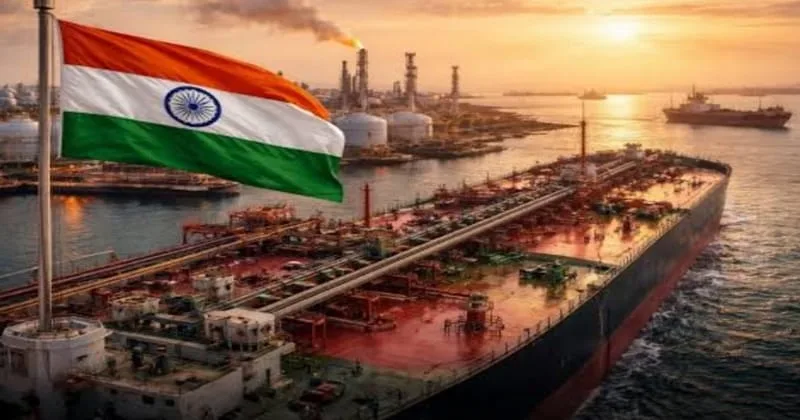
New Delhi: For decades, India was primarily known as one of the world’s largest importers of crude oil, relying heavily on overseas suppliers to meet its growing energy needs. While that reality remains, the country’s role in the global energy market has undergone a remarkable transformation. Instead of merely consuming imported crude, India has built one of the world’s most advanced refining industries, enabling it to convert crude oil into high-value petroleum products that are exported across the globe.
🚨MASSIVE ACHIEVEMENT: India Emerges as an Oil Export Superpower, Petroleum Exports Set to Surge by 25%
For decades, India was viewed as one of the world's largest crude oil importers. Today, that narrative is changing dramatically. While the country still imports most of its… pic.twitter.com/uRXp0n6GTe
— Not Just Headlines (@Notjustheadline) July 13, 2026
Today, India stands among the leading exporters of refined petroleum products, supplying fuels to markets in Asia, Europe, Africa, and beyond. This shift has significantly strengthened India’s position in the global energy supply chain while creating substantial economic value.
Petroleum Exports Set for Major Growth
India’s petroleum exports currently generate nearly $44 billion annually, making petroleum products one of the country’s largest export categories. This figure is expected to witness an impressive 25 per cent increase, taking export earnings to nearly $55–56 billion over the coming years.
The anticipated growth is backed by significant investments in refining infrastructure. Indian Oil Corporation Limited (IOCL), India’s largest oil refining and marketing company, has announced investments exceeding Rs 75,000 crore to expand refining capacity at its Panipat (Haryana), Vadodara (Gujarat), and Barauni (Bihar) refineries.
These projects will collectively add 17.3 million metric tonnes per annum (MMTPA) of refining capacity, taking India’s overall refining capability close to 300 MMTPA, further strengthening the country’s ability to meet both domestic demand and international export requirements. Instead of exporting crude oil, India exports a wide range of refined petroleum products that generate significantly higher value in international markets.
These include petrol (motor spirit), high-speed diesel, aviation turbine fuel (ATF), marine fuel, liquefied petroleum gas (LPG), naphtha, petrochemical feedstocks, and various speciality petroleum products. By converting imported crude into high-value refined fuels, India has strengthened its export earnings while establishing itself as a major supplier of energy products to countries around the world. Indian refineries supply these products to numerous countries, helping meet transportation, industrial, aviation, and energy requirements worldwide.
Building a Global Refining Hub
India possesses some of the most sophisticated and technologically advanced refineries in the world. These facilities are designed to process a wide variety of crude oils sourced from multiple regions, including Russia, the Middle East, the United States, and Africa. This flexibility allows Indian refiners to optimise production based on global crude availability and pricing, enhancing competitiveness in international markets.
Combined with competitive operating costs, skilled manpower, modern infrastructure, and strategic access to major shipping routes through the Indian Ocean, India is steadily emerging as one of the world’s most important refining hubs.
India’s growing refining capacity carries strategic significance beyond trade figures. Recent geopolitical tensions and disruptions in global energy supplies highlighted the importance of reliable refining nations. During periods when several regions faced fuel shortages, Indian refineries continued supplying refined petroleum products to international markets, reinforcing India’s reputation as a dependable energy partner.
As global demand for refined fuels remains strong, India’s expanding refining network is expected to play an increasingly vital role in maintaining energy security across multiple regions.
Boosting the Economy
Higher petroleum exports bring wide-ranging economic benefits for India, including increased foreign exchange earnings, higher industrial output, greater employment opportunities, a stronger manufacturing ecosystem, improved global trade competitiveness, and enhanced energy security. In addition, large-scale refinery expansion encourages investments in logistics, petrochemicals, storage facilities, pipelines, and port infrastructure, creating a multiplier effect that boosts economic activity across multiple sectors and supports long-term industrial growth..
India’s energy story is no longer defined solely by its dependence on imported crude oil. Instead, the country has successfully leveraged its refining expertise to create value, strengthen exports, and establish itself as a major player in the global petroleum market.
With refining capacity approaching 300 MMTPA, substantial investments underway, and petroleum exports expected to rise by nearly 25%, India is steadily transitioning from being viewed simply as a crude importer to becoming one of the world’s leading exporters of refined energy products.
The transformation reflects not only industrial growth but also India’s emergence as a key pillar of the global energy supply chain. As refining capacity expands and exports continue to grow, India is well-positioned to become one of the world’s foremost refining and petroleum export hubs in the years ahead.