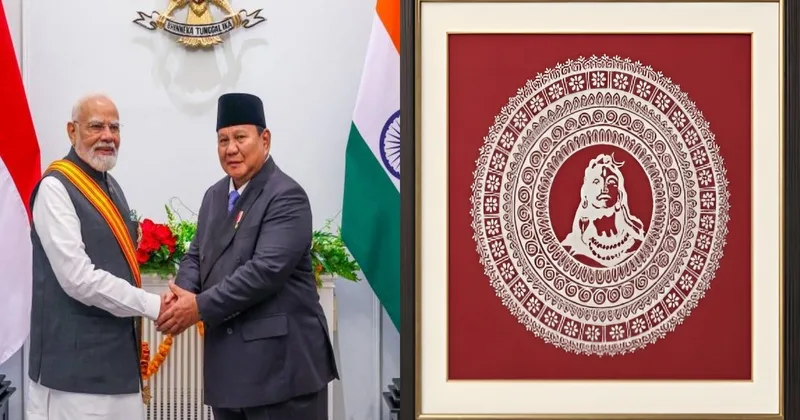
New Delhi: Prime Minister Narendra Modi presented a traditional Aipan artwork from Uttarakhand, dedicated to Bhagwan Shiva, to Indonesian President Prabowo Subianto as a diplomatic gift, showcasing India’s rich artistic traditions and centuries-old cultural heritage. The gift reflects India’s continued emphasis on promoting indigenous crafts on the global stage while strengthening cultural and civilisational ties with friendly nations.
Gift given by PM @narendramodi to Indonesian President Prabowo Subianto
UTTARAKHAND AIPAN ART SHIVA
Aipan is a traditional folk art from the Kumaon region of Uttarakhand, created mainly by women during festivals on floors and walls using a terracotta-red base (Geru) and… pic.twitter.com/mmLWlywBQQ
— DD News (@DDNewslive) July 12, 2026
The Aipan artwork is one of Uttarakhand’s most celebrated folk art traditions and originates from the Kumaon region of the Himalayan state. Practised primarily by women, Aipan has been an integral part of household rituals, festivals, and religious ceremonies for generations. The art is traditionally created on the floors, walls, entrances, and prayer spaces of homes during auspicious occasions such as Deepawali, Navratri, weddings, thread ceremonies, and other religious celebrations.
The word ‘Aipan’ is derived from the Sanskrit word ‘Arpan’, meaning “to offer” or “to dedicate.” True to its name, the art is regarded as an offering to the divine and is believed to invite prosperity, positive energy, and blessings into the household. Every motif is carefully designed according to the occasion and carries symbolic religious significance.
Unique Style and Traditional Technique
Aipan is distinguished by its striking visual contrast. The artwork is first prepared using a base of Geru, a natural terracotta-red clay that has been traditionally used for centuries. Over this background, artists create delicate white patterns using Biswar, a paste prepared from finely ground rice flour mixed with water.
Unlike many forms of decorative painting, Aipan is entirely drawn freehand without rulers, stencils, or measuring tools. The intricate symmetry and precision displayed by skilled artists reflect years of practice and the passing down of knowledge through generations. Common motifs include lotus flowers, swastikas, footprints of Maa Lakshmi, bells, conch shells, lamps, mandalas, and sacred geometric diagrams. Each design represents prosperity, purity, protection, divine energy, or spiritual harmony.
The artwork presented by Prime Minister Modi is dedicated to Bhagwan Shiva, one of Hinduism’s principal deities and the supreme god in the Shaivite tradition. The piece incorporates sacred geometric patterns associated with cosmic balance, spiritual awakening, and universal energy.
By choosing a Shiva-themed Aipan artwork, India highlighted the country’s enduring spiritual traditions while showcasing the exceptional craftsmanship of Uttarakhand’s women artisans.
A Symbol of India’s Living Heritage
Aipan is recognised as one of India’s important intangible cultural traditions. Although deeply rooted in Uttarakhand, the art has increasingly gained national recognition through exhibitions, government initiatives, and cultural festivals that seek to preserve traditional crafts.
The folk art represents more than decoration—it reflects local beliefs, family traditions, and the close relationship between everyday life and spirituality in the Himalayan region. Every generation has contributed to preserving this artistic legacy, making Aipan a living expression of India’s cultural diversity.
Strengthening India-Indonesia Cultural Ties
The presentation of the artwork also carries strong diplomatic symbolism. India and Indonesia share centuries-old civilisational links shaped by trade, maritime exchanges, religion, language, and culture. Hindu epics such as the Ramayana and Mahabharata continue to influence Indonesian literature, dance, theatre, and temple architecture.
Bhagwan Shiva occupies an important place in Indonesia’s historical and cultural heritage. Ancient Mandirs, including the famous Prambanan Mandir Complex in Java, are dedicated to Shiva and stand as enduring symbols of the deep cultural connections between the two countries. By gifting a traditional Indian artwork centred on Bhagwan Shiva, Prime Minister Modi acknowledged these shared historical roots while reinforcing the close friendship and strategic partnership between India and Indonesia.
Prime Minister Modi has consistently chosen handcrafted Indian artefacts, textiles, paintings, sculptures, and traditional crafts as diplomatic gifts for world leaders. These carefully selected gifts highlight India’s regional art forms while providing international recognition to local artisans and centuries-old traditions. The gift stands as a meaningful symbol of friendship, mutual respect, and the shared civilisational heritage that continues to unite India and Indonesia in the modern era.