“The Government of Pakistan should undertake to use its best endeavours : (a) To secure the withdrawal from the State of Jammu and Kashmir of tribesmen and Pakistani nationals not normally resident therein who have entered the State for the purpose of fighting, and to prevent any intrusion into the State of such elements and any furnishing of material aid to those fighting in the State; (b) To make known to all concerned that the measures indicated in this and the following paragraphs provide full freedom to all subjects of the State, regardless of creed, caste, or party, to express their views and to vote on the question of the accession of the State, and that therefore they should co-operate in the maintenance of peace and order”
– The UNSC Resolution on India-Pakistan Question, with special reference to Jammu and Kashmir, Resolution 47 (1948), April 21, 1948
The violence and protests are not a new phenomenon for Pakistan. Islamabad has developed a convenient strategy to deflect the blame on Bharat without reflecting on the limitations of the failed idea called Pakistan. What is happening in Pakistan-occupied Jammu-Kashmir (PoJK) is different from what happens within Pakistan and is of direct concern to Bharat. Hence, we need to have a larger debate over the façade of ‘Azad Kashmir’ and galvanise the international opinion against human rights abuses and political-administrative failures of Pakistan in the territory that legally belongs to Bharat.
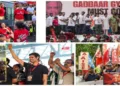
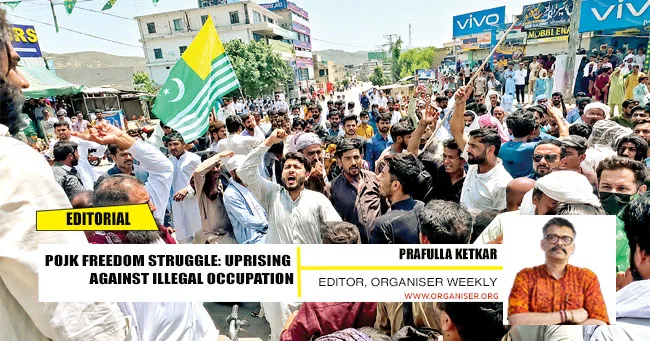
The killing of JAAC activist Shahzeb Habib, who was part of the ongoing protests demanding basic rights, including electricity and wheat subsidies for the people of the occupied region, triggered another wave of uprising against the tyrannical rule in Islamabad. He was a worker with the Joint Awami Action Committee (JAAC) in Rawalakot and a close associate of Omar Nazir. The JAAC is an umbrella organisation that has been peacefully demanding its democratic rights since May 2023, but the military rule in Pakistan has responded with an elusive response. The international situation enabled the occupational forces to suppress voices by shutting down internet services. The negotiations over the 39-point charter, which includes legislative reforms, have been lingering since the October 4, 2025, agreement. Pakistan, true to its nature, did not adhere to any of the clauses in the agreement; instead, it pushed for the abolition of refugee seats and the trifurcation of the region. When the JAAC boycotted the talks, the authorities banned JAAC, calling it a terrorist organisation. Since then, protests by traders, transporters, lawyers, students, and civil society groups have continued across the ten districts, and so has the brutal suppression by Pakistani security forces.
Since Pakistan illegally occupied some parts of Jammu-Kashmir, it is the same story over there also. The discontent in PoJK runs far deeper due to historical, cultural, political and economic reasons. The Mirpuri, Kashmiri, Gilgit and Balti, all identities are undermined through the cultural imposition of West Punjabi, Sunni Islamic and Urdu-speaking leadership. The dams are constructed, but electricity is diverted to the Punjab region, keeping the PoJK in the dark or subject to high tariffs. Political representation is denied. In the name of ‘Islam’, after illegally occupying the territory, Islamabad has been manipulating the people through demographic invasion, radicalisation and terror promotion, giving the fake ‘Azadi’ slogan while actually enslaving the masses. Installing puppet governments with a change of regime in Islamabad, and if somebody questions this, use military power to suppress their human rights. The last resort – blaming Bharat for all these failures has been the standard operating procedure of Pakistan. The Western powers that have created Pakistan as a strategic space to fulfil their own vested interests, keep silent over the tyrannical rule and do not hold Pakistan accountable for its misdeeds and abuses. Now, the people of J&K have realised the machinations of military rule that runs the country like a business. They also have democratic and developmental aspirations and seek participatory governance, as people on the Bharatiya side enjoy.
The idea that germinated from the principles of negativity and exclusion is bound to face resistance from its own people. From Baloch to Sindh, none of them are finding resonance with the larger Pakistani identity. From not being part of Hindu civilisation, it is struggling to create a common national consciousness due to utter confusion. The distorted idea, based on the fascination with the invasion by Mohammad Bin Qasim, is now suddenly finding Takshashila and Panini as part of their heritage. How can such a confused nation-state ensure dignity and justice for the people of PoJK?
The United Nations Security Council (UNSC) resolution of 1948 is frequently used by Pakistan, which through its networks in the US, raises the plebiscite card against Bharat. This clearly identifies Pakistan as an aggressor and puts ‘withdrawal of Pakistani nationals and tribesmen’ as the precondition for resolving the dispute. The international community can no longer afford to ignore the aspirations of the people of PoJK against the aggressor who never left.