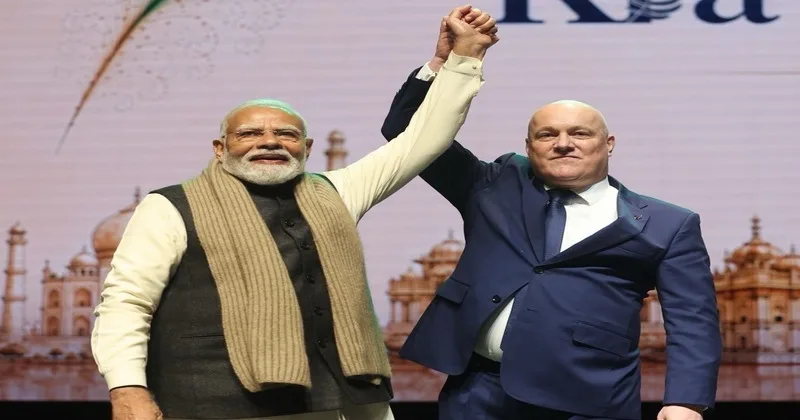
An Indian Prime Minister’s visit to New Zealand after four decades underscores the significant expansion in the scope of India’s foreign policy. Today’s imperatives, economic diplomacy, global investment, technological collaboration, free trade and the creation of reliable supply chains, are precisely the areas driving India’s current foreign policy.
Indeed, the high priority accorded to trade and investment, alongside defense, education, agriculture and maritime security, during the talks between Prime Minister Narendra Modi and New Zealand Prime Minister Christopher Luxon signals accelerated mutual economic growth between the two nations in the coming years.
https://x.com/narendramodi/status/2075907783711711678?s=20
Prof. Manish Kumar Punia, an economic affairs analyst at the University of Delhi, remarks on the visit: “Prime Minister Modi’s visit to New Zealand is a tangible example of this transformation. During this visit, the first in four decades, both nations elevated their ties to a strategic partnership and formulated a comprehensive roadmap for cooperation through 2030. This roadmap encompasses 18 key sectors, including trade, investment, defense, education, agriculture, innovation, maritime cooperation and the digital economy”.
Prof. Punia also highlights that while economic relations between India and New Zealand have not yet reached their full potential, available data clearly points to future possibilities. By December 2025, total bilateral trade between the two countries had reached approximately NZD 3.95 billion, with New Zealand’s exports to India accounting for NZD 2.03 billion. India is currently among New Zealand’s rapidly emerging export markets and this significance is expected to grow further in the years ahead.
https://x.com/narendramodi/status/2076214172380229809?s=20
He stated, “Both nations have set a target to nearly double this trade by 2030. This decision is undoubtedly part of a strategy to transform the relationship between the two economies into a long-term partnership. Today, India possesses a unique combination of political stability, a vast domestic market, competitive manufacturing capabilities, digital infrastructure and skilled human resources, factors that are attracting global companies. Cooperation with New Zealand in areas such as agricultural value chains, food processing, maritime logistics, cold chain facilities and export infrastructure is integral to this comprehensive strategy. If both countries move swiftly in this direction, India could emerge as a pivotal hub in the Asia-Pacific supply chain”.
Furthermore, Prof. Punia notes that approximately 250,000 people of Indian origin are active participants in New Zealand’s economy. They play significant roles in sectors such as information technology, healthcare, education, trade, financial services and entrepreneurship. This community has also become the most effective bridge for investment, trade and cultural trust between the two nations. Prime Minister Modi has described the Indian diaspora as partners in India’s development journey, while Prime Minister Luxon has openly praised the Indian community’s contributions. Clearly, this community will further strengthen the economic ties between the two countries in the future.
https://x.com/narendramodi/status/2075909168251445608?s=20
Free Trade Agreement to be a ‘Game Changer’
Dr. BMS Bhadauria, a Professor of Finance in the Madhya Pradesh Higher Education Department, observes, “The consensus reached on a Free Trade Agreement (FTA) between India and New Zealand marks the most significant achievement of this entire journey. Under this agreement, set to be signed in April 2026, provisions have been made to reduce or eliminate tariffs on approximately 95 percent of New Zealand’s exports, while a wide range of Indian products will also gain easy and competitive access to the New Zealand market”.
He stated, “The agreement provides for duty-free access for approximately 57 percent of New Zealand’s exports from the very first day of implementation, with the scope set to expand further over time. This holds great significance for Indian industry, as it will facilitate easier access to a developed market with high purchasing power for Indian pharmaceuticals, engineering goods, textiles, chemicals, processed foods, IT services and products from small and medium-sized enterprises (SMEs)”.
Which sectors will see the greatest growth in trade?
The sectors prioritized during the talks between Prime Minister Modi and Prime Minister Luxon will shape the trajectory of economic relations between the two nations in the coming years. Agriculture and food processing are among the most critical sectors. New Zealand is a global leader in dairy technology, animal husbandry, horticulture and agricultural research, while India possesses a vast agricultural market and significant food processing capacity.
Forestry and the timber industry already constitute a substantial portion of the trade between the two countries. In 2025, exports of forestry products from New Zealand to India amounted to approximately NZD 399 million. Other key exports included apples, kiwifruit, wool, aluminum and iron and steel. Conversely, India has been recording steady growth in exports to New Zealand across sectors such as pharmaceuticals, petroleum products, textiles, machinery, engineering goods, auto components, chemicals and information technology services. Significant expansion in these sectors is anticipated following the FTA.
https://x.com/narendramodi/status/2075871252926156807?s=20
India is an investment destination that goes beyond just being a market
Professor Anil Shivani, from the Department of Commerce and Management (Higher Education, Madhya Pradesh), states, “PM Modi’s visit conveys a significant message to global investors. Prime Minister Modi has invited New Zealand’s industry leaders to invest in India’s infrastructure development, clean energy, digital economy, logistics, water management, aviation, smart cities and manufacturing sectors. At the same time, Prime Minister Modi is raising India’s stature on the global stage; his foreign visits hold immense diplomatic significance alongside their economic importance”.
He adds, “Today, India is the world’s fastest-growing major economy. A vast domestic market, a young workforce, a rapidly evolving digital economy and a continuously improving business environment make it an attractive destination for global investors. This is why India is moving towards becoming a hub for global production and innovation, rather than remaining merely a consumer market”.
Professor Anil Shivani further remarks, “PM Modi is elevating India’s profile across the globe. Wherever he goes, not only is India’s head held high, but the Indian diaspora residing in those countries also feels a sense of pride in having their Prime Minister amidst them. His mindset has fostered a deep sense of reverence, beyond mere respect, within the global community. The fact that India stands ready to assist any nation during a crisis today is a direct result of Modi-ji’s leadership. Undoubtedly, his actions are continuously enhancing India’s global acceptance”.
https://x.com/narendramodi/status/2075850552244859060?s=20
A multi-billion dollar market to open in agriculture, dairy and agri-tech
In this context, S.K. Singh, a Professor of Commerce at Jiwaji University, observes that despite their differences, the economies of India and New Zealand complement each other. New Zealand is renowned for world-class dairy technology, livestock management, agricultural research, horticulture and food quality standards, while India is the world’s largest milk producer, boasting a vast agricultural market and a rapidly growing food processing industry. Both nations have agreed to enhance institutional cooperation in areas such as agricultural research, water management, dairy science, biosecurity, food processing and agricultural innovation.
It was noted that this could benefit Indian farmers through access to modern technology, improved productivity and export-oriented farming. Conversely, New Zealand companies would gain access to a massive market like India. This partnership offers an opportunity to move agriculture beyond traditional production methods and integrate it into global value chains.
https://x.com/narendramodi/status/2075850552244859060?s=20
Significant agreements reached in these sectors as well
India’s greatest strength has become its digital public infrastructure. UPI, digital payment systems, Aadhaar-based services, a thriving startup ecosystem, and fintech innovations have earned India global recognition. Consequently, New Zealand has shown keen interest in deepening cooperation with India in sectors such as digital technology, cybersecurity, artificial intelligence, fintech and innovation-driven industries.
Furthermore, the new partnership entails an agreement to expand collaboration in higher education, skill development, research, vocational training and university-level partnerships. Both nations reaffirmed their commitment to a rules-based order, secure maritime routes and seamless trade in the Indo-Pacific region, commitments that will directly benefit global trade and supply chains.
India’s global economic stature strengthened
The most significant message from this visit is that India is establishing itself as a trusted economic partner on the world stage. The fact that a developed, high-income nation like New Zealand is forging a strategic partnership with India demonstrates that global investors and developed economies view India as a central hub for the future growth story. Institutions such as the World Bank, the International Monetary Fund (IMF) and various global economic bodies consistently identify India as the world’s fastest-growing major economy. Against this backdrop, this new partnership with New Zealand further reinforces India’s economic credibility.
https://x.com/narendramodi/status/2075779258652545133?s=20
From diplomacy to economic power
This journey also symbolizes the shifting global economic landscape, in which India is emerging as a central pillar of production, investment, innovation and reliable supply chains. If the goals of Roadmap 2030 are achieved within the stipulated timeframe, the India-New Zealand partnership will be remembered in the years to come not merely as a successful bilateral relationship, but as a significant milestone in economic diplomacy. Such initiatives demonstrate that the India of today is not only making its voice heard on the global stage but is also charting a new geography of economic opportunities.