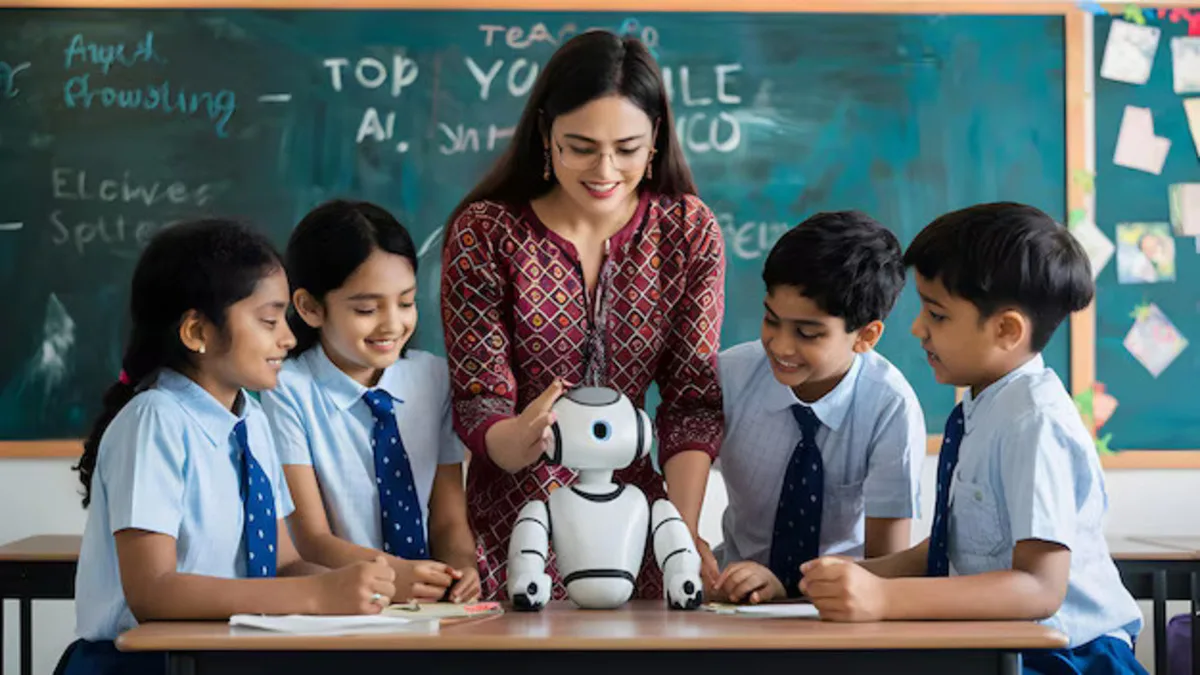
Artificial Intelligence is rapidly emerging as one of the most significant drivers of transformation in India’s school education ecosystem. Guided by the National Education Policy (NEP) 2020, governments, educational institutions, technology companies, and international organisations have increasingly collaborated to integrate AI, robotics, coding, STEM education, digital learning, and smart classroom infrastructure into schools across the country. These initiatives are gradually redefining how students learn, how teachers teach, and how schools prepare young learners for an increasingly technology-driven future.
Between 2021 and 2026, several states and institutions have introduced large-scale programmes aimed at strengthening AI literacy, digital competency, experiential learning, and innovation among school students. From AI-powered assessments and personalised learning platforms to robotics laboratories, virtual teachers, smart classrooms, and teacher capacity-building initiatives, these efforts represent a broad implementation of NEP 2020’s vision of preparing learners with future-ready skills. The initiatives also reflect increasing cooperation between central and state governments, educational boards, industry leaders, philanthropic organisations, and global partners to expand access to technology-enabled education.
The scale of implementation is notable across multiple regions of the country. Gujarat’s technology-enabled education ecosystem now reaches over 1.15 crore students across 54,000 schools, while Rajasthan has conducted more than 45 lakh AI-enabled student assessments. Uttar Pradesh has expanded the PM SHRI scheme to 1,713 schools, Chhattisgarh has introduced robotics and AI education across 800 government schools, and several other states have established AI laboratories, STEM centres, smart classrooms, and digital learning platforms. Together, these initiatives demonstrate the growing emphasis on competency-based education, digital inclusion, innovation, and the development of 21st-century skills under NEP 2020.
The detailed 14 major initiatives transforming school education under NEP 2020 are given below.
1. Kolkata Schools Upgrade Robotics and AI Labs to Strengthen Future-Ready Learning
Schools in Kolkata are expanding AI and robotics education under NEP 2020 through the introduction and upgradation of AI-driven robotics laboratories and advanced STEM learning programmes. DPS Ruby Park has inaugurated one of eastern India’s most advanced AI and Robotics Labs, while South Point, Birla Bharati, DPS Howrah, and St. Xavier’s Collegiate are upgrading their robotics infrastructure. The initiative is promoting coding, AI literacy, hands-on learning, and future-ready skills from the primary and middle school levels.
2. Uttar Pradesh Expands PM SHRI Scheme to 1,713 Schools for Technology-Enabled Learning
Uttar Pradesh has expanded the PM SHRI scheme to 1,713 government schools, the highest in India, to implement NEP 2020 through world-class infrastructure and technology-enabled learning. The schools feature smart classrooms, ICT labs, science laboratories, digital libraries, sports facilities, and green initiatives, while promoting skill-based and experiential education alongside continuous teacher training to prepare over 5 crore students for the future.
3. Google and UNICEF Launch Three-Year AI-Powered Education Initiative
Google and UNICEF have launched a three-year partnership to expand AI-powered education across India, Brazil, Pakistan, and Kenya. The initiative will use tools including Gemini, NotebookLM, Gemini for Education, and ReadAlong to support literacy, teacher training, and digital learning. In India, it complements the AI Educator Series under NEP 2020 to strengthen AI literacy and promote more inclusive, technology-enabled classrooms.
4. Madhya Pradesh Adopts AI-Driven School Education Model Under NEP 2020
Madhya Pradesh is implementing an AI-driven school education model under NEP 2020 through curriculum reforms, teacher training, and AI-enabled governance. AI courses have been introduced in 53 government schools, benefiting 6,462 students, while 274 Sandipani Schools are teaching AI concepts to more than 50,000 students. The state has also deployed AI-powered tools for personalised learning and automated assessments to strengthen future-ready skills and improve learning outcomes.
5. Uttar Pradesh to Establish Kalpana Chawla Space Lab for STEM and AI Education
Uttar Pradesh’s Raj Bhawan will establish the Kalpana Chawla Space Science and Innovation Lab to provide students of Classes 6–8 with hands-on training in space science, robotics, AI, drones, astronomy, and satellite technology. Developed in collaboration with the Vyomika Foundation, the initiative supports ISRO’s outreach goals and NEP 2020 while promoting STEM learning, innovation, and future-ready skills among government school students.
6. Cyient Foundation and Karnataka Government Launch AI Education Initiative in Government Schools
Cyient Foundation has launched CYIENT VijAIpatha in Karnataka to introduce AI, STEM, robotics, coding, and digital innovation in government schools. The pilot initiative covers five schools, benefiting more than 2,000 students and training over 200 teachers through AI-STEM laboratories equipped with computers, robotics kits, IoT devices, and broadband. Aligned with NEP 2020, the initiative aims to build future-ready skills and bridge the digital divide in rural communities.
7. NCERT Introduces AI Curriculum for Classes 11 and 12
NCERT began developing AI syllabi and textbooks for Classes 11 and 12 while expanding AI education across school levels. The initiative aligns with NEP 2020 by integrating emerging technologies into education, promoting experiential learning, and equipping students with future-ready digital and computational skills.
8. AI, Robotics and Smart Learning Expand Across India’s School Education System
India is expanding AI, robotics, and data-driven learning through multiple technology initiatives. Gujarat’s Vidya Samiksha Kendra tracks 1.15 crore students across 54,000 schools using 508 crore data points annually, saving more than 1 crore work hours. Rajasthan’s Padhai With AI has raised pass rates to 96.4%, while Pune has expanded AI-enabled smart classrooms to 1,200 classrooms serving 44,000 students. Robotex India has also introduced more than 24,000 government school students to coding, robotics, and AI, making technology-driven learning more inclusive and accessible nationwide.
9. Tamil Nadu Launches TN SPARK Pilot to Introduce AI and Robotics in Government Schools
Tamil Nadu launched the TN SPARK (Tamil Nadu Schools Programme for AI, Robotics and Knowledge of Online Tools) pilot in 85 government schools across Coimbatore district for students of Classes VI–IX. The programme provides hands-on training in AI, robotics, coding, and digital tools through bilingual learning materials, trained teachers, and upgraded computer laboratories. Aligned with NEP 2020, it promotes experiential learning, integrates emerging technologies into school education, and equips students with future-ready skills.
10. Government Launches SOAR AI Learning Programme Under NEP 2020
The Ministry of Education launched the SOAR (School Outreach for AI Readiness) AI Learning Programme to enhance AI literacy and build AI capabilities among school students and teachers through structured training and learning modules. The initiative supports the vision of NEP 2020 by integrating AI into school education, promoting digital literacy and experiential learning, and preparing learners with future-ready skills.
11. Rajasthan Adopts AI-Powered Assessments Under NEP 2020
Rajasthan is modernising school assessments through AI-enabled, competency-based evaluations under NEP 2020. More than 45 lakh students have been assessed using AI-powered tools, while over 26 lakh students completed AI-based reading tests within 10 days. The state has also introduced 100% digital evaluation of RSOS answer sheets, standardised the CET for Classes 9–12, and integrated 270 minutes of weekly remedial learning to make assessments more transparent, student-centric, and outcome-focused.
12. NagaEd Launches Northeast India’s First AI-Powered Teacher on WhatsApp
NagaEd launched Livi AI, Northeast India’s first AI-powered teacher on WhatsApp, to provide curriculum-aligned Science and Mathematics education to students in urban and remote areas. Integrated with NCERT and local curricula, Livi AI offers personalised learning, quizzes, performance tracking, and instant feedback. The platform will be rolled out in partner schools, supporting NEP 2020 while improving digital access, AI literacy, and future-ready skills for students across the region.
13. Chhattisgarh Introduces Robotics and AI in 800 Government Schools
The Chhattisgarh government launched a three-year Skill Education Programme in partnership with the Magic Bus India Foundation to introduce robotics, artificial intelligence, and skill education in 800 government schools. The initiative initially covers 40,000 students and trains 1,600 teachers. Aligned with NEP 2020, it promotes experiential and skill-based learning while equipping students with future-ready skills through emerging technologies.
14. Prime Minister Launches AI for All Initiative to Promote AI Literacy
The Prime Minister of India launched the AI for All initiative, a nationwide AI awareness programme introduced by the Ministry of Education, CBSE, and Intel India. Launched on the first anniversary of NEP 2020, the free four-hour self-paced programme is designed to build basic AI awareness among students and citizens. The initiative supports NEP 2020 by promoting digital literacy and AI education while preparing learners with future-ready skills for an AI-driven economy.
The fourteen initiatives compiled in this report collectively illustrate the growing integration of Artificial Intelligence, robotics, coding, STEM education, digital infrastructure, and technology-enabled learning within India’s school education system under the framework of the National Education Policy 2020. Implemented across multiple states and supported by collaborations between governments, educational institutions, industry partners, and international organisations, these programmes demonstrate a sustained emphasis on strengthening digital learning ecosystems and expanding access to emerging technologies.
The initiatives span a wide range of educational interventions, including AI-powered assessments, robotics laboratories, smart classrooms, teacher training, curriculum reforms, personalised learning platforms, digital governance, and AI literacy programmes. Their implementation across government and private schools reflects an increasing focus on competency-based education, experiential learning, innovation, and the development of future-ready skills among students from diverse regions of the country.
Taken together, these developments represent a significant phase in the implementation of NEP 2020’s vision for school education. By expanding AI literacy, encouraging technology-enabled teaching and learning, promoting digital inclusion, and strengthening STEM education, the initiatives contribute towards preparing students and educators for the evolving demands of an increasingly knowledge-driven and technology-oriented future.