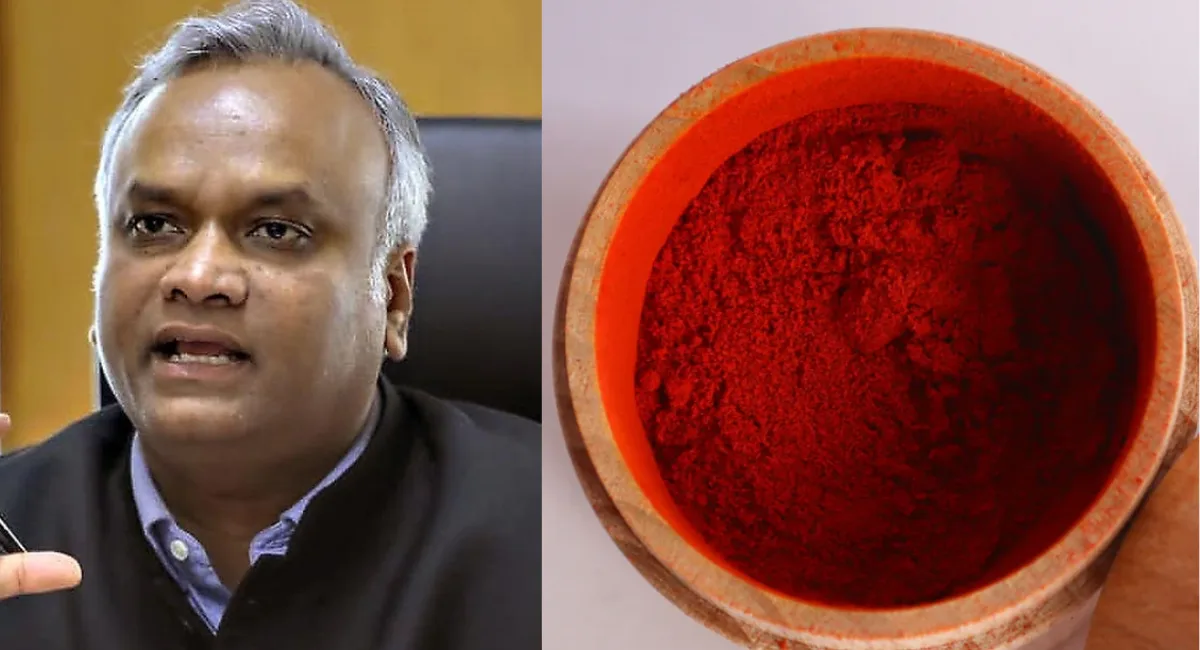
Bengaluru: Karnataka Home Minister Priyank Kharge has landed in the middle of a political storm after claiming that nearly 90 per cent of the saffron (kesar) used for applying tilak comes from Islamic countries. The remarks have sparked widespread criticism from the BJP, religious scholars and social media users, many of whom accused the minister of lacking basic knowledge about how kumkum is made and confusing two entirely different substances.
The controversy erupted after Priyank Kharge, while responding to questions related to the Rashtriya Swayamsevak Sangh (RSS), said that if most of the saffron used for applying tilak was imported from Muslim-majority countries, those advocating Hindutva should also stop using it. His comments quickly went viral, triggering a wave of criticism and fact-checks across social media platforms.
The BJP launched a scathing attack on the minister, alleging that he had displayed ignorance about Hindu traditions.
Party leaders pointed out that the kumkum commonly applied on the forehead during religious rituals is not prepared from saffron. Instead, traditional kumkum is made by processing turmeric with slaked lime, which turns the powder red through a natural chemical reaction.
Saffron, they said, is a completely different product used mainly as a spice, fragrance and occasionally in certain religious ceremonies.
“Kumkum is made out of kesar, 90% of kesar comes from Islamic countries. So will they stop wearing tilak?” – Priyank Kharge
Fact: Kumkum is not made from saffron.
Mocking a sacred Hindu symbol using misinformation is disgraceful. Would he dare do this with any other religion? pic.twitter.com/aeIDg75Ttb
— Shilpa (@shilpa_cn) July 7, 2026
Union Minister Shobha Karandlaje strongly criticised Priyank Kharge, saying a person holding constitutional office should possess basic knowledge of Indian customs and traditions before making public statements. She alleged that the minister had misled the public by equating saffron with kumkum and questioned whether he had verified the facts before making such remarks.
Several BJP leaders also demanded that the minister withdraw his statement and apologise to Hindus. They maintained that confusing saffron with kumkum reflected a lack of understanding of basic Hindu religious practices and traditions.
The controversy rapidly spread to social media, where thousands of users posted explanations highlighting the difference between saffron and kumkum.
Many users shared videos demonstrating how traditional kumkum is prepared using turmeric and slaked lime, while others uploaded educational posts explaining the significance of kumkum in Hindu rituals.
Social media platforms, particularly X, Facebook and Instagram, were flooded with memes and sarcastic comments targeting the minister. Many users mocked Priyank Kharge, claiming that he had no basic knowledge about the preparation of kumkum despite being a senior minister.
Several posts questioned how a public representative could confuse saffron, a costly spice obtained from the Crocus sativus flower, with kumkum, which has traditionally been prepared using turmeric.
At the same time, a Congress leader defended the broader context of the minister’s statement, pointing out that India imports significant quantities of saffron from Iran, one of the world’s largest saffron producers. They argued that while the import figures may have some basis, the comparison between saffron and kumkum was factually incorrect and had led to unnecessary controversy.
Fact-check discussions that followed clarified that kumkum and saffron are two distinct products with different uses. Kumkum used in temples and households is predominantly made from turmeric and slaked lime, while saffron is used sparingly in certain religious offerings, Ayurvedic preparations, perfumes and food. Experts also noted that saffron is cultivated in Jammu and Kashmir besides being imported from countries such as Iran.
The BJP accused the Congress government of repeatedly making statements that hurt Hindu sentiments, while Congress leaders defended Priyank Kharge, arguing that his remarks were made in a larger political context and should not be viewed in isolation.
As the debate intensified, hashtags related to Priyank Kharge, kumkum and saffron continued to trend on social media. Users kept sharing fact-checks, historical references and videos explaining the traditional preparation of kumkum, while political supporters from both sides engaged in heated exchanges online.