Tell the story of Christianity in India the way it is usually told, and it sounds like a gift. Men crossed oceans to build schools where there had been none, to set type in languages that had never been printed, and to open clinics in places a doctor had never reached. All of that happened; none of it is the complete truth. Underneath the ledger of good works ran a second ledger, and on that one the entries were political. For instance, in colonial Assam, the spread of the Gospel, the machinery of the colonial state, and the school rooms were not three separate things but one braided enterprise, and the men who ran it knew as much.
Look at the timing first, because timing gives the game away. The Western-origin faiths did not drift into India on their own current; they arrived on the tide of conquest. Take the example of the North East, the gate opened in 1826 with Treaty of Yandabo, which ended the First Anglo-Burmese War and ceded Assam to the British Raj. Once that transfer was sealed did the Western Missionary societies find the door unlocked, and they moved in through the administrative scaffolding the Company had just finished building. Missionary thinkers made little effort to hide the political utility of their work; some spelled it right out. Among evangelical circles in Britain, the case was made that winning colonial subjects to the faith would firm up the machinery of imperial rule rather than merely save souls. The Serampore missionary Joshua Marshman put it in almost administrative terms, “that one of the most effectual means of perpetuating the British dominion in India would be ‘the calm and silent, but steady and constant, diffusion of Christian light among the natives”. Read plainly, a claim like that recast’s evangelism as an instrument of statecraft, something that could steady a foreign Government and lend it a veneer of moral warrant.
Changing Modus Operandi
In Assam, Missionaries learned early that preaching alone did not get them very far. The American Baptists started out by speaking openly in the bazaars and villages of the Brahmaputra valley, but few people converted. So, they changed their approach. Instead of preaching directly, they set up schools, printed religious books in local languages, translated Christian texts, and ran clinics and hospitals. These institutions genuinely helped people, but they also worked quietly, over time, to bring them towards the faith. Education became their most powerful tool. Protestant Missionaries believed a person could only truly grasp Christian teaching by reading the Bible for himself, so learning to read and accepting the faith went hand in hand. Their schools were not built just to teach basic lessons; they were meant to produce readers who could then engage with scripture. Scholars call this method Preparatio Evangelica: using education first to prepare the ground, so that a society would slowly become open to Christianity.

The Colonial Raj was no bystander in this. Across several districts, it handed the Missionaries the job of running schools, paid for them with public money, and allowed religious teaching in the classroom, having decided, in the blunt words of one official order, that religion was the only thing that really worked on these communities. By the 1850s, the numbers told the story: mission schools across British India were teaching over a hundred thousand pupils, compared with only about twenty-three thousand in Government schools. On the frontier, in short, the Church had become the state’s own cultural arm.
Even after more than seven decades of Independence, the issues of foreign funding, religious conversion under the guise of social work, and challenges to national integrity refuse to die down. The present quarrel inherits this whole lineage and boils it down to a whole new phrase. Commentators who monitor these areas now sound the alarm over a meta version of the crown colony, i;e, “Jesus Corridor”, an allegedly dark funded ribbon of Christian demographic expansion said to run from Sikkim, North Bengal through the Bodo areas, the tea belts across, and into Arunachal Pradesh, with named politicians and Churches cast as its facilitators and fresh Church-building in border districts offered as proof of a coordinated demographic design.
What lends the unease a concrete grip is a genuine, documented habit of foreign nationals conducting religious work in the region in breach of Indian law. In October 2022, the Assam Police picked up three Swedish citizens, Hannah Mikaela Bloom, Marcus Arne Henrik Bloom and Susanna Elisabeth Hakanason, at a magical healing gathering in the tea-garden belt of Dibrugarh district, violating their tourist visas as this place did not permit religious activity. Each was fined 500 dollars under Section 14 of the Foreigners Act and deported. Days later, on October 28, seven German nationals were detained near Kaziranga in Golaghat district for the same offence, having taken part in magical healing and proselytisation work in Tinsukia, Margherita, and Karbi Anglong on tourist visas, and two Indian organisers were arrested alongside them. Indian law reserves religious work for holders of a missionary (M-1) visa, and all ten Europeans were found to have flouted that condition with no regard for the laws of the land. They not only flouted visa rules but also broke the Drugs and Magic Remedies Act 1954.
They changed their approach. Instead of preaching directly, missionaries in Assam set up schools, printed religious books in local languages, translated Christian texts, and ran clinics and hospitals
So, an honest reading is that foreign nationals did, as a matter of record, conduct unauthorised religious activities while utilising FCRA funds in sensitive border districts in defiance of visa law, and the state was within its rights to act. The through-line worth keeping is the method, not the melodrama.
On the demographic claim itself, the Christian share has held near 2.3 per cent across recent censuses, yet of 20,000-plus FCRA registrations cancelled over the past decade, a lopsided share by some counts, more than seventy per cent of those whose licences lapsed by early 2022 belonged to Christian-aligned bodies. Government calls this a compliance story; critics call it targeting. What the number will not bear is the full weight of either a demographic-emergency narrative or a clean bill of health. It proves the intensity of the foreign-funded Christian organisations, and nothing more certain than that.
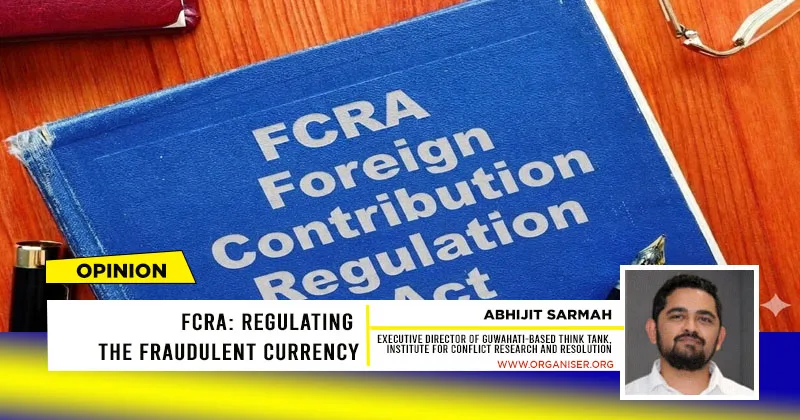
Start with the scale of the flows, because the raw magnitude resets the question. In the three years from 2019 to 2022, FCRA-registered bodies in India received more than Rs 55,741 crores in foreign contributions; the annual figure for 2024-25 was roughly Rs 20,000 crores. This is not the loose change of parish charity; it is capital on a scale that can move public opinion, bankroll agitations, tilt an electoral mood, and lean on policy, all of it arriving under the roomy, unfussy heading of “social work.” So, the real question is not whether money like this ought to be watched, which answers itself, but whether the pre-2020 law could actually watch it. It could not, and the enforcement history says why: more than 20,700 registrations have been cancelled since the Act came into being, a tally of FCRA bodies that could not say where their foreign money went with those accused of steering it toward ends hostile to the national interest. A regime forced to void twenty thousand licences was certainly in desperate need of new amendments in the first place.
The state argued exactly this in open court. The Solicitor General told the Supreme Court that foreign inflows had roughly doubled between 2010 and 2019 and pointed to Intelligence Bureau material suggesting that some of the money had gone towards “Naxalite and other activities”. The Home Ministry has, in its own assessments, repeatedly logged intelligence that foreign contributions moving through nominally charitable channels were being used to disturb public order and to influence policy in sensitive sectors such as the environment and energy.