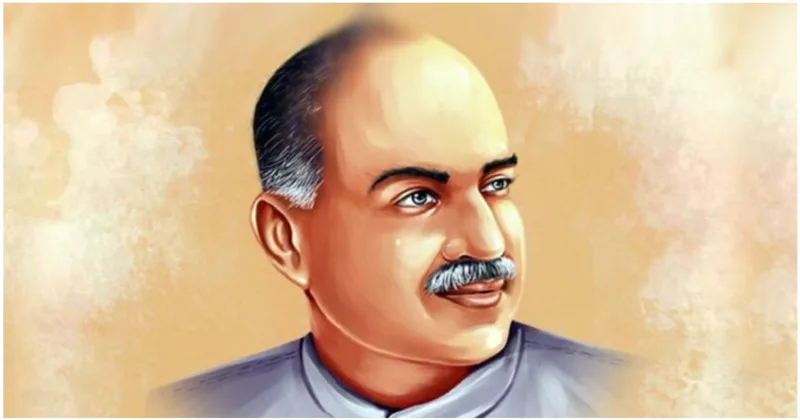
The life and work of Dr Shyama Prasad Mookerjee are a shining example of how profound the role of education can be in building an independent and self-respecting nation. He did not see education as just a means of acquiring some textbook knowledge or degrees confined within four walls. For him, education was the main tool to straighten the backbone of a nation, the mantra of freedom from colonial slavery and the key to the overall development of humanity. His visionary philosophy of education was based on a completely indigenous and nationalist ideology.
Dr. Shyamaprasad’s passion for education was an inheritance from his father, Sir Ashutosh Mookerjee, who was the architect of Calcutta University in the first quarter of the twentieth century. When Lord Lytton’s government tried to cripple the new system of postgraduate education at Calcutta University by denouncing it as an ‘ unreasonable expansion’, Sir Ashutosh roared in the University Senate: “Freedom is first, freedom is second, freedom is eternal.”
Naturally, Dr. Shyama Prasad Mookerjee, the worthy son of Sir Ashutosh, known as the Tiger of Bengal, followed the path shown by his father. Setting a unique example of talent and organizational skills, he took charge as the youngest Vice-Chancellor of Calcutta University in 1934, at the age of just 33. During this four-year tenure till 1938, he brought about a radical change in the administrative and educational structure of the university. His main aim was to make education not just a luxury for the upper class but to bring it to the doorstep of the common man and to raise the standard of education to international standards.
Dr. Mookerjee’s educational philosophy was based on the teaching of the mother tongue. He deeply believed that original thought could never develop in a borrowed language. In a historic convocation address at Patna University in 1937, he boldly pointed out that the dominance of foreign languages was crippling our intellectual capacity. He stressed that bharatiya languages should be established as the main medium of instruction from the primary level to higher education, so that students could delve deeper into the subject and develop their creativity.
Dr. Shyama Prasad Mookerjee was against a segregated education system. His dream was to create an integrated framework where there would be a clear and strong link from primary education to the university level. He also believed in the democratization of education. He advocated throughout his life to ensure that people from every strata of society, irrespective of race, religion, caste or gender, get equal opportunities for education. According to him, overall national progress is not possible by leaving any society behind.
The holistic education that we speak of today (reflection of which is observed in National Education Policy 2020) was understood by Dr Shyama Prasad almost a century ago. According to him, the purpose of real education is to develop the physical, mental, intellectual, moral and spiritual development of a person. He was in favor of a practical education that would not only make the youth clerks or involve them in the blind race of earning a living; but would awaken patriotism, sense of responsibility and human values in them. He wanted every student to become self-reliant and contribute directly to the reconstruction of the country, which has again been mirror-imaged in the Aatma Nirbhar Bharat initiatives launched by our Hon’ble Prime Minister Shri Narendra Modiji.
As the first woman Registrar of Calcutta University from year 2015-17, I had the privilege of reading several resolutions passed by the Senate of the University during the tenure of this legendary figure. It was undoubtedly a remarkable experience for me to witness a small part of his immense work as an administrator and an educationist.
During the period 1938-47, Calcutta University had four Vice-Chancellors, but among them, Dr. Syama Prasad’s role was that of a true visionary. His dominance in the Senate and Syndicate was never questioned. He was a symbol of consistency and restraint even in times of war, famine, communal riots and political conflict. His wisdom kept the university administration running smoothly at a time when, for one reason or another, the Vice-Chancellors failed to provide strong leadership.
In his last convocation address as Vice-Chancellor of Calcutta University in 1938, he highlighted his experience as the true purpose of the university, ‘To restructure the curriculum and syllabus, to reorganize the training and examination system in such a way that the young student may grow up not as a mere mechanical recorder of facts and theories, not as a dull specialist, but as a real ‘human being’ whose latent powers are well awakened, whose analytical thinking and reasoning are
strengthened, and whose capacity for broad thinking and application of knowledge in solving the problems of life is fully developed. In addition, to see that such education can be imparted at all levels in the language of the province, without neglecting the study of the English language.’ In the last eighty-eight years, hardly any other bharatiya vice-chancellor is known to have presented a better ideal for university education, as Dr. Shyama Prasad did.
Dr. Shyamaprasad knew that it might not be possible to impart education ‘at all levels’ through the ‘native language’ immediately. But he took well-considered steps to give Bengali an effective role in the field of education. It was made the medium of instruction and examination at the secondary education level. Honours courses were introduced in Bengali, Hindi and Urdu. It is noteworthy that he gave equal status to the three languages. Under his direction, Bengali synonyms of scientific terminology (paribhasik shabdavali) were prepared by experts and an attempt was made to rationalise the spelling of Bengali words. A special plan was taken for Bengali publications on subjects of general interest in various branches of knowledge for the convenience of students and general readers.
The secondary education system was reorganised. Elementary science, history and geography were made compulsory subjects. Earlier there was no provision for teaching science in schools and history and geography were optional subjects. Since Bengali was adopted as the medium of instruction and examination, suitable textbooks were prepared in Bengali. A teacher training department was established to supply quality teachers to the schools. Vacation courses were arranged for teachers who were unable to complete the full course. Arrangements were made for the study of Chinese and Tibetan languages. The Ashutosh Indian Art Museum was established to supplement the Department of Ancient Indian History and Culture. A spacious central library hall with fresco paintings on the walls was constructed for the convenience of post-graduate students. A military training course (University Cadet Corps) was introduced. A diploma course in agriculture was introduced. Special attention was paid to women’s education and as a result of some measures taken at that time, the Biharilal College of Home Science was later established.
The problem of educated unemployment took a serious turn in the thirties. All the while, the global economic depression crippled industry, trade and commerce. The provincial government’s policy of job reservation for Muslims practically closed the doors of the department to graduates seeking jobs on the basis of merit. Dr. Shyama Prasad opposed this and established a Recruitment and
Information Board, which functioned as an employment exchange centre for the current and former students of the university. Today it is known as the placement cell. The idea of connecting job seekers and employers through a regular working organization was quite new at that time. From here it is possible to understand that he was truly a ‘forward looking person with a vision, mission and a goal’. In my opinion, he was the best ‘Wisdom leader’ of ‘Paschim Banga’.
Many senior officials of the university were surprised to see how he performed his duties under various adverse conditions, despite being the youngest Vice-Chancellor of Calcutta University.
The educational initiatives he took as a visionary educationist at that time were unimaginable. Notable among them are:
1) Change the symbols to suit bharatiya culture
2) Reform of the Bengali spelling system
3) Teaching and writing examinations through the mother tongue at the matriculation level.
4) Plan to create a terminology for scientific terms.
5) Application for writing a PhD research paper in Bengali.
6) Introducing ISC courses in colleges.
7) Provision of geography studies from secondary to MA.
8) During his tenure, a separate department and course of ancient Indian history and culture were introduced at the University of Calcutta for the preservation and research of ancient civilizations and culture.
9) History and Archaeology of Asia: He gave special importance to the preservation of ancient bharatiya civilization, history and archaeology. He directly sponsored young researchers in the collection of ancient manuscripts and archaeological research.
10) Promotion and respect for Bengali language: He introduced the tradition of delivering speeches in Bengali for the first time at the convocation ceremony of Calcutta University. In 1937, he invited the Vishwakavi Rabindranath Tagore to the university’s convocation ceremony. For the first time, convocation speech was given in bengali.
11) Launching courses in Social Welfare, Business Management and Communication Engineering.
12) Establishment of the University Rowing Club and Athletic Club.
13) Establishment of Student Welfare Board for students.
14) Introduction of Teachers’ Training Course for Teachers i.e. Teaching Framework and ‘ Panchsheel’ Scheme: In 1936, he introduced the ‘Panchsheel’ policy in the field of education. Its objective was to develop the latent talent of the youth, combine cultural and professional education, and educate teachers on the basis of national culture.
15) Education in mother tongue: He strongly advocated for providing education through bharatiya languages and mother tongue up to higher education.
16) Introduction of Asiatic Studies: To promote Asian culture, he introduced facilities for the study of Chinese and Tibetan languages and cultures at the University of Calcutta.
17) He inaugurated the Department of Islamic History for the purpose of studying Muslim history.
Dr Shyamaprasad’s excellence as an educationist was appreciated by various cultural organizations and they sought his help. He was a member of the Court and Council of the Indian Institute of Science, Bangalore. He was the Chairman of the Inter-University Board. In 1938 he was nominated as India’s representative to the Intellectual Co-operation Committee of the League of Nations. He was the President of the Royal Asiatic Society. From 1943 to 1945 he was associated with the oldest educational institution of Bengal. In 1947 he became the President of the Mahabodhi Society.
Today, when we think about the modernisation and ‘bharatiyata’ of the education system, Dr. Shyama Prasad Mookerjee’s thoughts become even more relevant. He has long shown the way how to stand tall on the world stage by freeing ourselves from the colonial mentality and embracing our own language, culture and tradition. Dr. Mookerjee’s philosophy of education is actually not limited to any specific time frame, it is an eternal light that even today shows us the right path. Today, when the whole country and the new government of West Bengal have started walking the path with his ideals in mind, the ineffable words of poet Atul Prasad Sen also seem to come true –
“ Balo balo balo sobe, Shoto bina benu robe
(Speak, speak, speak, with a hundred harps, lutes, and harps)
Bharat abar jogot sobhay, Sreshtho ason lobe
(India will once again take the highest seat in the world assembly)
Dhorme mohan hobe, korme mohan hobe
(He who is great in religion, will be great in action) Nobo dinomoni udibe abar, Puraton e purobe ”
(The new day will dawn in the East and the old will fade away)
‘Ek desh me do vidhan, do pradhan aur do nishan..nahi chalenge’ was the dream of Dr. Shyama Prasad Mookerjee of which the first part has seen reality in 2019, and it will be the privilege of this nation to eliminate ‘do vidhan’ by implementation of Uniform Civil Code in West Bengal which is down under way to honour this great leader on his 125th birth centenary.