
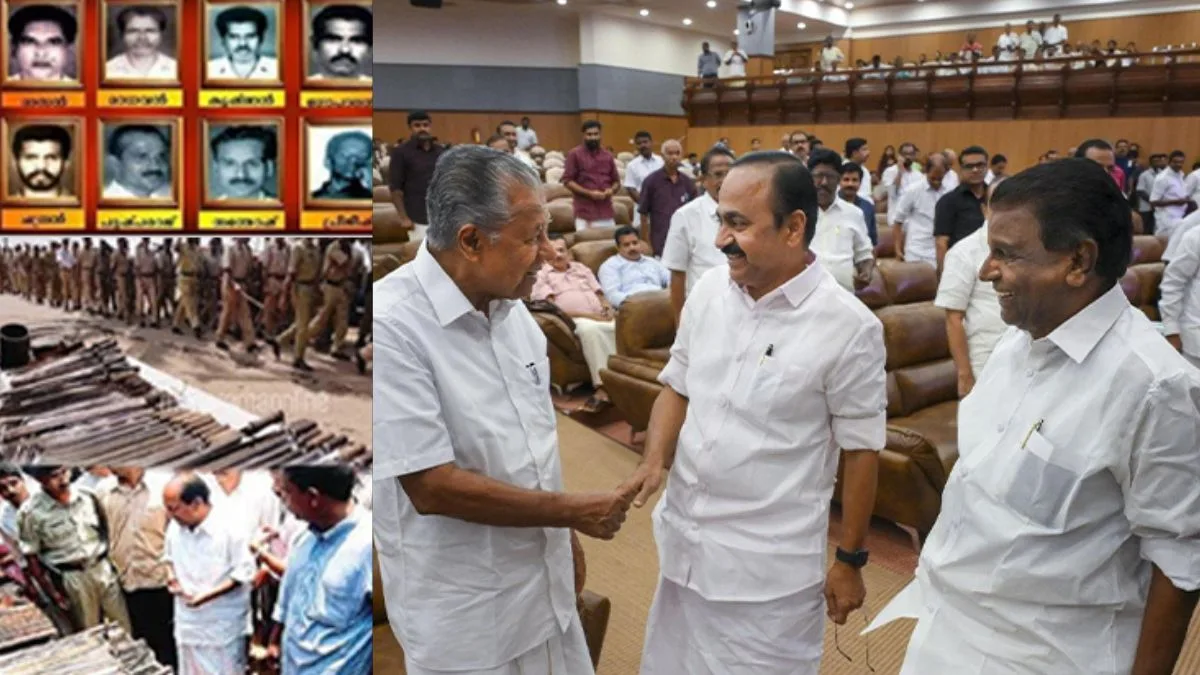
In the sleepy fishing village of Marad in Kozhikode, May 2, 2003, remains etched in blood. An armed mob of Muslim men of over 200 launched a pre-dawn massacre, hacking to death eight innocent Hindu fishermen in one of Kerala’s most brutal communal atrocities. What should have been a moment of national outrage and ruthless accountability quickly dissolved into political convenience.
A judicial commission headed by District Judge Thomas P. Joseph didn’t just call it a revenge killing. It described a well-planned conspiracy involving local fundamentalist and Muslim radical networks. Crucially, the commission flagged serious suspicions of foreign funding and external support — pointing to how large quantities of weapons were stockpiled and questioning the source of money that made the massacre possible. It strongly recommended a CBI inquiry into the larger conspiracy, foreign connections, and the trail of funds.
Yet Both Fronts Pass Resolution Against FCRA
Decades later, the same Kerala that failed to fully investigate those foreign links is now actively shielding such inflows from scrutiny. On Wednesday, political rivals — the ruling Left Democratic Front (LDF) and the opposition United Democratic Front (UDF) — set aside their differences to form a united front. The ‘secular’ alliance passed a resolution opposing the Centre’s FCRA Amendments, which aim to regulate and monitor the inflow of foreign funds into the country.
BJP MLA BB Gopakumar he defended the amendments. He framed the Assembly’s motion as a way for the state’s two main political fronts to protect a network funded by foreign money, which he claimed has already caused harm in Kerala.
“A law made for national security”
Gopakumar argued that the FCRA, both in its original and amended forms, is a law passed by Parliament to safeguard national security. He claimed that when a state legislature passes a resolution against it, even as a symbolic act, it wrongly positions itself in an area meant for the national government.
Alleged Involvement of a ‘Minister’ in Antony Government
The commission criticised the local police and strongly recommended a CBI inquiry to uncover the broader conspiracy and the source of the significant funding. Yet, both the then-ruling A K Antony, Congress government and the Left opposition refused to permit a CBI probe into the foreign funding connections. There were also unconfirmed reports that one of the Ministers in Antony government were directly involved in the brutal Hindu massacre.
The commission report did name some leaders (part of the ruling UDF coalition) as having prior knowledge or involvement in the conspiracy. However, it did not directly accuse any sitting Minister of the Antony government of direct involvement in the massacre. There were political allegations and media reports at the time linking some UDF figures
The response from Kerala’s so-called ‘secular’ establishment?
- Little enthusiasm for a full-fledged probe
- As it could expose uncomfortable foreign links
- UDF government (Congress-led under A.K. Antony) did not enthusiastically pursue a full CBI inquiry into the broader conspiracy and foreign links
- The case was quietly buried under local politics
- Marad’s victims were forgotten
- The foreign funding angle was never seriously pursued.
Fast Forward to Vizhinjam — Same Old Pattern
Two decades later, the script repeated itself, this time targeting a project of national strategic importance. When protests erupted against the Adani Vizhinjam International Seaport, what began as a fishermen’s agitation soon turned violent. Protesters stormed police stations, damaged project property worth crores, and even dragged barricades into the sea. Central intelligence agencies reportedly found something disturbing:
₹11 crore transferred from abroad into accounts linked to key figures in the agitation committee. Some reports pointed to possible foreign lobbies (including concerns over competition with Chinese-backed ports like Hambantota) using local networks and foreign-funded NGOs to stall the project. Once again, the ‘secular’ chorus dismissed any talk of foreign funding as “baseless” and “communal”. The Church-backed protests were painted purely as a livelihood issue. Serious questions about opaque foreign money were brushed aside.
Whitewashing “International Terrorist” Abdul Nazer Madani: Kerala Assembly’s Resolution Seeking His Release
Abdul Nazer Madani was arrested on 31 March 1998 in connection with the 1998 Coimbatore serial bomb blasts, in which 58 people were killed and over 200 were injured. The Tamil Nadu Police accused him of being part of the larger conspiracy behind the attacks, and he remained in Coimbatore Central Prison as an undertrial for more than nine years while the case was tried.
In March 2006, the Kerala Legislative Assembly unanimously passed a resolution urging the Tamil Nadu government to release Madani on humanitarian grounds, citing his prolonged incarceration without the completion of trial. In August 2007, a special court acquitted him of all charges, ruling that the prosecution had failed to establish his involvement. His acquittal was subsequently upheld by the Madras High Court.
FCRA and the Latest MHA Report on Foreign Fund Inflows
The stakes in this ideological conflict are high. Across India, approximately 16,000 registered associations receive around ₹22,000 crore—roughly $2.6 billion—in foreign contributions every year. The Centre’s 2026 changes are harsh, limiting organizations to 105 specific sectors and linking new funding to strict usage checks, with penalties of up to 30% for simple procedural mistakes.
By early 2026, over 21,900 organizations had already lost their licenses. While activists argue that these rules unfairly target minority and environmental groups.
Latest FCRA Amendments (2026) – Key Points
The Union Government has introduced significant amendments to the Foreign Contribution (Regulation) Act (FCRA) Rules in 2026 to enhance transparency and curb misuse of foreign funds.
- Mandatory Disclosures: FCRA-registered NGOs must now specify the exact activities, geographical areas of operation, and social media accounts where foreign funds will be utilised
- Real-time Monitoring: The new FCRA 2.0 portal enables digitised registration, renewals, and real-time tracking of foreign contributions
- Purpose-Specific Registration: Organisations can only use funds for the declared purposes; diversion is strictly prohibited
- Tighter Oversight: Enhanced scrutiny on administrative expenses, sub-granting, and asset utilisation to prevent anti-national activities, forced conversions, or funding of protests/violence
- Objective: While genuine charitable work is encouraged, the amendments aim to stop foreign money from being used for destabilising activities, as alleged in past cases like Marad and Vizhinjam