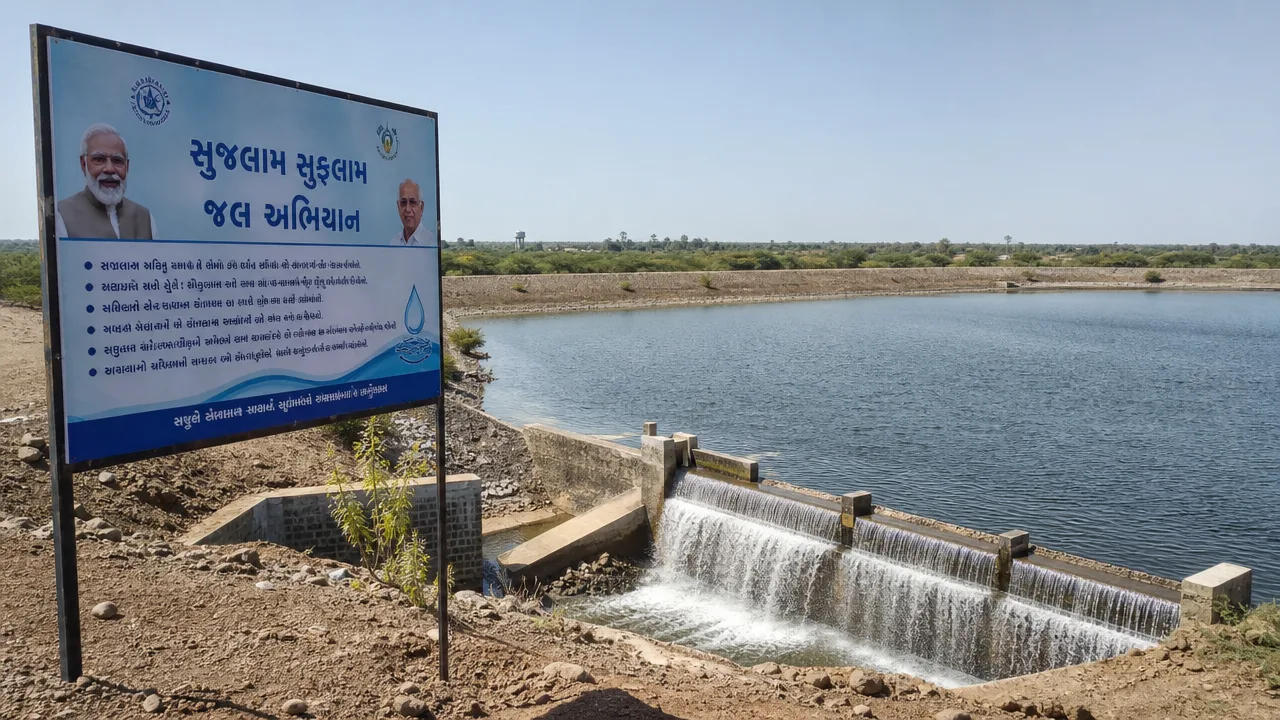
Gujarat’s ambitious water conservation programme, the Sujalam Sufalam Jal Abhiyan, has continued to deliver significant results, adding 20,789 lakh cubic feet to the state’s water storage capacity during the current year alone.
The achievement was announced by Gujarat Water Resources and Water Supply Minister Ishwarsinh Patel, who said the campaign has emerged as one of the state’s most extensive water conservation initiatives, combining government efforts with active public participation.
According to official figures, the campaign has now increased Gujarat’s cumulative water storage capacity by 1,38,039 lakh cubic feet over the past eight years, highlighting its role in strengthening water security and improving groundwater availability across the state.
From Government Programme to Public Movement
The Sujalam Sufalam Jal Abhiyan was launched with the objective of increasing water storage capacity, improving groundwater recharge and creating sustainable water conservation infrastructure throughout Gujarat.
Over the years, the initiative has evolved into a large-scale people’s movement involving local communities, government departments, village institutions and public participation.
The campaign is aligned with Prime Minister Narendra Modi’s “Catch the Rain” initiative, which encourages rainwater harvesting and water conservation measures across the country.
Speaking about the programme, the minister said that citizen participation has been central to its success. The campaign focuses not only on creating new water conservation assets but also on restoring and strengthening existing infrastructure such as ponds, check dams, canals and drainage systems.
The overarching goal is to ensure better utilisation of rainwater, reduce water scarcity and improve groundwater levels, particularly in water-stressed regions of the state.
Statewide Campaign Launched Earlier This Year
The 2026 phase of the campaign was launched on February 23 in Gandhinagar by Chief Minister Bhupendra Patel.
Since its launch, multiple government departments and local agencies have worked together to implement water conservation projects across Gujarat.
By May 2026, a total of 13,315 water conservation works had been completed under the campaign.
The large number of completed projects reflects the scale at which the initiative is being implemented and the emphasis placed on water resource management before the monsoon season.
Thousands of Water Conservation Works Completed
The campaign’s impact has largely come through a series of targeted interventions aimed at improving water storage and groundwater recharge.
According to official data, 2,450 pond deepening projects were completed during the current year. Deepening ponds increases their capacity to store rainwater and enhances groundwater recharge during the monsoon.
In addition, 3,661 check dams underwent desilting operations. Over time, silt accumulation reduces the storage capacity of check dams. Removing this silt helps restore their effectiveness and improves water retention.
Another 1,160 check dams were repaired under the initiative. These repairs ensure that existing water conservation structures continue to function efficiently and support local water needs.
Apart from ponds and check dams, the campaign also focused on improving water flow infrastructure. Canals stretching across 626 kilometres were cleaned, while drains covering 1,277 kilometres were cleared to improve water movement and prevent blockages.
Together, these interventions have significantly strengthened Gujarat’s water conservation infrastructure.
Water Storage Capacity Rises by 20,789 Lakh Cubic Feet
The cumulative impact of the projects undertaken this year resulted in an increase of 20,789 lakh cubic feet in water storage capacity.
The enhancement is expected to improve the state’s ability to capture and store rainwater during the monsoon season, reduce runoff losses and support groundwater recharge.
In a state where water management remains critical for agriculture, drinking water supply and industrial growth, additional storage capacity provides a significant buffer against future water stress.
Officials believe the increased storage capacity will help improve water availability in both rural and urban areas while strengthening resilience against drought-like conditions.
Employment Generation Through Conservation Works
Apart from strengthening water infrastructure, the campaign has also contributed to rural employment generation.
According to government figures, this year’s conservation activities generated approximately 2.30 lakh man-days of employment.
The works provided livelihood opportunities to local communities while simultaneously creating assets that contribute to long-term water security.
The integration of employment generation with conservation efforts has been one of the distinguishing features of the programme, ensuring that environmental benefits are accompanied by economic gains at the grassroots level.
Multi-Departmental Approach Driving Implementation
One of the key reasons behind the programme’s scale has been the coordinated involvement of multiple government departments.
The campaign is being implemented jointly by six major departments:
Water Resources Department
Water Supply Department
Forest and Environment Department
Urban Development Department
Rural Development Department
Sardar Sarovar Narmada Nigam Limited
The works are executed through a combination of departmental agencies, public participation and schemes such as the Mahatma Gandhi National Rural Employment Guarantee Act (MGNREGA).
This collaborative approach has enabled large-scale implementation while ensuring that projects are aligned with local needs and priorities.
Eight Years of Sustained Water Conservation
The latest achievements add to the substantial gains recorded under the programme since its inception.
Over the past eight years, Gujarat has completed 1,23,635 water conservation works under the Sujalam Sufalam Jal Abhiyan.
These include 39,770 pond creation and deepening projects, 26,873 check dam desilting works and 7,810 check dam repair projects.
In addition, canals and drains covering a combined length of 80,793 kilometres have been cleaned during the period.
The scale of these interventions demonstrates the state’s sustained focus on water conservation and groundwater recharge as key components of long-term water management.
Strengthening Gujarat’s Water Security
According to official figures, the cumulative impact of the programme over eight years has increased Gujarat’s water storage capacity by 1,38,039 lakh cubic feet.
The initiative has also generated 206.73 lakh man-days of employment during this period, combining environmental conservation with livelihood creation.
As climate variability, growing water demand and recurring water stress continue to challenge many regions of India, Gujarat’s experience highlights the role of large-scale conservation efforts in improving water resilience.
With thousands of ponds restored, check dams strengthened and water channels cleaned, the Sujalam Sufalam Jal Abhiyan has emerged as one of the state’s flagship water management initiatives, contributing to improved groundwater levels, enhanced water storage capacity and greater long-term water security for communities across Gujarat.