When the Union Cabinet cleared a ₹9,585 crore incentive scheme in June 2026 to replace Delhi-NCR ageing trucks and buses, it did something the region annual pollution debate has rarely managed. It moved the conversation away from emergency, winter-only firefighting and toward a structural, market-based reform of the commercial fleet. This decision was taken at a meeting chaired by Prime Minister Narendra Modi, is best read not as a standalone subsidy but as the paired with a long-standing regulatory stick and as a test of whether cooperative federalism can deliver clean air where decades of court orders and previous government seasonal curbs have only partially succeeded.
A scheme built on research data
The scheme explains why the government chose heavy commercial vehicles as its target. According to the 2018 study of NCR particulate matter prepared by the Automotive Research Association of India (ARAI) and The Energy and Resources Institute (TERI), the transport sector contributes 14 per cent of PM2.5, 40 per cent of carbon monoxide and 63 per cent of nitrogen oxide emissions in the National Capital Region. Within that, trucks and buses generate a 36 per cent of transport-related PM2.5 while constituting just 3 per cent of the total vehicle fleet. A single pre-Bharat Stage (BS) heavy vehicle, emits as much pollution as fourteen BS-VI-compliant trucks, and even a BS-IV vehicle releases 2.7 times the pollutants of a BS-VI one.
That disproportion is precisely the lever the scheme pulls. Rather than chasing the politically sensitive private car, it concentrates resources on the small slice of the fleet doing the most damage. An evidence-led targeting that distinguishes this intervention from the blanket age-based bans of the past.
What this scheme actually offers
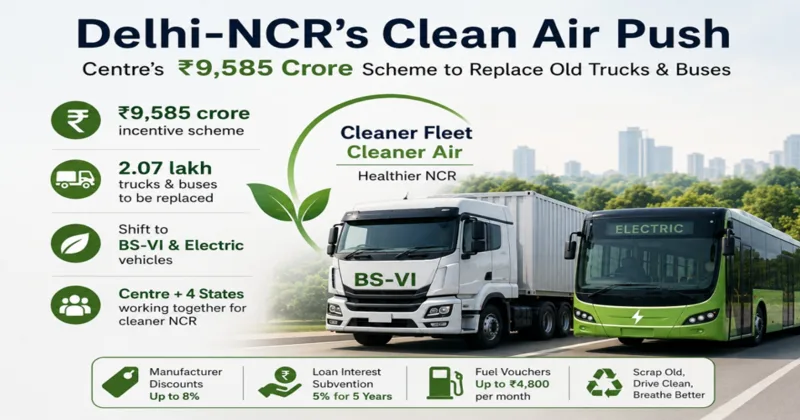
The two-year programme carries a total outlay of ₹9,585 crore, comprising ₹5,041 crore from the Central government and an estimated ₹1,601 crore in tax concessions from participating states. It covers roughly 2.07 lakh vehicles, about 1.91 lakh trucks and 16,329 buses registered across Delhi, Haryana, Rajasthan and Uttar Pradesh. Owners of BS-IV and older vehicles are incentivised to replace them with BS-VI-compliant or electric vehicles.
The incentive package is layered with automobile manufacturers to provide an 8 per cent discount on the ex-showroom price of new vehicles. The Centre adds a 5 per cent interest subvention on loans for five years, monthly fuel vouchers worth up to ₹4,800 depending on vehicle category and one-time benefits for EV purchase or for trading scrappage certificates of deposit. Participating states layer on registration-fee waivers and motor vehicle tax concessions.
The filters are precise BS-III and older vehicles must be scrapped at registered vehicle scrapping facilities, while BS-IV vehicles may either be scrapped or sold outside the NCR in non-NCAP cities. Replacement vehicles must be bought and registered within the NCR. In Delhi light goods vehicles bought under the scheme must be electric and buses must be BS-VI CNG or electric. Government vehicles are excluded.
Funding flows through the National Capital Region Planning Board under the Ministry of Housing and Urban Affairs, with implementation shared by the Ministries of Road Transport and Highways and of Petroleum and Natural Gas, in concert with the four state governments.
The CAQM interpretation behind the scheme
The scheme does not exist in a vacuum, it answers a hardening legal and regulatory deadline. On 17 December 2025, the Supreme Court modified an earlier order to lift protection from impoundment, fines and deregistration for end-of-life vehicles, diesel vehicles over ten years and petrol vehicles over fifteen years that fail to meet BS-IV diesel or BS-III petrol standards, reinstating the stricter directions originally laid down by the National Green Tribunal in 2015 and affirmed by the apex court in 2018. The Commission for Air Quality Management (CAQM), the permanent statutory body created under the 2021 CAQM Act with binding authority across the NCR airshed, had pressed for the change, arguing that blanket interim protection was letting the worst polluters back onto the roads.
The human stakes of that enforcement surfaced immediately. With the NCR estimated to hold over 50 lakh end-of-life vehicles and earlier petitions citing as many as 82 lakh non-compliant vehicles across the region, transport unions and owner-drivers voiced fears about livelihoods being scrapped overnight without support. An earlier attempt to cut off fuel supply to end-of-life vehicles from July 2025 had been temporarily suspended after public opposition, a reminder that enforcement without a viable transition path invites backlash.
The Cabinet’s incentive scheme is in effect, the State answer to a way to make compliance affordable rather than punitive. The December court order and the June scheme form a coherent two-handed strategy: regulation creates the obligation, while incentives soften the cost of meeting it. The scheme also dovetails with the broader CAQM toolkit, including the “No PUC, No Fuel” rule enforced through automated number-plate-recognition cameras at fuel stations, which ties a vehicle’s right to refuel to its emission compliance.
The Union cabinet has approved a landmark ₹9,585 crore scheme to phase out, old BS-IV or earlier trucks and buses across Delhi-NCR.
Backed by ₹5,041 crore from the Center alongside state tax concessions, this initiative aggressively incentivizes the switch to ultra-clean… https://t.co/fh9aVHdpdr
— Office of G. Kishan Reddy (@KishanReddyOfc) June 3, 2026
Private partnership and industry in lockstep
Air pollution in the NCR is an airshed problem that ignores state borders and the scheme requires Delhi, Haryana, Rajasthan and Uttar Pradesh to align their tax and registration systems behind a single Cabinet decision. At the NCR Planning Board’s 42nd meeting, participating states formally agreed to notify the conversion plan for implementation a concrete instance of cooperative federalism translating a central vision into synchronised state action.
Indian industry has decided to be in line too. Tata Motors, Ashok Leyland and Switch Mobility are together accounting for roughly half the domestic truck and bus market, have signed agreements with the Ministry of Road Transport and Highways to participate, supplying the manufacturer discount and positioning themselves to capture the replacement demand the scheme is designed to unlock. The commercial vehicle business is acutely sensitive to the economic cycle and a policy that converts ageing fleets into fresh orders is precisely the kind of demand catalyst the sector has been waiting for the genuine variable. As analysts have flagged the rate of uptake by fleet operators rather than the headline target.
The market read the signal instantly. Shares of state-run trading firms MSTC and MMTC, which stand to gain from a surge in organised scrap auctions and the resulting flow of ferrous and non-ferrous metal, rallied by up to 14 per cent in the session after Cabinet approval, with MSTC whose business model is most directly tied to e-auctioning end-of-life vehicles.
A clean-air policy in other words has simultaneously become an industrial stimulus and a recycling-economy boost, channelling end-of-life vehicles into the formal recycling ecosystem rather than the informal grey market where dismantling escapes both environmental and revenue oversight. This is the deeper logic of the National Vehicle Scrappage Policy that frames the scheme, an aged vehicle is not merely a pollutant to be banished but a stock of recoverable material to be returned to the economy through registered and traceable channels.
For all its design discipline the scheme will ultimately be judged on execution and here the open questions are real. The incentives reduce the first barrier the upfront cost of a new vehicle but they cannot by themselves settle the economics of heavy-duty electrification. Electric trucks demand high-capacity charging, depot land, reliable power supply and distribution upgrades; without that infrastructure, a cleaner fleet risks becoming, as one analysis put it, an accounting achievement rather than a road-level reality. CNG and LNG may remain necessary transition fuels for heavy goods movement until charging networks mature.
The scheme runs through an integrated digital portal, monitored at the top by an Empowered Committee under the Cabinet Secretary and locally by District Collectors and Magistrates. That architecture is sound, but digital systems can become fresh barriers for the single-truck owner unfamiliar with online documentation, loan approvals and scrappage certificates. If larger fleet operators capture the benefits first while small owner-drivers are left navigating portal errors and paperwork, the scheme equity promise will erode. Safeguards matter where eligibility checks must be clean, scrappage must be genuine rather than paper certificates traded for cash and vehicles removed from the NCR must not quietly return through informal routes.
Future of greener and pollution free India
Delhi’s winter smog is produced by a regional airshed that also includes industrial emissions, road and construction dust, waste burning, biomass combustion, thermal power plants and seasonal crop-residue burning where all trapped by adverse meteorology. Cleaning up trucks and buses addresses one significant slice of that problem, not the whole of it. Cleaner public buses will improve air quality only if public transport remains frequent and reliable enough to reduce dependence on private vehicles in a region with one of India’s highest vehicle densities.
It is a narrow, evidence-based, well-targeted intervention that pairs incentive with regulation, aligns four states and major Indian manufacturers behind a common goal and attempts to convert an annual pollution emergency into a permanent fleet-modernisation pathway. For a problem long defined by reactive, season-bound measures, that shift toward structural reform is itself a meaningful step. The ₹9,585 crore commitment buys the Capital not clean air outright, but a credible mechanism to begin earning it provided the charging stations, the district help desks and the integrity checks arrive as reliably as the Cabinet intent.