Bengaluru : A day after the Enforcement Directorate (ED) conducted searches at multiple locations linked to senior Excise Department officials in Karnataka, the central agency has revealed details of what it describes as a large-scale corruption network involving excise officers, their associates and private individuals. The investigation has gained significant political attention as one of the key persons under scrutiny is Y.D. Manjunath, Additional Excise Commissioner and brother-in-law of Karnataka PWD Minister Satish Jarkiholi.
The ED carried out coordinated raids on June 24 across Bengaluru, Mysuru and Belagavi districts, covering 14 locations connected to excise officials, their family members, business associates and close aides.
According to the agency, the searches led to the seizure of cash, gold, foreign currency and several incriminating documents that allegedly reveal the functioning of an organised bribery network within the Excise Department.
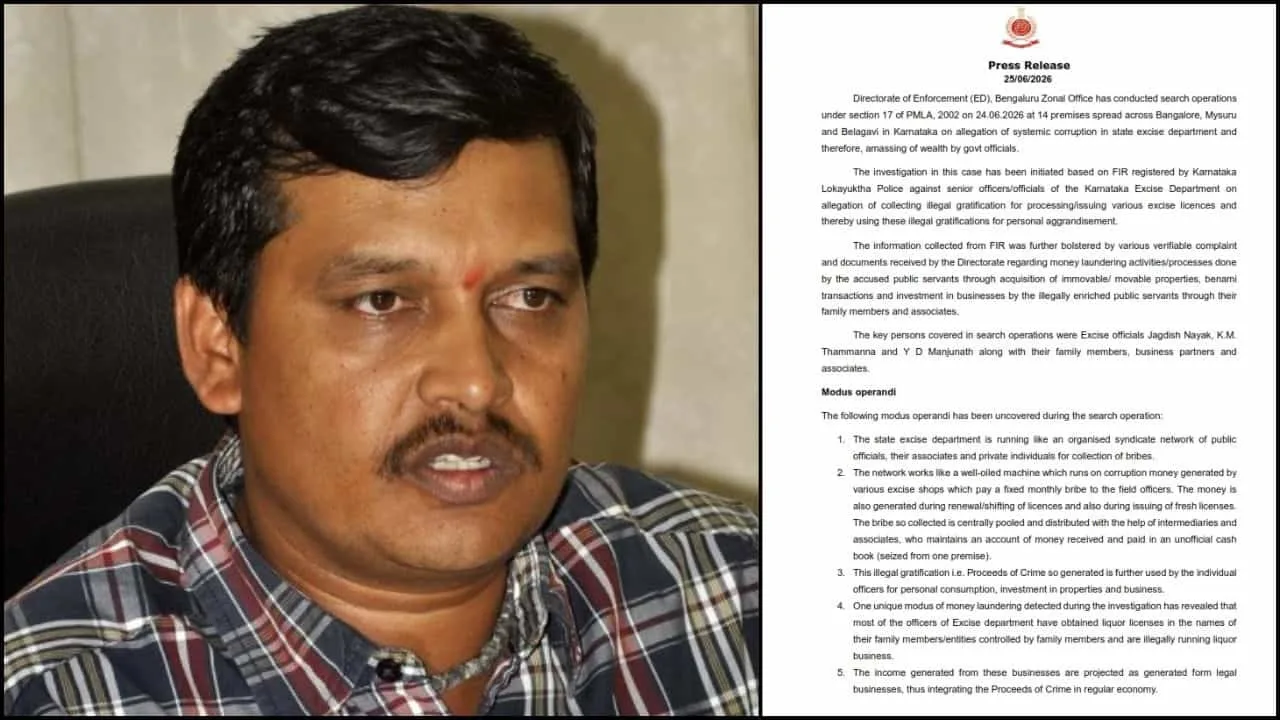
ED, Bengaluru Zonal Office has conducted search operations under PMLA, 2002 on 24.06.2026 at 14 premises spread across Bangalore, Mysuru and Belagavi in Karnataka on allegation of systemic corruption in state excise department and therefore, amassing of wealth by govt officials.… pic.twitter.com/jtG7T9a3pB
— ED (@dir_ed) June 25, 2026
Officials said the raids were conducted at premises linked to Y.D. Manjunath, his driver, family members and associates.
During the operation, investigators recovered approximately ₹5.5 crore in cash, gold and jewellery worth around ₹7.8 crore and foreign currency valued at ₹3.3 lakh. In total, assets worth about ₹13.3 crore have been identified and seized as suspected proceeds of crime.
Apart from cash and valuables, the ED also seized digital devices, property-related records and what investigators describe as a detailed cash ledger documenting the collection and distribution of bribe money. The discovery of the ledger is being viewed as one of the most significant findings of the operation, as it allegedly contains records of illegal payments made within the department.
According to the ED, the investigation has uncovered evidence suggesting that a structured system of corruption was operating across different levels of the Excise Department.
Officials claim that monthly collections were allegedly being made from liquor vendors and retail outlets across the state.
The agency alleges that money collected at the field level was routed through intermediaries before being distributed among various beneficiaries. Investigators believe the seized cash book contains details of these transactions and may help identify the flow of illicit funds within the network.
One of the most startling revelations made by the ED concerns the alleged involvement of excise officials in the liquor business itself.
According to investigators, several officers are suspected of indirectly owning or controlling liquor outlets through family members and relatives.
The ED has further alleged that the illegally collected funds were used for personal expenses, acquisition of properties and investments in private businesses. Investigators are now examining financial records and property transactions to trace the movement of money and identify additional beneficiaries.
Besides Manjunath, the searches covered locations linked to Excise Department officials Jagadish Nayak and K.M. Thammanna, along with their relatives, business partners and associates. The agency is scrutinising documents recovered during the raids to determine the extent of the alleged corruption network.
The development has triggered political discussions because of Manjunath’s relationship with Minister Satish Jarkiholi.
While the ED has not named the minister in its findings, the involvement of his brother-in-law has intensified public and political interest in the case.
Officials said the probe is still at a preliminary stage and further action could follow based on the evidence collected during the searches. The ED is expected to examine additional financial transactions, property holdings and alleged links between excise officials and liquor businesses in the coming weeks.
With the seizure of ₹13.3 crore worth of cash, jewellery and foreign currency, along with records allegedly detailing bribe collections and distribution, the case has emerged as one of the most significant anti-corruption investigations involving Karnataka’s Excise Department in recent years.