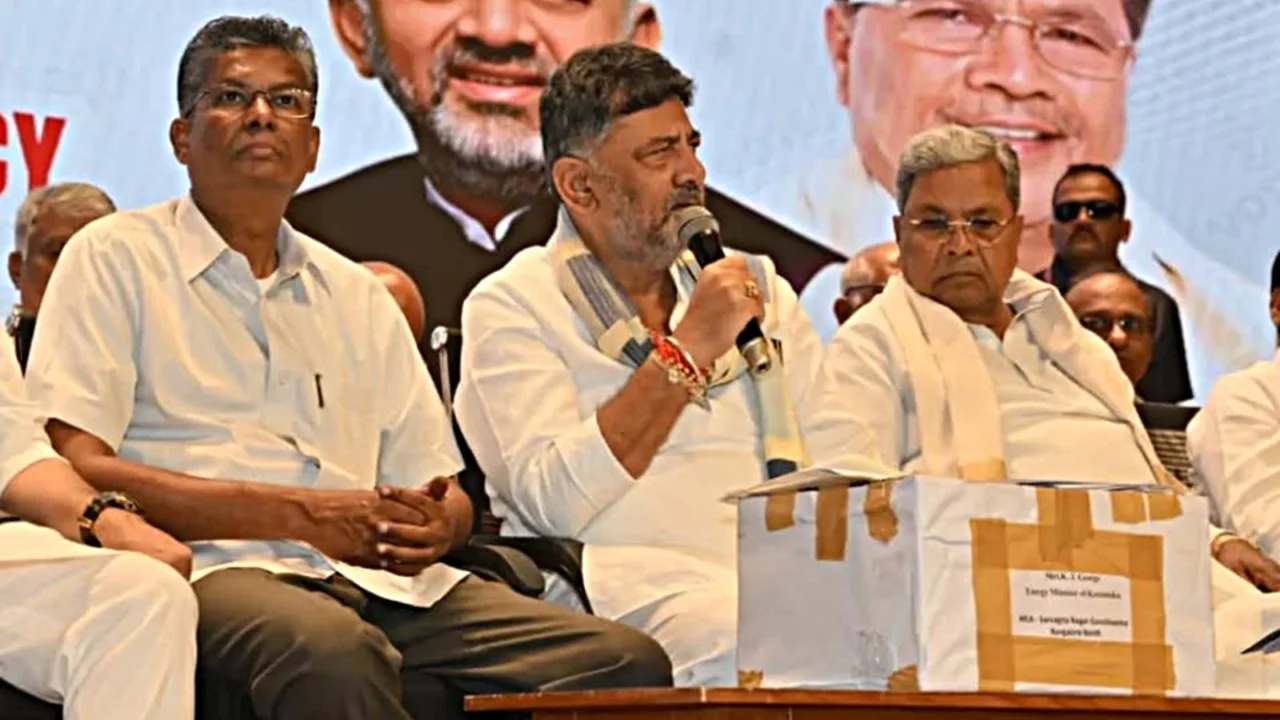
Bengaluru: The Karnataka government has come under sharp criticism after it emerged that a ₹10,000 crore infrastructure contract was awarded to a company already under investigation by the Central Bureau of Investigation. The revelation has raised serious questions about transparency, due diligence, and political accountability within the state administration.
The company at the centre of the controversy, Bharat Vanijya Eastern Private Limited, is facing a CBI probe in connection with alleged corruption and bribery in a highway project in Jharkhand.
Despite this, the Karnataka Public Works Department proceeded to award it a major contract involving elevated corridors and road development projects in Hosakote, Malur, and the Malur industrial area.
What has intensified the controversy is the timeline. The CBI had registered an FIR against the company on July 11, 2025, in connection with irregularities in a National Highway project.
However, even after this development, the company’s technical bid was opened and it was allowed to participate in the tender process without restriction.
According to official records, the tender process for the Karnataka project began on March 1, 2025, under the hybrid annuity model. The last date for submission of bids was April 16, 2025, and technical bids were opened on September 27, 2025. Eventually, financial bids were opened on October 6, 2025, and the contract was awarded on October 17, 2025, to the lowest bidder, which included Bharat Vanijya Eastern Private Limited.
The government has defended its decision, stating that although the FIR was registered, the case had not reached a final conclusion and the company had not been blacklisted.
Officials also claimed that no competing bidder had raised objections regarding the company’s involvement, and the information about the CBI case was brought to the government’s notice only on July 24, 2025, through a third-party complaint.
However, critics argue that this explanation exposes a glaring failure of Siddiramaiah led Congress government in the Karnataka. They question why the state did not proactively verify the background of a firm bidding for a massive public project, especially when serious corruption allegations were already under investigation by a central agency.
The issue was raised in the Legislative Council by BJP MLC N. Ravikumar, who questioned the Congress government’s decision to proceed with the contract despite the ongoing probe.
Notably, the Congress ministers reportedly failed to respond to starred questions on the issue, further fuelling allegations of evasion and lack of transparency.
The CBI FIR itself contains serious allegations. It relates to a four-laning project on NH-75 in Jharkhand, where the company was engaged as a subcontractor.
Investigations revealed that company officials allegedly attempted to bribe officials of the National Highways Authority of India to secure favourable quality inspection reports.
Senior officials, including inspection team members, were allegedly offered and paid bribes ranging from ₹1 lakh to ₹5 lakh.
The FIR also details instances where meetings were arranged, payments facilitated through intermediaries, and even logistical support such as travel arrangements were provided to influence outcomes.
The CBI has already arrested multiple individuals in the case, including company executives and government officials. Charges have been invoked under various provisions of the Prevention of Corruption Act and the Bharatiya Nyaya Sanhita, pointing to a well-organized network of bribery and collusion.
Adding to the controversy are unverified but persistent allegations that the company had extended undue favours, including gifting a helicopter to an influential minister in the Congress government. While these claims remain unproven, they have added a political dimension to the issue and intensified demands for a thorough investigation.
Opposition leaders have accused the Karnataka government of deliberately overlooking red flags to favour a tainted company. They argue that awarding such a massive contract to a firm under CBI scrutiny undermines public trust and raises the spectre of systemic corruption.
The involvement of certain senior officials within the department, including those reportedly linked to the company’s home state, has also drawn attention. Questions are being raised about whether there was internal collusion or pressure to push the contract through despite the risks.