The exchange of allegations and counter-allegations is nothing new in democratic politics. Speeches delivered by leaders at election rallies are often replete with political attacks, charges of corruption and sharp rhetoric. However, when serious allegations are leveled against a specific individual, only for it to be claimed later that the name was mentioned by mistake, the matter transcends mere politics; it touches upon issues of accountability, credibility, and the decorum of public life. The expression of regret by Congress leader and Leader of the Opposition in the Lok Sabha, Rahul Gandhi, before the Madhya Pradesh High Court has once again brought this debate to the forefront.
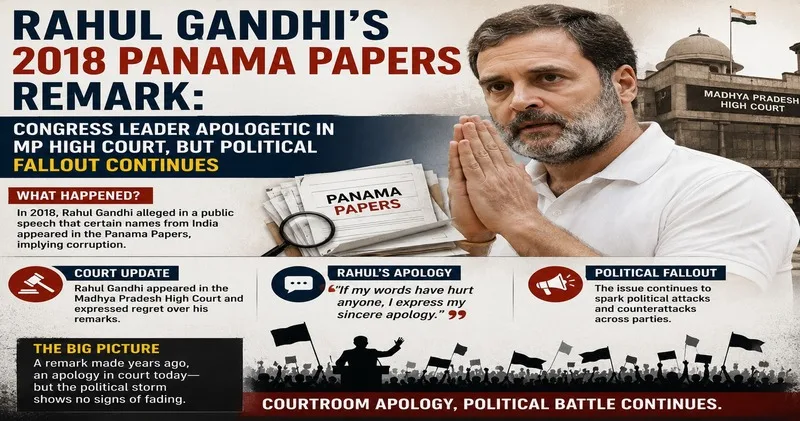
In an ongoing defamation case concerning an election speech delivered in 2018, Rahul Gandhi informed the court that he had mentioned the name of Kartikeya Chouhan, son of Union Agriculture Minister Shivraj Singh Chouhan, due to a misunderstanding; he had intended to name someone else. While this admission has increased the likelihood of a legal resolution to the case, it has simultaneously sparked a fresh discussion regarding factual accuracy in political discourse and the responsibility of political leaders.
What was the entire matter?
The controversy stems from an election speech delivered by Rahul Gandhi during the 2018 Jhabua Assembly by-election. Rahul Gandhi, who was the Congress President at the time, alleged at a public rally that Kartikeya Chouhan’s name had surfaced in the Panama Papers case. Citing the example of former Pakistani Prime Minister Nawaz Sharif, he remarked that action had been taken there, whereas no such action was taken in Madhya Pradesh.
A controversy erupted immediately following this statement because Kartikeya Chouhan’s name had never been implicated in the Panama Papers episode. Terming the allegation a direct attack on his reputation, Kartikeya Chouhan stated that the charge, leveled by a national leader from a public platform, had damaged his public image.
Rahul Gandhi’s Stance in the High Court
During the hearing at the Madhya Pradesh High Court, Rahul Gandhi submitted a written application stating that the controversial statement was not made in reference to Kartikeya Chouhan and should be viewed in that context. He stated that Kartikeya Chouhan’s name was mentioned due to a mix-up during the speech.
Rahul Gandhi also noted that the very next day after making the statement, he had publicly clarified that he intended to name Abhishek Singh, the son of the then-Chhattisgarh Chief Minister Raman Singh, but had inadvertently named Kartikeya Chouhan instead. The court has sought a response from the complainant, and arguments from both sides will be considered at the next hearing.
Dispute moves from MP-MLA Court to High Court
Following Rahul Gandhi’s statement, Kartikeya Chouhan filed a defamation complaint in a special MP-MLA court in Bhopal. After an initial hearing, the court issued a summons requiring Rahul Gandhi to appear in person.
Challenging this summons and the lower court’s proceedings, Rahul Gandhi approached the Madhya Pradesh High Court. He also sought an exemption from personal appearance. Now, following the expression of regret in court, it is believed that the possibility of a settlement in the matter may increase.
The major question of accountability in political discourse
This entire episode is not merely a defamation dispute; it also raises significant questions regarding factual accuracy and the accountability of leaders in political life. In a democracy, the opposition’s role is to question the government and the ruling party, yet it is equally important that the allegations leveled are factually correct.
Linking an individual to corruption, a scam, or a controversial issue from a public platform can impact their social reputation. This is why courts have repeatedly underscored the importance of responsible expression in public life.
Rahul Gandhi and a history of controversial statements
The Kartikeya Chouhan episode is not the first instance where a statement by Rahul Gandhi has sparked a legal or political controversy. Over the past few years, several of his statements have become subjects of court proceedings and political debates.
The ‘Modi Surname’ Remark
During the 2019 Lok Sabha elections, Rahul Gandhi had asked, “Why do all thieves have the surname Modi?” Gujarat BJP MLA Purnesh Modi filed a defamation case regarding this statement. A Surat court convicted Rahul Gandhi and sentenced him to two years in prison. Consequently, he lost his Lok Sabha membership, although the Supreme Court later stayed the conviction and restored his membership.
The ‘Chowkidar Chor Hai’ Controversy
Rahul Gandhi repeatedly targeted the then Prime Minister Narendra Modi over the Rafale aircraft deal and coined the slogan “Chowkidar Chor Hai”. A controversy later arose regarding the context of a Supreme Court order, leading BJP MP Meenakshi Lekhi to file a contempt petition. Rahul Gandhi subsequently expressed regret before the Supreme Court.
Remarks on Veer Savarkar
Rahul Gandhi also faced widespread opposition regarding his remarks on Veer Savarkar. Various organizations and political parties in Maharashtra protested against his statements. In some instances, complaints were filed and demands for legal action were raised.
The RSS and Other Controversies
Several statements made by Rahul Gandhi regarding the Rashtriya Swayamsevak Sangh (RSS), the assassination of Mahatma Gandhi, China policy and national security sparked political controversies. The BJP and other organizations frequently expressed strong reactions to these comments.
Will the ‘Controversy’ End This Time?
The regret expressed by Rahul Gandhi in the Kartikeya Chauhan defamation case adds a new dimension to this controversy. It is possible that this could alleviate legal tensions and steer the matter toward a resolution based on mutual agreement. However, the fundamental questions surrounding the issue remain.
Shouldn’t national-level leaders verify facts thoroughly before making allegations on public platforms? Does the intensity of rhetoric in electoral politics sometimes overshadow the facts? And if that happens, who bears the responsibility?
The Madhya Pradesh High Court’s upcoming stance will shape the legal perspective on these questions, but politically, the case has already conveyed a significant message: in a democracy, the power of words is matched by the magnitude of the responsibility attached to them. In public life, a misnamed individual, a baseless allegation, or an incorrect fact does not merely trigger a political controversy; it can also damage an individual’s reputation and erode public trust. This is precisely why factual accuracy and accountability are considered just as essential as freedom of expression in politics.