In India, a systematic attempt has long been made to create misconceptions regarding both Dr B. R. Ambedkar and the Constitution. The reason is not difficult to understand. Those who sought to advance divisive political narratives feared that if society gained access to the original ideas and writings of Ambedkar and the true spirit of the Constitution, their ideological campaigns would face serious challenges.
Dr Ambedkar dedicated his scholarship and intellectual energies to the unity, progress, and advancement of India. Portraying him as anti-national was never an easy task. Likewise, presenting the Constitution—designed as a framework for building a strong and prosperous India—as something contrary to national aspirations required sustained effort. Yet sections of the Left and Communist movements continued to propagate such interpretations for decades.
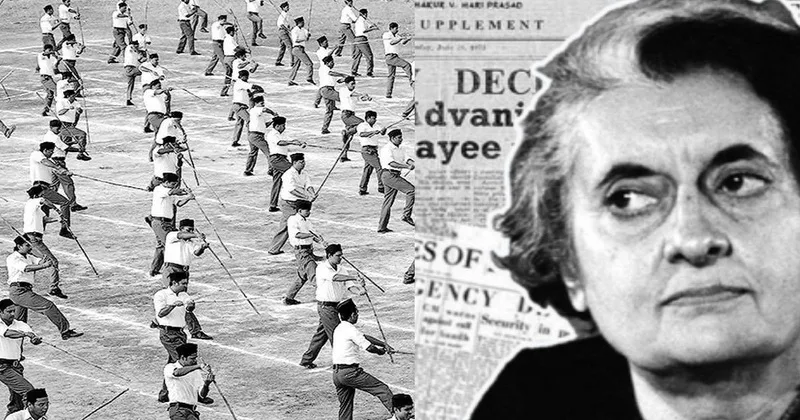
In recent times, an old debate has resurfaced in a new form: the question of the RSS and its relationship with the Constitution. As the Rashtriya Swayamsevak Sangh (RSS) completes one hundred years of its existence, the nation also marks fifty-one years since the imposition of the Emergency—one of the gravest assaults on the Constitution of India. Even after more than five decades, it remains difficult to fully comprehend the extent of the damage inflicted upon constitutional values by those who claimed to be the protectors of the Constitution. Equally difficult is adequately describing the role played by the RSS during those dark years when it operated underground, inspired thousands of young Indians, and contributed to the struggle to safeguard constitutional principles.
Seventy-seven years ago, independent India adopted its own Constitution as the symbol of its sovereignty. Under the leadership of Dr Rajendra Prasad, the Constituent Assembly, and under the chairmanship of Dr B. R. Ambedkar, the Drafting Committee prepared a Constitution that was formally adopted on November 26, 1949. Although the Constitution contained detailed provisions and extensive legal safeguards, its central objective was to guarantee the widest possible rights to citizens.
While discussing the Constitution, Dr Ambedkar observed that it granted citizens fundamental rights and, importantly, empowered them to seek protection from the Supreme Court under Article 32 whenever those rights were violated. He described this provision as one of the most significant features of the Constitution.
During the debates of the Constituent Assembly between 1946 and 1949, members extensively discussed the rights relating to personal liberty and life, embodied in Articles 20 and 21. A broad consensus emerged that these rights should remain inviolable and should not be suspended even during extraordinary situations. Though provisions such as Articles 352, 356, and 360 empowered the government to proclaim emergencies under specific circumstances, the Constitution was framed with the intention that the fundamental rights relating to life and personal liberty would remain protected.
The right to life is intrinsic to human existence and cannot be treated as a privilege granted by the State. Yet, fifty-one years ago, the intentions of the Constitution’s framers suffered a severe setback. Just as those who have never experienced colonial rule may find it difficult to appreciate the value of freedom, those who did not witness the Emergency may struggle to comprehend its severity.
On June 25, 1975, constitutional governance gave way to executive survival. Citizens lost their freedoms, rights ceased to have practical meaning, and democratic institutions came under unprecedented pressure.
The immediate backdrop was the historic judgment delivered by Justice Jagmohanlal Sinha of the Allahabad High Court on June 12, 1975. After examining allegations concerning electoral malpractice, the court invalidated the election of Prime Minister Indira Gandhi and further disqualified her from contesting elections for six years. The measures subsequently adopted to protect political power at the expense of constitutional norms constitute one of the darkest chapters in India’s constitutional history.
Seeking relief from the Supreme Court, Indira Gandhi obtained only a conditional stay from Justice V. R. Krishna Iyer on June 24, 1975. The order restricted her participation in parliamentary proceedings. Within hours, on the night of June 25, 1975, the Emergency was proclaimed and imposed across the country.
This occurred despite the Supreme Court’s landmark judgment in the Keshavananda Bharati case (1973), which held that Parliament could not amend the basic structure of the Constitution. Nevertheless, a series of constitutional amendments followed. The 38th Amendment restricted judicial review of Emergency proclamations. The 39th Amendment placed the elections of the President, Vice-President, Prime Minister, and Speaker beyond judicial scrutiny. Subsequent amendments further strengthened executive authority and imposed severe restrictions on democratic institutions and public discourse. These measures may have helped protect the political position of the Prime Minister, but they represented a setback for constitutional democracy.
At this juncture, one is reminded of Dr Ambedkar’s famous warning: “I have brought the chariot of the Constitution thus far. If possible, take it forward. But do not push it backward.”
The Emergency was not merely a series of constitutional violations; it represented a broader attempt to alter the character of the democratic system. The most controversial among these measures was the 42nd Constitutional Amendment of December 1976, often described as one of the most far-reaching amendments in Indian constitutional history. It altered dozens of constitutional provisions and significantly expanded the powers of the central government.
The amendment also inserted the words “Socialist” and “Secular” into the Preamble. During the Constituent Assembly debates, proposals relating to similar terminology had been discussed, and Dr Ambedkar had expressed reservations about incorporating specific ideological labels into the Constitution. The continuing debates regarding the intent and implications of these additions remain a matter of public and legal discussion.
Another major development occurred on April 28, 1976, when the Supreme Court, in the ADM Jabalpur case, ruled that citizens could not seek judicial remedies through habeas corpus petitions during the Emergency. Justice H. R. Khanna famously dissented, defending the principle of personal liberty.
The Maintenance of Internal Security Act (MISA) became one of the principal instruments of repression during this period. More than one lakh individuals were detained under its provisions. The law permitted detention without ordinary legal safeguards, and even seeking information regarding detainees became extremely difficult. In effect, it undermined the constitutional commitment to individual liberty and human dignity.
Other measures included restrictions on parliamentary procedures, the passage of major constitutional changes within a remarkably short period, and the arrest of hundreds of journalists. Taken together, these developments reflected the extent to which democratic norms had come under strain.
The Emergency did not emerge in isolation. Several earlier statements and political developments suggested a growing preference among sections of the political establishment for centralised authority. During a visit to Kenya, Indira Gandhi reportedly argued that the absence of opposition parties could facilitate nation-building and economic development. Similar sentiments were expressed by several Congress leaders during the early 1970s. The slogan “Indira is India, India is Indira,” articulated by Congress President D. K. Barooah in 1975, came to symbolise this concentration of political authority.
Viewed in this broader context, the Emergency appears less as a sudden development and more as the culmination of a longer political trajectory. It was during this difficult phase that the RSS emerged as one of the principal social organisations participating in resistance to authoritarian rule. Despite severe restrictions, arrests, and government action against its members, the organisation continued to operate through underground networks. Its volunteers played a significant role in disseminating information, mobilising public opinion, and supporting movements dedicated to the restoration of democracy and constitutional governance.
Among all organisations involved in the anti-Emergency movement, RSS volunteers and workers constituted a substantial proportion of those imprisoned. When strict censorship was imposed on the press, underground publications such as Kahale helped spread information and sustain public awareness, largely through the efforts of volunteers.
Leaders associated with the broader democratic movement—including Jayaprakash Narayan, Sundar Singh Bhandari, Neelam Sanjiva Reddy, K. Krishnamurthy, and others—provided direction and inspiration. However, the dedication and organisational discipline of RSS volunteers played an important role in sustaining resistance against authoritarianism. The organisation’s Sarsanghachalak, Balasaheb Deoras, provided crucial guidance during this period.
Following the lifting of the Emergency, many leaders inspired by the RSS and associated democratic movements contributed to the formation and success of the Janata Party in the 1977 elections. The Janata government subsequently enacted the 44th Constitutional Amendment, reversing several provisions introduced during the Emergency and restoring important democratic safeguards.
In this sense, supporters of the RSS argue that the organisation played a meaningful role in the defence of constitutional democracy during one of the most challenging periods in independent India’s history. They contend that its commitment to constitutional values, combined with its social and national service activities, has enabled it to expand across the country and reach even the remotest parts of India.
As the RSS completes one hundred years of its journey, its supporters view its role during the Emergency as a significant chapter in its history. The struggle against authoritarianism and the restoration of democratic institutions remain central to its claim of having contributed to the protection of the Constitution during one of the darkest phases of Indian democracy.