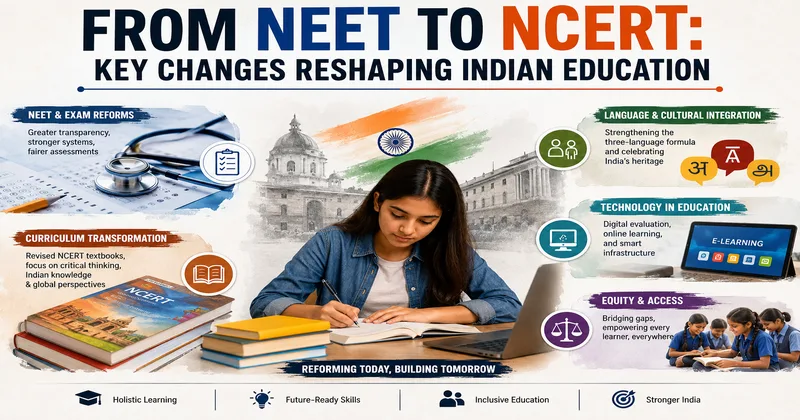
The Education system in India is undergoing a sea change since independence. The debates on NEET exam irregularities, including score inflation and paper leaks, are the main focus of the present public discussion, as well as questions about board exams and school board exams in India are in full swing. The National Testing Agency (NTA) has also been at the forefront of the country-wide administrative issues. The above discussion is only the first layer of our discourse, but there is a much bigger structural change. At first glance, it appears that the debate is purely about exam leaks, evaluation errors, digital failure and the student’s feelings. These are pressing challenges for Indian youth and hence should be the priority of policymakers. But beneath it all is a much more profound change: how India defines knowledge, how it teaches history, how it structures language learning, and how it modernises assessment in a system that cares for more than 250 million school-going students every year.
The Three Dimensions of India’s Education Crisis
To understand this moment in detail we need to assess India’s education system in three key ways: operational governance, curriculum and knowledge design and long-term structural change. Understanding the Examination Breakdown Operational stress in the examination system. India has one of the largest examination systems in the world. The national and state-level examination of board exams, competitive entrance exams and university exams every year attract millions of students. The scale itself poses a structural challenge that no system of this scale can overcome without occasional/significant stress points. In recent months there have been growing concerns around NEET and other national level exams and this has brought into focus the National Testing Agency (NTA).
Problems like unfairness, logistical problems and non-standardization of exams and the standards of assessment have been raised at the level of students, parents and the general public. But there are three broad categories of problems. When the infrastructure is stretched beyond capacity, systems overload is inevitable. Second, there are implementation errors, such as technical glitches or coordination failures, that cause problems. Third, governance and transparency concerns are related to how processes are constructed, monitored and held accountable. These categories usually overlap in public perception and require fundamentally different solutions. For example, improving digital infrastructure can cure technical glitches but it will not solve structural issues like irregular capacity distribution or pressure from intense competition. The central question is whether the system is failing and if not why it is under so much stress?
Rethinking What We Teach
The need for Curriculum Reform and Knowledge. One of the most drastic changes in Indian education is the revision of school curricula under the National Council of Educational Research and Training (NCERT) which aims to remake how history, mathematics, and social sciences are taught. At the heart of these reforms is a bigger philosophical question: what is knowledge in school and how to convey it to students? SulbaSūtras and the early mathematics.
Ancient Mathematics in Modern Classrooms
The role of SulbaSūtras ( स लभसूत्र) in curricula is one of the most commonly discussed aspects in the context of teaching traditional knowledge. These ancient Sanskrit texts are part of the Vedic literature and are connected with geometric principles used in building ritual altars. Mathematical concepts like area calculation and space measurement were first estimated in these texts. In addition, it includes systematic ways to produce the correct geometric structure such as right angles, rectangles, squares. Mathematical thinking in India has ancient origins. It is a clear example of early scientific thought systems that developed independently in different civilizations. While we would like to include the old knowledge systems of the Indian people in our school system, we must have a clear educational distinction between the school curriculum and the modern ones. These old scholarly articles are all the evidence of achievements in the study of mathematics in history but can’t be considered as a substitute for modern mathematics. The present mathematics is based on formal axioms, algebraic structures and globally standardized methods that can’t be replaced by historical accounts. So curriculum designers have to strike a good balance between accepting indigenous intellectual traditions and being scientific and global.
Rewriting the Past Perhaps, no area in India’s curriculum is more sensitive or controversial than the teaching of ancient Indian history. Over the decades, views of the origins of Indian civilization and migration have shifted dramatically. The Aryan Invasion Theory has been one of the most heated topics in Indian history. In the school textbooks, it was stated that Indo-Aryan speaking people invaded the Indian continent and took the native people away from them. The model has been extensively reanalyzed over the years, and research on the subject has been ongoing through the years. As a result, most of the research in genetics, archaeology and linguistics has been on the Aryan Migration Theory. The idea is that people and culture move slowly over time and not as a single invasion event. This shift is not ideological but methodological. It is evidence and research techniques that allow us to understand more deeply the population movement in ancient times. The Indus Valley Civilization, one of the first urban civilizations, is the most common term in academic literature. It is the term used to describe archaeological sites on the Indus River and its tributaries dating back more than 4,000 years. Sindhu-Sarasvati Civilization is also used in some alternative approaches. This paradigm focuses on the significance of the river system mentioned in ancient Indian scriptures, especially the Sarasvati River, which is discussed in Vedic literature but the exact history of which is not known to archaeologists. The debate over naming is more than linguistic. It is also about how civilizations are defined. How do we get more accurate historical data to be used, whether it’s through archaeological data alone or a combination of literary, cultural and geographical interpretations? These discussions are common in historical scholarship. But when they are presented to students in school, they need to be framed well so that students can make sense of the difference between academic scholarship and interpretive thinking.
The Language Policy Dilemma
Language is another politically and culturally sensitive aspect of Indian education. The three-language formula aims to ensure that students learn multiple languages during their education years, with the emphasis on regional languages like Hindi or other Indian languages and English or another language depending on the state. The logic behind the three-language formula is that it provides multilingual competence that is cognitive and social. Second, it protects India’s linguistic diversity. And thirdly it helps in national integration because it enables communication across regions. However, the implementation of these innovative formulas is inconsistent. There is a shortage of efficient language instructors in many Indian states. In other states, implementation faces resistance due to language identity and autonomy. There is an urban-rural divide in language formula implementation. Schools in rural areas struggle to have consistent language instruction in multiple languages. This creates a gap between policy intent and teaching reality. If schools do not have staff training and curriculum resources, the three-language model would be inconsistent.
Technology as Tool, Not Saviour
India’s education system is evolving with digital tools and technology-based platforms. They technological advances has been On-Screen Marking (OSM), which is intended to digitize the evaluation of the answer scripts. The aim is to increase efficiency, reduce manual errors, and help with transparency. However, recent implementation challenges have revealed infrastructure weaknesses. There have been recurring issues of missing scanned pages, late uploads, and inconsistencies in marking. These issues have raised concems among stakeholders. In high-stakes exams (e.g., NEET), even small technical failures can have a significant effect on students. The lesson here is not that digital systems are broken, but that large-scale digital transformation needs to be carefully planned and rolled out. Systems must be tested in real-world situations before full deployment. It is also essential to introduce redundancy mechanisms and contingency systems. Technology in education is not a solution in itself; it can only be as powerful as the systems that support the technology.
The Coaching Trap: When Inequality Becomes the System
In the last 20 years, India has experienced a massive coaching industry. An ecosystem has developed that is now fundamental to preparing students for competitive exams like engineering and medical entrance tests. Coaching institutions offer structured education, experienced faculty, and exam preparation strategies. But they also put enormous pressure on students to achieve high scores in exams and are associated with a competition that can be seen as a more competitive mindset that is often driven by performance and not growth as a whole and thus, are not good in terms of quality in education. So formal education does not fully prepare students for competitive exams, and families turn to external coaching systems to do so. As a result, education becomes more stratified, and quality preparation is largely dependent on economic abilities. This raises fundamental questions about equity and fairness in access to opportunity across many different strata of society. Any meaningful reform must therefore address school quality, teaching capacity, and pedagogy (as opposed to exam standards).
India in a Global Mirror
The global education systems also have similar tensions, but the scale and issues are different. China has highly centralised examination systems that are uniform but have extreme competition. The United States has decentralised systems that are flexible but can also result in regional inequality. When considering these diverse approaches, i.e., centralised testing and regional diversity in schooling in India, India’s system tries to balance both. This hybrid model is a gamechanger for the future.
These global comparisons are important to understand: India’s challenges are not unique. They’re also a global question about how to create fair, scalable, and effective education systems for large populations.
Beyond Binary Thinking: The Reality of Policy Reform
Over-simplifying the problems related to the educational reforms in India is very common. Public debate often reduces complex policy debates to binary narratives. It is mostly about success or failure, reform or rollback, and progress or decline. But in reality, education reforms in India are incremental. It involves testing, feedback, correction, and long-term change. But mistakes and failures are inevitable, and not all of us can do with them. However, mistakes in implementation are also not a sign of failure but part of the learning process of governance at scale. Curriculum reform is
more than just changing textbooks; it is about classroom adaptation, redesigning assessment, teacher training, and long-term evaluation of learning outcomes. Examination reform also requires coordination between technology systems, administrative bodies, and institutional frameworks
Conclusion
As mentioned at the outset of this essay, India’s education system is undergoing one of
its consequential transitions since its post-independence era. The changes underway are broad in scope, touching curriculum content, historical interpretation, language policy, and examination technology. The fundamental challenge is not whether reform is happening, but whether it is being implemented in a way that strengthens trust, improves learning outcomes, and ensures fairness.
Eventually, the success of reforms in any education system is measured not just by its intent but by its outcomes. There are multiple outcomes that these reforms may intend to achieve. For example, whether learning improves over time, whether students are evaluated fairly, and whether access to opportunity becomes more equitable. The goal must remain consistent: a stable, transparent, and inclusive education system that can support the aspirations of millions of students across the country.