Indian History: A confluence of truth, self-respect and self-reflection
October 3, 2026
  • Read Ecopy
  • Circulation
  • Advertise
  • Careers
  • About Us
  • Contact Us
Android AppiPhone AppArattai
Organiser
  • ‌
  • Bharat
    • Assam
    • Bihar
    • Chhattisgarh
    • Jharkhand
    • Maharashtra
    • View All States
  • World
    • Asia
    • Europe
    • North America
    • South America
    • Africa
    • Australia
  • Editorial
  • International
  • Opinion
  • RSS @ 100
  • More
    • World Hindu Congress 2026
    • Op Sindoor
    • Analysis
    • Sports
    • Defence
    • Politics
    • Business
    • Economy
    • Culture
    • Special Report
    • Sci & Tech
    • Entertainment
    • G20
    • Azadi Ka Amrit Mahotsav
    • Vocal4Local
    • Web Stories
    • Education
    • Employment
    • Books
    • Interviews
    • Travel
    • Law
    • Health
    • Obituary
  • Subscribe
    • Subscribe Print Edition
    • Subscribe Ecopy
    • Read Ecopy
  • ‌
  • Bharat
    • Assam
    • Bihar
    • Chhattisgarh
    • Jharkhand
    • Maharashtra
    • View All States
  • World
    • Asia
    • Europe
    • North America
    • South America
    • Africa
    • Australia
  • Editorial
  • International
  • Opinion
  • RSS @ 100
  • More
    • World Hindu Congress 2026
    • Op Sindoor
    • Analysis
    • Sports
    • Defence
    • Politics
    • Business
    • Economy
    • Culture
    • Special Report
    • Sci & Tech
    • Entertainment
    • G20
    • Azadi Ka Amrit Mahotsav
    • Vocal4Local
    • Web Stories
    • Education
    • Employment
    • Books
    • Interviews
    • Travel
    • Law
    • Health
    • Obituary
  • Subscribe
    • Subscribe Print Edition
    • Subscribe Ecopy
    • Read Ecopy
Organiser
  • Home
  • Bharat
  • World
  • Operation Sindoor
  • Editorial
  • Analysis
  • Opinion
  • Culture
  • Defence
  • International Edition
  • RSS @ 100
  • Magazine
  • Read Ecopy
Home Bharat

Indian History: Not just foreign rule, but a timeless story of resistance, self-respect and civilisational resilience

India’s history is not merely a tale of foreign domination but also a remarkable story of resilience, resistance, and civilisational continuity. This article explores how a balanced understanding of the past must acknowledge both the realities of subjugation and the enduring spirit of struggle that shaped the nation

Dr Manmohan PrakashDr Manmohan Prakash
Jun 24, 2026, 07:00 pm IST
inBharat, Opinion
Follow on Google News
India’s history is not merely a tale of foreign domination but also a remarkable story of resilience, resistance & civilisational continuity

India’s history is not merely a tale of foreign domination but also a remarkable story of resilience, resistance & civilisational continuity

Facebook
Twitter
WhatsAppTelegramEmail

History is the systematic and analytical account of the evolving journey of human society through time. It enables us to understand our past civilisation, culture, social structures, and political transformations. However, this purpose can be fulfilled only when history is written and interpreted with factual accuracy, objectivity, and intellectual honesty.

History is not merely a collection of events and dates; it is also the foundation of a nation’s collective memory, self-awareness, and vision for the future. In the context of India, a long-standing debate has existed regarding whether the period of foreign or colonial rule should be described solely as an era of subjugation or also understood as an era of continuous struggle and resistance. This question is not merely about terminology; it is closely linked to historical perspective, national consciousness, and collective self-respect.
Respected Dr Mohan Bhagwat, the Sarsanghchalak of the Rashtriya Swayamsevak Sangh (RSS), has also expressed the view that India’s history is not merely a history of slavery but a history of continuous struggle. This perspective highlights the processes of resistance and resurgence that remained active among Indians throughout different periods.

It is undeniable that from approximately the late twelfth century until 1947, various regions of the Indian subcontinent came under the rule or influence of rulers of foreign origin and, ultimately, British colonial administration. During this period, local societies experienced limitations on their control over governance, taxation, judicial systems, and resources. It is on the basis of this historical reality that the term “subjugation” has often been used to describe this era. Yet, can such a vast and multifaceted period be adequately understood solely through the lens of subjugation?

A comprehensive study of Indian history reveals that alongside various phases of political domination, there were continuous processes of resistance, cultural preservation, reconstruction, and aspirations for freedom. There appears to be no period in Indian history during which the entire society passively surrendered to prevailing circumstances.

Also Read: Toxic Harvest? Why cancer-linked pesticides continue to be used across Indian farms despite global concerns

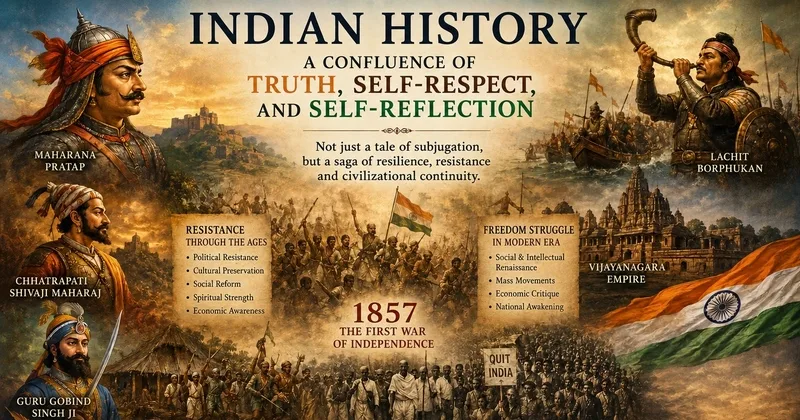
Medieval India provides some of the most striking examples of this phenomenon. Even when the Delhi Sultanate and the Mughal Empire were at the height of their power, political and cultural resistance never ceased. In Rajputana, the struggle of Maharana Pratap, the symbol of Mewar’s valour, remains an extraordinary example. Rather than submitting to the vast military and economic resources of Emperor Akbar, Maharana Pratap chose a life of hardship in the forests and continued his struggle for freedom and self-respect. His perseverance established an enduring model of resistance for future generations and demonstrated that the spirit of India never fully accepted subjugation.

Similarly, in northeastern India, the Ahom Kingdom under the leadership of the brave Lachit Borphukan decisively halted Mughal expansion in the Battle of Saraighat in 1671. In southern India, the Vijayanagara Empire remained a major centre of political and cultural strength for a long period and played a significant role in preserving Sanatan traditions. Later, the concept of “Hindavi Swarajya” established by Chhatrapati Shivaji Maharaj and the subsequent rise of Maratha power became a golden chapter in India’s political resurgence. Likewise, the establishment of the Khalsa Panth by Guru Gobind Singh Ji provided a powerful new direction to religious freedom and social resistance.

During British colonial rule, resistance became more widespread and organised. Following the Battle of Plassey in 1757, numerous uprisings emerged across different regions, including the Sannyasi Rebellion, the Chuar Rebellion, and the Santhal Hul of 1855–56. The Revolt of 1857 marked a revolutionary turning point in Indian history. Although colonial historians often referred to it as the “Sepoy Mutiny,” Indian historical consciousness recognises it as the “First War of Independence.”

Subsequently, social and intellectual renaissance movements developed alongside political resistance. Thinkers such as Raja Ram Mohan Roy, Swami Dayananda Saraswati, and Swami Vivekananda strengthened ideas of social reform, education, and self-awareness. In the twentieth century, the Swadeshi Movement, the Non-Cooperation Movement, the Civil Disobedience Movement, and the Quit India Movement transformed the freedom struggle into a broad-based mass movement. At the same time, Dadabhai Naoroji’s “Drain Theory” exposed the economic exploitation inherent in colonial rule.

The writing of history itself has often been a subject of debate. Historical narratives have sometimes been influenced by colonial and ideological perspectives. In the past, attempts were even made to portray some of India’s freedom fighters, such as Bhagat Singh and Chandrashekhar Azad, as “terrorists” rather than as patriots(freedom fighters)fighting against colonial rule. Such examples remind us that historical interpretations can be shaped by the political context of their time and that history must continually be revisited through the lens of evidence, fairness, and intellectual integrity.

Many colonial-era historians frequently portrayed Indian society as fragmented, passive, and dependent upon external forces. In contrast, modern Indian historians and scholars of post-colonial studies have demonstrated that Indian society consistently displayed remarkable capacities for adaptation, resistance, and reconstruction across different historical periods.

However, viewing this entire period solely as an “era of struggle” would also be inadequate, as it risks underestimating the realities of political subjugation, economic exploitation, social distortions, and the often harsh consequences of colonial policies. Conversely, reducing the period merely to an “era of subjugation” obscures the courage, self-respect, and freedom-consciousness displayed by countless individuals and communities throughout Indian history.

Therefore, a more balanced perspective may be to understand these historical periods as representing the coexistence of both subjugation and continuous resistance. Such an approach neither denies the suffering experienced under foreign domination nor overlooks India’s enduring tradition of resilience and revival.
The purpose of history is not only to tell us what happened to us, but also to reveal how we responded to those circumstances. History should therefore be studied and written in a manner that maintains a balance between truth, self-respect, and self-reflection. Only then can it serve as a meaningful guide for present and future generations.


Topics: National ConsciousnessIndian historyMaharana PratapChhatrapati Shivaji MaharajFreedom struggleindian civilisationColonial RuleHistorical Perspective
Share
Tweet
SendShareSend
✮ Subscribe Organiser YouTube Channel. ✮
✮ Join Organiser's WhatsApp channel for Nationalist views beyond the news. ✮
Previous News

From $10 Billion to $190 Billion: India’s Bioeconomy leads a 12-Year science revolution

Next News

Padma Awards 2026: Tamil Nadu’s distinguished achievers receive national honours

Related News

Bhikaji Cama Birth Anniversary: The woman who raised India’s Tricolour on foreign soil

“The PM who made us look again at Bharat”: A Manipuri’s journey with Narendra Modi

‘India was not poor; it was made poor’: The truth re-emerges through Jema Ferrer’s perspective

Vande Mataram: The eternal mantra of national consciousness

Vande Mataram remains an enduring symbol of Bharat’s civilisational heritage, national unity and deep-rooted love for the motherland

Vande Mataram: Reclaiming a civilisational legacy against opposition cynicism

RSS Sarsanghchalak Mohan Bhagwat

Universal Oneness in America: What RSS Sarsanghchalak Mohan Bhagwat’s New York speech really means

Load More

Latest News

Hamam Al-Hammami’s extremist past and reported security concerns at Oman Air now under scrutiny after Flydubai cockpit attack

Omani-Syrian Hamam Al-Hammami identified as Flydubai co-pilot who attacked captain and tried to crash Tel Aviv flight

President Droupadi Murmu has given assent to the Gujarat UCC Bill, 2026, paving the way for its implementation in the state

Gujarat UCC Bill 2026 gets President Droupadi Murmu’s assent, legislation comes into effect across the state

SJTA plans dedicated darshan assistance for elderly and divyang devotees and restoration of 1.5 acres of temple land

Odisha: Shri Jagannath Mandir plans dedicated darshan assistance for elderly and divyang devotees

Representative image

Weekly Love Jihad Report: From fake names to fake social media accounts – Here’s how Islamists targeted Hindu women

Shivaji Park locals expressed anger against CJP protest

CJP’s Shivaji Park show fizzles in Mumbai: Low turnout, clueless crowd, angry residents and strong counter-protest

Former chief election commissioner Navin Chawla

From emergency indictment to election commission: The Navin Chawla record that Congress would rather not discuss

RSS All-India contact chief (Sampark Pramukh) Ramlal ji

Women farmers must be at forefront of policymaking: RSS Sampark Pramukh Ramlal ji

AI Generated Representative Image

Swachhata Hi Seva 2026: How Bharat’s festivals are rediscovering their green dharma

27th National Conference of Akhil Bharatiya Poorva Sainik Seva Parishad Begins at Kaneri Math

27th National Conference of ABPSSP focusses on Agniveer rehabilitation & social security

PM Modi's Mann ki Baat completes 12 years

12 years of PM Narendra Modi’s radio program ‘Mann Ki Baat’: Serves as a public platform inspiring millions of Indians

Load More
  • Privacy
  • Terms
  • Cookie Policy
  • Refund and Cancellation
  • Delivery and Shipping

© Bharat Prakashan (Delhi) Limited.
Tech-enabled by Ananthapuri Technologies

  • Home
  • Search Organiser
  • Bharat
    • Assam
    • Bihar
    • Chhattisgarh
    • Jharkhand
    • Maharashtra
    • View All States
  • World
    • Asia
    • Africa
    • North America
    • South America
    • Europe
    • Australia
  • Editorial
  • Operation Sindoor
  • Opinion
  • Analysis
  • Defence
  • Culture
  • Sports
  • Business
  • RSS @ 100
  • Entertainment
  • More ..
    • Sci & Tech
    • Vocal4Local
    • Special Report
    • Education
    • Employment
    • Books
    • Interviews
    • Travel
    • Health
    • Politics
    • Law
    • Economy
    • Obituary
  • Subscribe Magazine
  • Read Ecopy
  • Advertise
  • Circulation
  • Careers
  • About Us
  • Contact Us
  • Policies & Terms
    • Privacy Policy
    • Cookie Policy
    • Refund and Cancellation
    • Terms of Use

© Bharat Prakashan (Delhi) Limited.
Tech-enabled by Ananthapuri Technologies