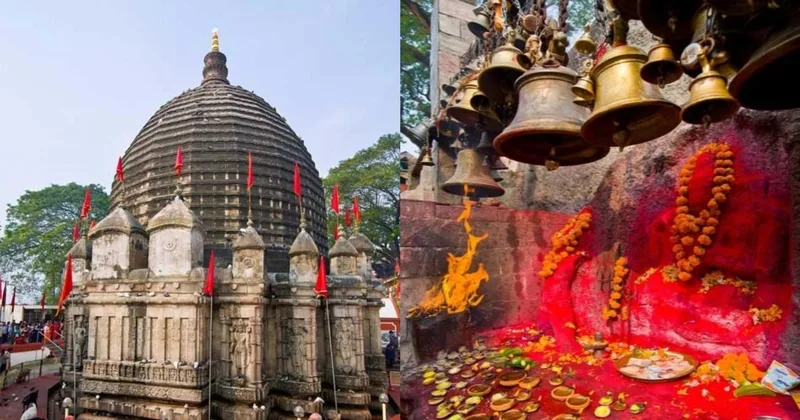
For millions of Sanatani tourists, not to speak of pilgrims, who visit Guwahati in far eastern Bharat, their itinerary includes the Mandir of Maa Kamakhya to pay a sacred visit to the Shakti Peeth with the legacy of Kamrup civilisation.
The consecrated Mandir atop Nilachal hills on the southern bank of the mighty Brahmaputra river. Now a mere district covering the prehistoric city of Guwahati, Kamrup was once a gigantic empire covering all eastern Bharat provinces, including a larger part of northern Bangladesh. One of the major religious festivals, organised annually at the picturesque Kameshwari Mandir, is the Ambubachi Mela, which attracts hundreds of thousands of Sanatani Hindu pilgrims from different parts of the globe.
During the revered festival, the Mandir’s primary door is closed for four days (this year, it falls in the afternoon hours of 22 June for Pravritti, till the early morning hours of 26 June for Nibritti). The religious belief holds that during this period, Mother Earth undergoes the annual cycle of menstruation, which is reflected in Devi Kamakhya’s genital organ (Yoni). No religious performances are organised during this period. Farmers across the Hindu world avoid cultivating during this period so that the Earth can have an undisturbed atmosphere. The Mandir door is reopened after Devi’s ritual bathing, and devotees throng in for Darshan and to worship Maa Kamakhya. One can witness a sea of humans with a large number of Hindu saints in the Mandir premises during the festival.
Kamakhya Mandir, which is recognised as one of the sacred 51 Shakti Peeths of Maa Durga, was built by Kamdev with the help of God Vishwakarma. According to the belief, the demon king Narakasura constructed a stiff-stone Mekhela Ujowa path connecting the Mandir from the foothills with the intention of marrying Devi Kamakhya. The Muslim convert Kalapahar, the king of Coach Behar in western Assam, destroyed the temple in 1553 AD. Maharaja Biswa Singh later repaired it in the Seventeenth century. King Nar-Narayan, who ascended to the throne of Coach Behar after his father’s demise, constructed the upper portion of the temple with the help of his brother Mahabir Chilarai.
The present form of the main Mandir and its surroundings was shaped during the time of Nar-Narayan, one of the greatest kings of ancient Assam. As the legend goes, Sati was one of the incarnations of Maa Shakti, and she sacrificed her life protesting the behaviour of her father, Dakshya Nripati. The wife of Maheswar (one of the holy Trinities after Bhagwan Brahma and Bhagwan Bishnu), Sati took her life at a Yagna, a sacrificial rite organised by her father Dakshya. But his son-in-law, Shiva, was not invited to the ceremony. Sati arrived at Yagna Bhumi, but she was also not welcomed by Dakshya; he made derogatory comments about Maheswar. Annoyed with the situation, Sati sacrificed her life at the location of Yagna. Listening to the death of Sati, Shiva got angry and appeared at Yagna Bhumi. After pronouncing punishment to Dakshya, a furious Shiva started Tandav Nritya with the corpse of his beloved wife Sati on his shoulder. Tandav Nritya continued for several days, and the universe was on the brink of being destroyed. Then all the gods and goddesses appealed to Bhagwan Bishnu to pave the way for bringing an end to Maheshwar’s dance of destruction. The caretaker of the universe chopped off the corpse of Sati with his Sudarshan Chakra to bring Shiva back to sanity. Her lifeless body was made into 51 pieces, which fell in different parts of Bharatbarsha, and each location later emerged as a sacred Peeth.
The Yoni of Sati fell at Nilachal Hills, where the Mandir was erected. Kalika Purana, an ancient work in Sanskrit, describes Kamakhya as the deity to fulfil the desires of devotees and gives salvation. The temple does not contain any image or statue of Kamakhya. There is only a sculptured image of the Yoni of the Maa in a cave inside the main temple. When the world communities today make voluminous speeches to protect the globe, it’s amazing how ancient Bharat realised the importance of worshipping the green planet as Mother Earth.