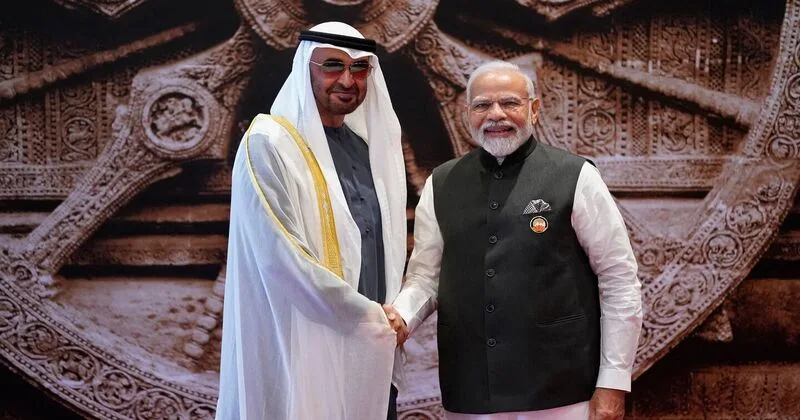
The indigenous defence ecosystem of India is set to reach landmark heights, as the West Asian country, United Arab Emirates(UAE) is aiming to purchase BrahMos and Akashteer air defence systems. As per the sources, New Delhi and Abu Dhabi are in early stages of talks to seal a defence purchase deal. The deal has paramount strategic significance, as the UAE is considering India, as a credible defence partner amid a steep crisis in West Asia.
The geopolitical wildfire is rigorously engulfing the Gulf region, the rift & faultlines among the countries of the region, is evidently visible. Amidst such an uncertainty and upheaval, Abu Dhabi is looking towards New Delhi, to ensure its national security and regional stability. With this deal, the stakes of India will also rise, as a defence manufacturing and export hub of the region and net security provider.
“UAE has shown interest in a number of our weapon systems including BrahMos and Akashteer. The talks between India and UAE are at initial stages and are progressing fast”, said the sources.
Global demand for BrahMos rises post Operation Sindoor
BrahMos supersonic cruise missile and the Akashteer air defence systems are the flagship military systems of the country, which are war-tested. Both the air defence systems evidently exhibited their overarching offensive and defensive capabilities during Operation Sindoor. The systems were the “game-changers” during the military conflict, which aided to seal national security and territorial integrity of the country. They successfully intercepted and neutralised the intruding drones and missiles from Pakistan, thus fortifying India’s sovereignty.
Post Operation Sindoor, the global demand for BrahMos has witnessed a sharp rise. If finalised, UAE will be the fourth country to purchase BrahMos after Philippines, Indonesia and Vietnam. Also, countries such as Thailand, Brazil, South Africa and Chile have expressed interest in purchasing the BrahMos air defence system. This soaring demand for the indigenous weapon systems, places India as a key defence partner of the region and the nation will emerge as the pivotal security partner and geopolitical anchor to ensure collective security, regional stability, strategic deterrence and balance of power.
The strategic compulsions of UAE
As the geopolitical wildfire engulfs West Asia and the fissures among the countries in the region is deepening, Abu Dhabi is looking for partners to consolidate its national security. The UAE aims to diversify its defence partners and purchases, by reducing dependency on the United States, as the net security provider of the region. Thus, post the US-Iran conflict and its devastating impact, the UAE is reassessing its security credentials. In this strategic calculus of Abu Dhabi, New Delhi stands as a credible defence partner.
Thus, amidst the escalating crisis in the region, Abu Dhabi has a strategic compulsion to diversify, reinvigorate and strengthen its defence and security apparatus. Infact, during the conflict, the UAE was directly targeted by Iranian drones and other weapon systems. In this direction, New Delhi stands as a firm defence partner. India and the UAE hitherto share deep comprehensive strategic ties. The bilateral bonhomie spreads across trade, business, investment, defence and energy cooperation.
If materialised the latest BrahMos and Akashteer can herald a new chapter in India-UAE ties and can catalyse both nations as key partners to ensure peace, security and freedom of navigation in critical chokepoints such as the Strait of Hormuz, which are being weaponised amidst great power competition. Apparently, the majority of the energy and other trade of India passes through this critical waterway.
The outstanding defensive capabilities of BrahMos
As mentioned, BrahMos and Akashteer are war-tested and have stellar operational competitiveness. BrahMos, jointly developed by India and Russia, is regarded as the world’s fastest operational supersonic cruise missile.
- Operational range of approximately 300kms
- It is a multi-platform missile; Can be launched from land, air and sea
- High precision, flexibility and durability; Can operate during day, night and amidst turbulent weather conditions
- It is a two-stage missile with, solid propellant engine in the first stage and liquid ramjet in the second stagemedi
- It can carry heavy warheads including conventional high explosives, semi-armours etc.
- To further boost the indigenous manufacturing of BrahMos, a production unit has been launched in Lucknow, as a part of UP defence industrial corridor
Akashteer is an indigenously developed automated air defence command and control system. It is a key layer in India’s integrated air defence network.
- Medium-range surface-to-air missile
- Can cover altitude upto 18kms
- Can simultaneously engage and counter multiple targets from diverse directions
- Developed by DRDO, Manufactured by BEL
- Protects air bases and other critical infrastructure
- Has high immunity from jamming and spoofing
- Advanced digital, real-time command and control systems that enhances efficiency
- Simultaneously combines data from diverse 3D tactical radars and sensors across Army and Air
- Force platforms and provides a comprehensive picture of the intruding threat
- Capable of AI driven autonomous operation
- Supports synchronized operation with missile defence systems like Akash SAM, S-400 Sudarshan Chakra etc., thus ensures robust airspace security
- Dynamic mission reassignment and precision strikes without human intervention, thus ensures rapid response
- Utilizes ISRO’s Earth observation satellites and NAVIC for accurate surveillance and targeting
India’s defence production and exports reach remarkable heights
In the Financial Year 2025-26, India’s defence production has reached record heights at Rs. 1.78 lakh crore. It is a 15.6 per cent growth, compared to previous fiscal year when the defence production was at Rs. 1.54 lakh crore. Also, it is a stellar increase of 110 per cent compared to 2020-21, when the defence production numbers were at Rs. 84,643 crore. And it is a four times increase compared to 2013-14, when the indigenous production was at Rs. 43,746 crore.
The defence exports are also at an all-time high by reaching the record mark of USD 4 billion as of March 2026. It is a stark increase from USD 7.26 million exports in 2013-14. The growing numbers reflect the trust in India as a credible defence manufacturing and export powerhouse. Post Operation Sindoor, the demand for home-grown weapon systems have spiked drastically.